


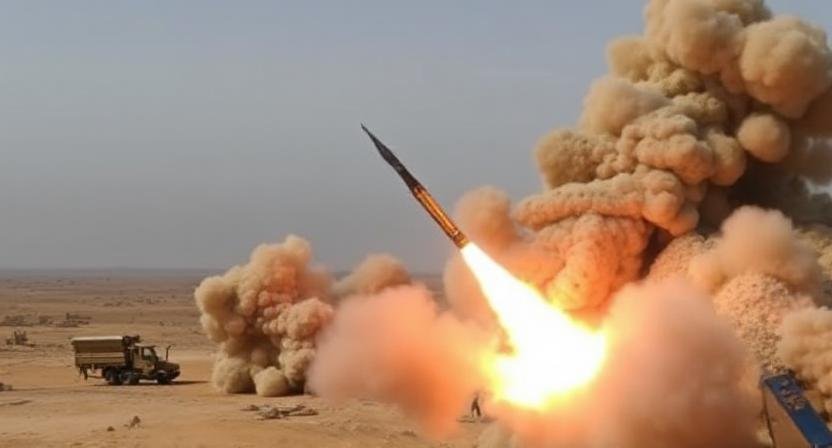
- Iran launches missile strikes on U.S. military bases in Syria in direct retaliation for American bombing of Iranian nuclear facilities.
- Tanf base in southern Syria reportedly hit by multiple missiles; U.S. casualties feared as tensions spiral out of control.
- Middle East on edge, with potential for a broader regional war involving Iran, Israel, and the United States.
- Oil markets, air travel, and diplomacy already disrupted as U.S. embassies evacuate personnel across the region.
In a dramatic escalation of an already volatile crisis, Iran has launched a barrage of missile strikes on U.S. military installations in eastern Syria, less than 24 hours after American B-2 bombers struck Iranian nuclear sites. The attack marks the most direct confrontation between Tehran and Washington in years and threatens to plunge the entire Middle East into a wider regional war involving Iran, Israel, and the United States.
Iranian state media described the missile operation as a “preliminary response” to the U.S. assault on key nuclear facilities near Natanz and Fordow, which reportedly caused significant damage. “Every American soldier and base in the region is now a legitimate target,” declared an Iranian military analyst during a broadcast on IRIB late Saturday evening.
America Bombs Iran’s Nuclear Sites: What Triggered Trump and What Comes Next?
According to Pentagon sources, at least five U.S. positions in Syria came under direct missile and drone attack, including the Tanf garrison in southern Syria, a base that houses a reduced American presence following earlier troop drawdowns. Initial reports indicate casualties, though the exact number remains undisclosed pending notification of families.
A Flashpoint Years in the Making
The Iranian strikes came after weeks of mounting threats. Iranian Defense Minister Aziz Nasirzadeh had issued a stark warning on June 11: “All U.S. bases are within our reach, and we will boldly target them if provoked.” That warning, once seen as political theater, has now materialized in what analysts fear could be the start of sustained asymmetric warfare across the region.
In Washington, the Pentagon confirmed the strikes and announced the mobilization of additional assets to the region. Defense Secretary Pete Hegseth stated that U.S. forces were “in a heightened state of readiness” and vowed to “defend American lives with all necessary force.”
READ MORE: Trump Meets the Moment on Iran
Meanwhile, President Trump has summoned the National Security Council for an emergency session at the White House to weigh further military options. Trump had earlier boasted of delivering a “decisive blow” to Iran’s nuclear ambitions. Now, with American troops under fire, the administration faces the real possibility of a full-blown war.
The Regional Chessboard: Iran, Israel, and the U.S.
The fallout from this military exchange is likely to ripple across the entire Middle East. In Israel, where air defenses remain on high alert, officials welcomed the U.S. bombing of Iranian nuclear facilities but now fear that Iranian retaliation could also target Israeli cities.
Iran’s regional proxies — including Hezbollah in Lebanon, the Houthis in Yemen, and various Shiite militias in Iraq — are already being activated. Kataib Hezbollah, an Iraqi militia with deep ties to Tehran, declared that “American bases will become duck-hunting grounds,” adding ominously that “unforeseen surprises” await U.S. aircraft in regional skies.
READ MORE: Alarming Signs the World Is Entering a New Nuclear Arms Era
Experts say the conflict could spiral into a prolonged, multi-front war. “This is not just about Iran versus the United States,” said a senior European diplomat briefed on recent intelligence. “If Israel is drawn in directly, and if Hezbollah retaliates from Lebanon or Syria, you are looking at a scenario that could eclipse anything we’ve seen since 2006 — perhaps even worse.”
Vulnerable U.S. Footprint in the Middle East
The United States maintains a sprawling network of military bases across the region — all now potentially exposed to Iranian missile fire. In Iraq, Al-Asad Air Base, which hosts thousands of American troops, has been attacked repeatedly in recent years. It was struck in January 2020 during Iran’s retaliation for the killing of General Qasem Soleimani.
Other key facilities include:
-
Tanf Base in Syria, which was hit in today’s attack.
-
Al-Udeid Air Base in Qatar, the largest U.S. military installation in the Middle East.
-
Naval Support Activity Bahrain, headquarters of the U.S. 5th Fleet.
-
Ali al-Salem and Camp Buehring in Kuwait, which house thousands of U.S. troops.
-
Al-Dhafra Air Base in the UAE, home to the 380th Air Expeditionary Wing.
Earlier this week, Iranian officials reportedly warned Qatari diplomats that U.S. bases in the Gulf would be legitimate targets if Washington struck Iranian territory.
There are also growing concerns about the safety of U.S. diplomatic missions. Several embassies, including those in Baghdad and Tel Aviv, have begun evacuating non-essential staff and dependents. American citizens have been advised to leave the region immediately.
The Fallout: A Region on the Brink
The impact of this escalation goes far beyond military casualties. Commercial air traffic has already been disrupted. Air France and KLM have suspended flights to Dubai, citing the “rapidly deteriorating security situation.” Oil prices surged overnight, and energy analysts warn that a regional war could choke global supply lines, particularly if the Strait of Hormuz is affected.
Most troubling of all is the potential for nuclear proliferation. Iran has vowed to resume uranium enrichment “without limit,” and Israeli officials fear Tehran may now abandon all pretense of compliance with international agreements.
“The nuclear deal is dead, and diplomacy is on life support,” said Dr. Mona Asgari, a Tehran-based geopolitical analyst. “The Americans have burned their last bridge.”
Could Iran Strike the U.S. Homeland?
While experts agree that Iran lacks the long-range capability to hit the continental United States directly, its missile arsenal poses a significant threat to U.S. forces and allies in the Middle East. The Center for Strategic and International Studies (CSIS) notes that Tehran’s inventory of cruise and ballistic missiles, though limited in range, is increasingly accurate and lethal.
A Dangerous New Phase
The current escalation represents more than a tit-for-tat military exchange — it’s the start of a new, dangerous phase in the Middle East. With diplomacy shattered and the region’s major powers dug in, the next moves by Washington and Tehran could shape the fate of the region for years to come.
For now, the world watches — breath held — as war drums beat louder in the deserts of Syria and beyond.