


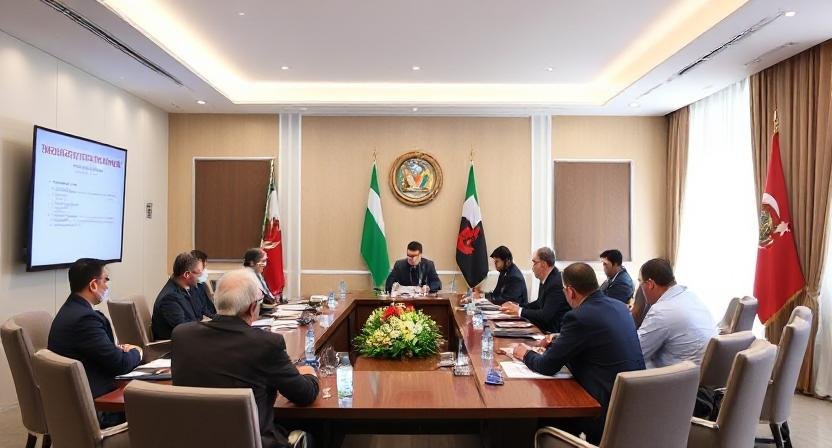
- Arab states shift tone: Once supportive of U.S. pressure on Iran, Gulf nations like Saudi Arabia and the UAE are now condemning the U.S. strikes, fearing regional destabilization.
- Economic alarm bells: With oil routes threatened and regional trade at risk, Gulf countries brace for fallout, activating emergency economic protocols.
- Iran prepares response: Tehran vows retaliation for what it calls “blatant aggression,” with U.S. bases across the region potentially in the crosshairs.
- Trump escalates rhetoric: By floating regime change in Tehran, President Trump complicates diplomatic efforts and heightens fears of long-term conflict.
In what may be a defining moment for the Middle East’s future, the U.S. bombing of three Iranian nuclear facilities has jolted the region into collective alarm. With President Donald Trump hinting at regime change in Tehran and Iran warning of a “proportionate response,” leaders from Riyadh to Muscat fear that this war—already raging for 11 days—may spiral into a regional cataclysm that unravels years of diplomacy, economic integration, and fragile coexistence.
From Bahrain’s work-from-home orders to emergency military meetings in Jordan, the shockwaves from the strikes are already being felt. But beyond immediate fallout lies a deeper, more unsettling truth: this time, the war feels personal for many in the Gulf—not just because of proximity to Iran, but because of the direct threat it poses to their stability, economies, and vision for a post-conflict Middle East.
A War Nobody Wants
Unlike the 2019 near-conflict between Iran and the U.S.—also under Trump—this time, the strikes are not symbolic. The U.S. explicitly targeted Iran’s nuclear infrastructure. Although the International Atomic Energy Agency (IAEA) has not yet confirmed the extent of the damage, Trump claims it was “substantial.”
U.S. Strikes Iran’s Nuclear Sites: The World Asks—Where Did the Uranium Go?
The strikes, carried out with bunker-busting bombs, have prompted Iran to declare it will retaliate. Tehran says it reserves the right to defend its sovereignty, calling the attack a blatant act of aggression.
But this time, the Gulf is not cheering.
Saudi Arabia and the UAE—longtime critics of Iran’s nuclear program—have condemned the U.S. action. In Riyadh, officials described the strikes as “a dangerous escalation.” The UAE called for restraint, while Bahrain, host to the U.S. Navy’s Fifth Fleet, warned of “horrors and dangers of war.” Oman, historically a mediator between Washington and Tehran, accused the U.S. of violating international law.
READ MORE: U.S. Strikes Iran’s Nuclear Sites: The World Asks—Where Did the Uranium Go?
This marks a significant shift. For years, Gulf monarchies quietly encouraged Western confrontation with Iran, seeing its regional proxies and atomic ambitions as existential threats. Today, the calculus has changed.
Why the Gulf Is Alarmed
The economic pivot since the COVID-19 pandemic, the 2023 Saudi-Iran diplomatic normalization brokered by China, and the fragile balancing act of detente with both Israel and Iran have made regional peace a strategic necessity.
“This is a proper war now,” said Renad Mansour, a fellow at Chatham House. “Instability is bad for business.”
With oil prices spiking and supply chains under threat, Gulf leaders worry that a prolonged conflict could choke the Strait of Hormuz, disrupt energy exports, and send their post-oil economic dreams crashing. In Kuwait, financial emergency protocols are already active. In Bahrain, roads are being cleared for potential crisis use. And in Jordan, where Iranian missiles have flashed across the night sky, daily life is in disarray.
ALSO READ: Officials Concede They Don’t Know the Fate of Iran’s Uranium Stockpile
Egypt, meanwhile, fears economic collapse. Having just begun to recover from its worst financial crisis in decades, Cairo is wary of any conflict that might scare off investors or shutter the Suez Canal.
Israel, Iran, and the Unraveling of Red Lines
Since Israel launched strikes on Iranian positions earlier this month, the situation has steadily deteriorated. The two nations have now been trading fire for 11 days. What was once a covert, tit-for-tat shadow war has become an overt military campaign. And the U.S. entry has shattered any remaining boundaries.
Arab League nations, often split on key issues, have unified in condemnation—not just of Israel’s actions, but of Washington’s decision to intervene militarily. In an emergency session, all 22 member states declared the U.S. and Israeli actions to be “flagrant violations of international law.”
Their fear is justified. Iran has vowed to strike U.S. bases in Saudi Arabia, the UAE, Qatar, and Iraq. The Gulf has made it clear it wants no part in this—some reportedly forbade Washington from launching attacks from their soil—but geography offers little refuge when missiles fly.
Trump’s Gamble and the Prospect of Regime Change
President Trump, now in his second term, appears to be playing for high stakes. In statements that shocked even his allies, he raised the possibility of regime change in Iran—a move that not only undercuts diplomatic messaging but may harden Iranian resolve.
Some Republicans and most Democrats in Washington have questioned the legality and wisdom of the strike, which was not preceded by Congressional authorization. But Trump’s calculus seems clear: strike hard, project strength, and dominate headlines ahead of the NATO summit.
Whether this leads to deterrence or disaster is unclear.
The Seventh War
“This is our seventh war,” said Dr. Abdulkhaleq Abdulla, a prominent Emirati political scientist. “We had Iran-Iraq, the Gulf War, the invasion of Iraq, the war in Yemen, the Arab Spring uprisings, Syria… and now this. We tried to pivot to peace. This isn’t what we wanted.”
That sentiment is widely echoed across Middle Eastern capitals. Despite long-standing distrust of Tehran, there is growing recognition that any conflict now may destroy the region’s economic future and erode decades of careful diplomacy.
Iran’s proxies—Hezbollah, Hamas, and the Houthis—have been weakened but not neutralized. A wider war could resurrect their influence or invite fresh chaos.
And the longer the guns fire, the less room remains for compromise.
As Iran prepares its response, and Trump doubles down, one truth echoes across the Middle East: this is not just another war. This is the one they hoped would never come.