


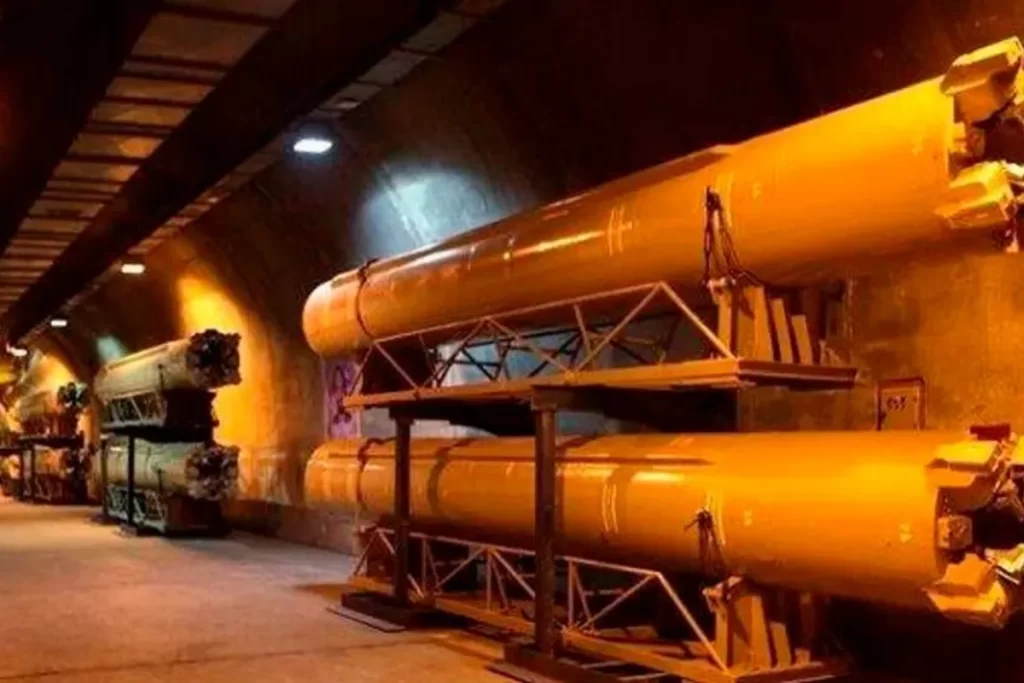
- Iran missile production is reportedly restarting underground despite extensive American and Israeli strikes on Tehran’s military-industrial infrastructure.
- Iran’s stockpiled warheads, airframes, guidance systems and other components could allow limited missile assembly even while damaged factories remain difficult to restore.
- The rebuilding effort could transform the war into a prolonged contest between Iranian weapons regeneration and U.S.-Gulf missile-defense capacity.
Iran’s ballistic-missile program was supposed to be one of the clearest casualties of the war. After weeks of American and Israeli strikes destroyed missile sites, industrial facilities, launchers and storage areas, Washington and Jerusalem presented the degradation of Iran’s military-industrial capacity as a major strategic achievement. But intelligence now emerging from the region suggests a more complicated reality: Iran is rebuilding.
U.S. and Middle Eastern officials familiar with the matter say Tehran has resumed assembling ballistic missiles, using stockpiled components and underground facilities that survived the initial bombardment. Activity has reportedly been detected at several locations, including the Khojir missile complex southeast of Tehran, while Iran is also working to establish additional underground assembly points designed to make its production network harder to destroy.
The significance extends well beyond the number of missiles being assembled.
Iran does not need to immediately restore its prewar production rate to change the strategic calculation. It needs only to demonstrate that its missile industry cannot be permanently eliminated through airstrikes alone. A relatively small but sustainable production capability can eventually replenish launch inventories, restore deterrence and force the United States and its regional partners to spend enormous sums defending against each successive wave.
READ MORE: Houthi Attacks Put Saudi Arabia at a Crossroads: Can MBS Fight a War and Still Deliver Vision 2030?
That is the central paradox of the campaign against Iran.
The more Washington attempts to eliminate Tehran’s missile infrastructure from the air, the more Iran has an incentive to disperse production underground, decentralize its supply chain and maintain large inventories of critical components. The objective therefore becomes less about destroying a factory than creating an industrial system that can survive the destruction of individual factories.
Iran appears to have anticipated precisely this problem.
Its missile architecture was developed over decades, beginning during the Iran-Iraq War in the 1980s, when Tehran faced a fundamental military disadvantage and lacked a modern air force capable of deterring superior regional adversaries. Missiles became Iran’s substitute for airpower. Over time, the program evolved into a distributed strategic insurance policy: launchers could be moved, weapons could be hidden underground and production could be separated across multiple facilities.
The current rebuilding effort suggests that this architecture is now being tested under wartime conditions.
Iran reportedly entered the conflict with substantial stocks of missile components, including airframes, warheads and guidance systems. That inventory provides Tehran with an important cushion. Even if damaged industrial facilities prevent immediate large-scale manufacturing, existing components can be assembled into operational weapons.
READ MORE: A Post-War Model for Verifying Iran’s Missile Arsenal
This distinction is crucial.
Destroying missile production capacity is not the same as destroying a missile arsenal. And destroying an arsenal is not the same as eliminating the knowledge, personnel, machinery and infrastructure required to build another one.
The United States and Israel may have inflicted severe damage on all three layers, but Iran appears to have retained enough of each to begin regeneration.
That could become particularly important in a prolonged war of attrition.
Iran’s missile inventory is finite. So are American and Gulf stocks of sophisticated missile interceptors. Every Iranian missile launched creates a financial and logistical problem for its opponents. A relatively inexpensive offensive weapon can force the deployment of an enormously expensive defensive interceptor, radar network, aircraft patrol or naval asset.
This creates an asymmetric economic equation that Tehran has exploited for decades.
The question is therefore not simply whether Iran can manufacture hundreds or thousands of missiles. The more important question is whether it can maintain a production cycle sufficiently resilient to survive repeated attacks.
Evidence of repaired roads, reopened tunnel entrances and reconstructed military infrastructure suggests that Iran has already begun treating the conflict as a long-term contest rather than a single campaign. Satellite imagery reportedly showing renewed access to underground missile facilities reinforces that assessment.
Iran’s strategic objective may consequently be shifting from victory to endurance.
Tehran does not necessarily need to defeat the United States militarily. It needs to convince Washington that permanently suppressing Iran’s military capabilities would require an open-ended campaign involving continuous airstrikes, intelligence operations and missile-defense deployments across the Middle East.
That is a much higher threshold.
The reported resumption of missile assembly also exposes a weakness in the idea that military strikes can permanently solve the Iranian missile problem. Airpower can destroy infrastructure quickly. It is far less effective at destroying industrial knowledge, engineering expertise, dispersed inventories and the political determination to rebuild.
This is why Iran’s underground strategy matters.
Every repaired tunnel and every concealed assembly facility reduces the effectiveness of future strikes. Every stockpiled component gives Tehran another opportunity to restart production after a bombing campaign. And every new underground site forces Israel and the United States to expand their intelligence requirements before considering another round of attacks.
The strategic contest is therefore becoming one of regeneration versus interdiction.
Washington may have severely weakened Iran’s military-industrial base. But if Tehran can rebuild even at a fraction of its previous capacity, it will have demonstrated that the missile program remains a durable instrument of national power.
For President Donald Trump, that presents a difficult strategic choice. The administration can continue military pressure and attempt to prevent Iran from rebuilding, but that risks turning the conflict into an indefinite campaign. Alternatively, Washington can pursue an agreement that places meaningful restrictions on Iran’s missile production and stockpiles while accepting that some indigenous capability will survive.
The lesson from the latest developments is uncomfortable but clear: Iran’s missile program cannot simply be bombed out of existence.
It can be degraded. It can be delayed. Its factories can be destroyed and its inventories reduced.
But unless the political and strategic conditions that created the program are changed, Tehran will continue trying to rebuild it.
And that means the ruins of Iran’s missile facilities may ultimately prove to be not the end of the program, but the beginning of its next, more dispersed and harder-to-destroy phase.