


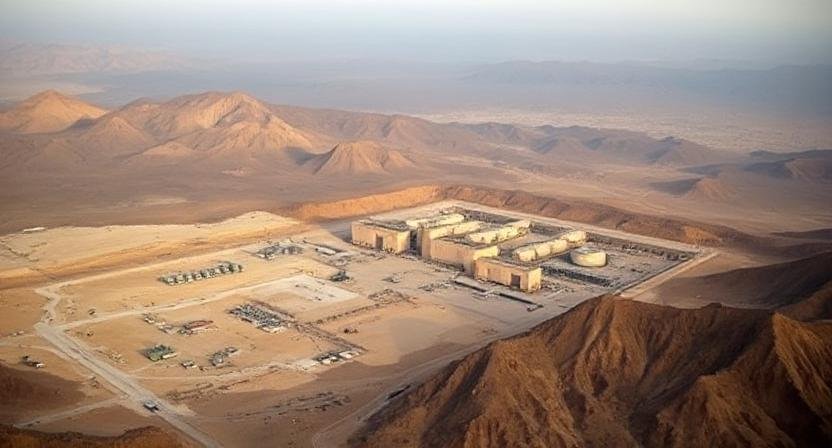
- Fordo facility destroyed: U.S. bunker busters decimated Iran’s top enrichment site, crippling its nuclear program.
- Long recovery timeline: Experts estimate a 3–5 year setback for Iran’s nuclear capabilities.
- Limited but targeted assault: Only three primary sites struck—others may remain operational.
- Uncertain future: Iran’s next move—rebuild, retaliate, or retreat—is still unclear.
In what is now being hailed as one of the most strategically successful air campaigns in recent history, U.S. and Israeli airstrikes have inflicted massive structural and operational damage on Iran’s most secretive and heavily fortified nuclear facility at Fordo. The scale of destruction—captured through satellite imagery and confirmed by sources inside Iran—marks a turning point in the standoff over Tehran’s nuclear ambitions.
According to a new American intelligence assessment, the Fordo enrichment plant, buried deep under a mountain near Qom, was struck by 12 GBU-57 bunker-busting bombs dropped by U.S. Air Force B-2 Spirit bombers. The assessment, backed by overhead surveillance and seismic activity data, confirms that Fordo has been rendered inoperable, with thousands of advanced centrifuges destroyed and key command infrastructure collapsed beneath the rubble.
“This is not damage—it’s annihilation,” said Lt. Gen. (Ret.) Douglas Lute, former U.S. National Security Council advisor. “Fordo was Iran’s crown jewel. Now it’s just a smoking crater beneath a mountain.”
Exposed: The Untold Story Behind Iran Nuclear Strikes and Tehran’s Strategic Defiance
Trump’s Operation Midnight Hammer: “Obliterated”
President Donald J. Trump, speaking from Mar-a-Lago, described the mission, code-named Operation Midnight Hammer, as a “decisive strike that obliterated Iran’s nuclear capacity.”
In a televised address, Trump declared:
“Iran’s nuclear dream is buried under 250 feet of rock. They won’t be enriching anything but rubble for years.”
While the Fordo strike took center stage, two additional facilities—Natanz and Isfahan—were also targeted. The U.S. Navy launched cruise missiles at aboveground components of Isfahan’s uranium conversion site, while two more Massive Ordnance Penetrators (MOPs) were dropped on Natanz’s dual-layered facility.
READ MORE: New Assessment Finds Site at Focus of U.S. Strikes in Iran Badly Damaged
Although these secondary strikes were less intense, they successfully destroyed critical infrastructure necessary for uranium conversion and bomb fabrication.
‘Years to Rebuild,’ Say Intelligence Officials
A classified report delivered to Capitol Hill by CIA Director John Ratcliffe describes the damage as “extensive and long-lasting,” predicting that Iran would need between 3 to 5 years to recover its full nuclear capacity. Ratcliffe’s report notes that reconstruction of the metal conversion facility at Natanz alone could take upwards of 24 months, assuming no further airstrikes occur.
“The centrifuges are gone. The enrichment pathways are gone. Even the air shafts used to ventilate these sites have collapsed,” a senior U.S. intelligence official told The Islamabad Telegraph. “The Iranians would have to rebuild from scratch.”
ALSO READ: Iran-Israel Standoff Escalates: Experts Warn Only Diplomacy Can Defuse Nuclear Crisis
Pentagon spokesman Sean Parnell echoed the assessment, saying:
“There is no doubt about it—Operation Midnight Hammer was a significant blow to Iran’s nuclear capabilities. It will take them years to recover.”
Israel’s Message: ‘We Will Mow the Lawn Again’
Israeli military officials have publicly supported the U.S. campaign and hinted that more strikes could follow if Iran attempts reconstruction.
“We’re not done,” said an Israeli defense official familiar with the planning of the joint operations. “If Iran starts to dig again, we will mow the lawn again.”
Iran Under Strike: Fuel Survives, But It’s Trapped
While it’s believed that Iran still possesses stockpiles of uranium enriched up to 60%, the material is now inaccessible, buried under collapsed ceilings and rubble. According to Israeli estimates, the only accessible stockpile may be located at the Isfahan laboratory, and even that is now under close watch by allied surveillance.
“Even if Iran has the fuel, it has lost the tools,” said Dr. Ali Baqeri, a former IAEA nuclear inspector based in Vienna. “Without the centrifuges, the control systems, the conversion units—this fuel is just expensive gravel.”
Debate Among Experts: Was This Enough?
Despite the overwhelming tactical success, some defense experts caution that Iran’s nuclear infrastructure is more decentralized and redundant than often assumed.
“Focusing only on Fordo, Natanz, and Isfahan is short-sighted,” warned Dr. Rosemary Kelanic of Defense Priorities. “Iran has a history of building covert sites. There’s strong evidence that additional underground facilities near Parchin and other military zones remain intact.”
Jeffrey Lewis of the Middlebury Institute, analyzing commercial satellite data, confirmed that three suspected sites—including one near the Parchin military complex—were not struck during the assault.
“If these were easy targets, they’d already be bombed,” Lewis said. “The U.S. went after what it could reliably destroy without a prolonged war.”
Limited Strike or Missed Opportunity?
Military planners from U.S. Central Command had initially proposed multiple waves of strikes, warning that Fordo’s depth (over 250 feet underground) would require prolonged pounding. But President Trump reportedly opted for a single, precision wave to avoid an extended campaign—and pushed Israel to wrap up its concurrent operations.
Critics argue this decision may have allowed elements of Iran’s nuclear program to survive.
But others, like retired Air Force General Charles Wald, argue that Trump’s gamble paid off.
“He struck hard, fast, and smart,” Wald said. “We destroyed what mattered most and sent a message: No underground bunker is safe.”
What Next for Iran’s Nuclear Program?
Whether Iran will attempt to rebuild, retaliate, or redirect its program remains uncertain. Analysts suggest the leadership in Tehran is weighing the cost of recovery against the risk of another devastating strike.
“Fordo was their pride,” said Col. Reza Pahlavi (Ret.), an Iran-born analyst now advising NATO. “Its destruction is both a technical and psychological blow. The regime is stunned.”
For now, the skies over Iran remain quiet—but tense, as U.S. and Israeli reconnaissance drones continue to monitor activity around surviving sites.
As one Western intelligence official put it:
“The message is clear: If you rebuild, we return.”