


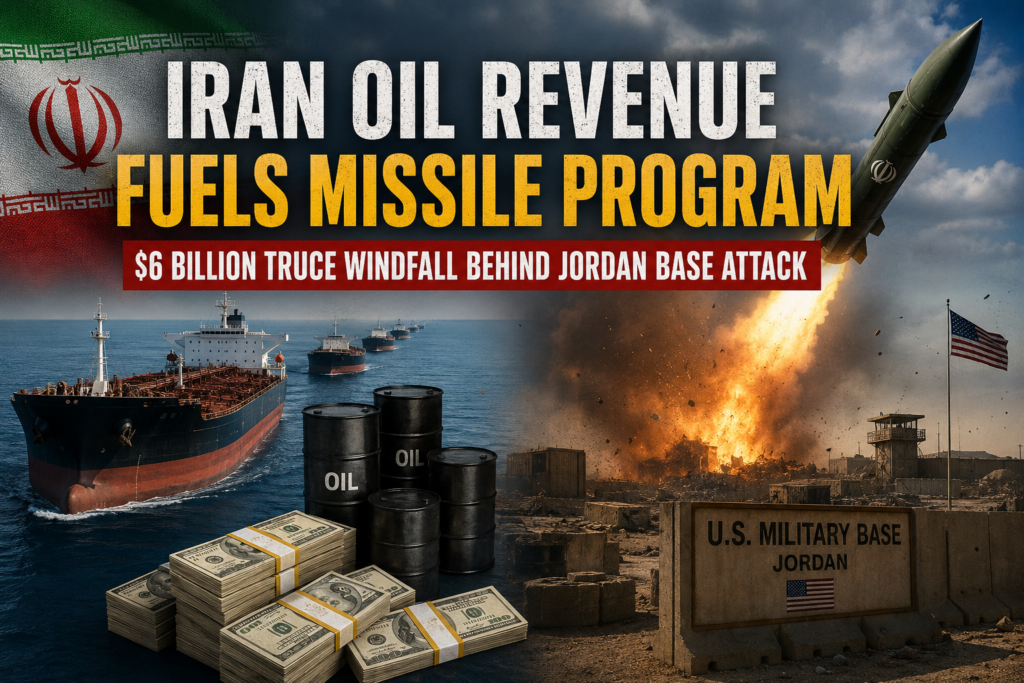
- Iran oil revenue and missile program surged after Tehran earned $6 billion during a brief U.S. truce
- Nearly 70 million barrels exported using covert ship-to-ship transfers near Malaysia
- Funds invested in precision-guided and laser-guided missile technologies
- Upgraded missiles later used in a devastating strike on a U.S. base in Jordan
The brief mid-summer truce between Washington and Tehran has triggered intense scrutiny after emerging evidence revealed how Iran oil revenue and missile program expansion were directly linked during the pause in hostilities. Analysts now confirm that billions earned from oil exports were rapidly redirected into advanced missile technologies—capabilities that later enabled a devastating strike on a U.S. military base in Jordan.
Between mid-June and mid-July, Iran exported nearly 70 million barrels of oil, generating an estimated $5–6 billion, according to independent assessments by United Against Nuclear Iran and regional energy analysts. The exports became possible after the United States temporarily lifted its blockade on Iranian oil shipments under a short-lived de-escalation agreement signed on June 17.
What followed, experts argue, was a strategic exploitation of diplomacy to accelerate the Iran oil revenue and missile program nexus.
Surge in Tanker Activity Signals Strategic Intent
Starting in late June, approximately 20 Iranian oil tankers began arriving in waters off Malaysia’s eastern coast. Vessels including Diona, Hero II, Sonia 1, and Stream carried significant volumes of crude destined for Asian markets—primarily China.
Iran Missile Attack on Muwaffaq Salti Air Base Exposes US Defense Failure and Signals Major War Escalation
The shipments originated from key Iranian ports, including Chabahar, where stockpiled oil was rapidly mobilized once restrictions eased. Within weeks, Iran exported nearly 50 million barrels, matching its pre-conflict monthly export levels.
Analysts say this surge reflects how the Iran oil revenue and missile program strategy was executed with speed and precision.
“Iran moved immediately to capitalize on the window,” said a Singapore-based analyst. “The goal was clear—build financial reserves and sustain strategic programs.”
Sanctions Evasion and the Shadow Oil Trade
Iran relied on sophisticated evasion techniques to sustain exports. Tankers were routed to the Eastern Outer Port Limits near Malaysia, where ship-to-ship transfers were conducted in international waters.
Using large hoses, Iranian crude was transferred to secondary vessels, masking its origin before being shipped to China’s independent “teapot refineries.” These refineries purchase discounted oil outside formal global channels.
This shadow trade has been central to sustaining the Iran oil revenue and missile program, allowing Tehran to bypass sanctions enforcement mechanisms.
From Oil Profits to Missile Power
Western intelligence assessments now indicate that a significant portion of the $6 billion windfall was diverted toward military development, particularly:
- Precision-guided missile systems
- Advanced navigation and targeting technologies
- Laser-guidance systems for enhanced strike accuracy
The rapid expansion of the Iran oil revenue and missile program became evident when Iran launched a high-impact missile strike on a U.S. base in Jordan shortly after the truce collapsed.
Two U.S. Troops Were Killed, One Is Missing After Iran Missile Attack in Jordan
Defense officials described the attack as “catastrophic in precision and impact,” highlighting a clear evolution in Iran’s strike capabilities.
Jordan Strike: A Direct Outcome of Truce Financing
The attack on the U.S. installation in Jordan marked a turning point, demonstrating how quickly financial gains were converted into battlefield capability.
Military analysts believe the missiles used in the strike incorporated upgraded guidance systems developed during the truce period. The precision and lethality of the attack underscored the effectiveness of investments made under the Iran oil revenue and missile program.
“This was not a routine strike—it reflected technological advancement,” said a regional defense expert. “The timeline directly aligns with the revenue surge.”
Strategic Miscalculation by Washington?
The developments have reignited debate in Washington over whether the temporary easing of sanctions and blockade restrictions enabled Iran’s military buildup.
While the agreement aimed to reduce tensions, critics argue it inadvertently strengthened the Iran oil revenue and missile program, giving Tehran both financial relief and strategic momentum.
“The intention was de-escalation,” said a policy expert. “But the outcome was rearmament.”
Economic Pressure vs Military Priorities
Despite severe economic strain, Iran continues to prioritize defense spending. Analysts note that the regime channels critical revenue into strategic capabilities rather than domestic recovery.
“Iran’s economy is under immense pressure, but military investment remains a top priority,” said a Middle East expert. “The Iran oil revenue and missile program reflects that reality.”
A Financial Buffer for Future Conflict
Although the United States has since reimposed restrictions and tightened enforcement in the Strait of Hormuz, the billions earned during the truce provide Iran with a crucial buffer.
This financial cushion is expected to sustain the Iran oil revenue and missile program in the coming months, even as export capacity declines again.
Iran oil revenue and missile program : Rising Tensions and Lessons from the Truce
The sequence of events—from truce to oil surge to missile strike—illustrates the risks of temporary de-escalation without strict enforcement mechanisms.
The Iran oil revenue and missile program has now become central to understanding how economic openings can rapidly translate into military escalation.
As tensions rise again across the Middle East, policymakers face a critical challenge: ensuring that future diplomatic efforts do not unintentionally empower adversarial military capabilities.