


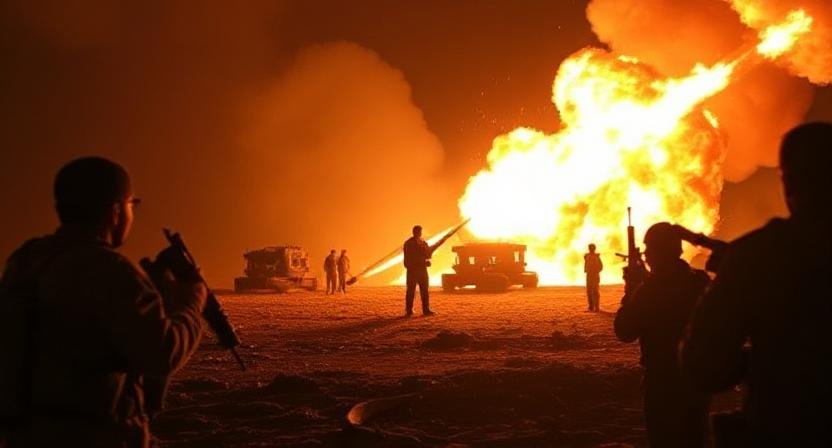
- Iran’s largest arms shipment yet—750 tons of missiles and drones—was seized en route to Yemen’s Houthis, exposing Tehran’s aggressive rearming strategy post-U.S. and Israeli strikes.
- Hezbollah is rebuilding its arsenal with Iranian support, smuggling weapons like Kornet missiles and drones through new Syrian routes despite a hostile Damascus government.
- Iran’s proxy militias escalate regional attacks, with Houthis sinking merchant vessels in the Red Sea and launching missiles at Israel, reflecting renewed capability.
- Evidence found in seized cargo—including Farsi manuals and Iranian quality certificates—proves Tehran’s continued involvement in arming its regional allies.
Despite suffering a dual blow from Israeli strikes on top commanders and a U.S. raid on its nuclear infrastructure, Iran is far from retreating. A string of recent weapons seizures across the Middle East has revealed a vigorous new Iranian campaign to rearm its regional proxy militias—from Yemen to Lebanon—with increasingly sophisticated and high-value armaments.
The seizures, which include surface-to-air missiles, drone engines, and long-range rocket systems, mark a new phase in Tehran’s asymmetric strategy. Experts say the uptick in clandestine arms transfers underscores Iran’s determination to replenish the stockpiles of its battered allies—including the Houthis in Yemen, Hezbollah in Lebanon, and scattered militia remnants in Syria—after months of relentless Israeli and American military pressure.
“Iran is rebuilding its presence in the Levant by sending missiles to Hezbollah and weapons from Iraq to Syria,” said Michael Knights, senior fellow at the Washington Institute for Near East Policy. “What we’re seeing is Tehran’s shift from nuclear brinkmanship to proxy rearmament.”
Yemen Intercepts Iran’s Largest-Ever Weapons Shipment
The most dramatic evidence of Iran’s rearming effort came this week when Yemeni government-aligned forces intercepted what U.S. Central Command described as the largest Iranian weapons shipment ever seized en route to Houthi rebels.
Acting on intelligence, the National Resistance Force halted a dhow—an unassuming cargo ship—off the Red Sea coast. Hidden under a load of air conditioners were 750 tons of military-grade hardware: cruise missiles, antiship and antiaircraft missiles, warheads, guidance systems, and drone engines.
“This wasn’t a drip-feed of parts—it was a military windfall,” said Mohammed al-Basha, a Yemeni security analyst and founder of the Basha Report. “The scale and timing suggest Tehran is moving urgently to replace what was lost in U.S. airstrikes.”
READ MORE: Iran Is Moving to Rearm Its Militia Allies
The cache included Qader antiship missiles and components for the Saqr air-defense system, which the Houthis have previously used to down U.S. MQ-9 Reaper drones. The dhow’s cargo was accompanied by Iranian-language manuals, missile quality certificates, and control systems—clear forensic evidence pointing to Iranian origin, despite Tehran’s official denials.
“Claims that Iran has supplied weapons to Yemen are baseless,” insisted Foreign Ministry spokesman Esmail Baqaei in Tehran Thursday.
But military analysts note that the operation fits into a broader, consistent pattern of clandestine support—often through maritime smuggling routes originating near the Iranian port of Bandar Abbas and routed via Djibouti across the Bab el-Mandeb Strait into Yemen.
ALSO READ: Iran-Israel Standoff Escalates: Experts Warn Only Diplomacy Can Defuse Nuclear Crisis
Syria and Lebanon: The Rebirth of the Arms Pipeline
Meanwhile, Syria’s new government—hostile to Iran and aligned with Gulf Arab states—has made multiple seizures in recent weeks along its borders with Iraq and Lebanon, revealing Tehran’s continuing efforts to maintain its smuggling routes to Hezbollah in Lebanon and pro-Iranian militias in Syria.
In one instance in June, Syrian authorities intercepted a shipment of Russian-made Kornet antitank missiles hidden in a truck transporting cucumbers near the Lebanese border. In May, Iranian-made air-defense missiles were uncovered by Syria’s General Security branch near Homs.
The fall of the Bashar al-Assad regime—long Iran’s strategic linchpin in the Levant—has forced Iran’s agents to adapt. Instead of moving large convoys under Syrian government protection, Iranian networks are now smuggling in smaller, harder-to-detect shipments using commercial vehicles, Syrian opposition sources say.
“There has been an intensifying trend of smuggling attempts from Syria into Lebanon in recent months,” said Michael Cardash, former deputy head of Israel’s national bomb disposal division and current analyst at the Israeli firm Terrogence.
Even with tighter borders and heightened Israeli intelligence operations, Hezbollah has managed to get limited resupplies across. A source familiar with Hezbollah operations told The Islamabad Telegraph that the group is now rebuilding its inventory of Kornet missiles, medium-range rockets, and drones—and manufacturing some locally.
Proxy Escalation: Houthis Strike Back
Just days after the massive seizure off the Yemeni coast, Houthi rebels demonstrated that Iran’s rearmament drive is already bearing fruit. Using a mix of RPGs, missiles, and drones, the Houthis launched coordinated attacks on tw§o merchant vessels in the Red Sea, killing three crew members and taking others hostage. The group has also resumed launching ballistic missiles toward Israel in recent weeks—most of which were intercepted, but their frequency indicates renewed capability.
The attacks come after the U.S. concluded a two-month air campaign against Houthi positions earlier this spring, aiming to degrade their launch capabilities. But the new weapons flow shows that Tehran views its Yemeni partners as central to its strategic depth—especially in disrupting commercial shipping and striking at Israeli and Western interests.
“The operational tempo has returned,” said al-Basha. “Iran wants to maintain pressure on maritime routes and support Hezbollah’s ongoing operations in northern Israel. This is Tehran’s way of responding to being hit at home.”
Strategic Implications: Iran Adjusts, Not Retreats
The broader context of Iran’s renewed regional weapons push cannot be separated from its recent military and political setbacks. In June, Israeli warplanes killed several senior Islamic Revolutionary Guard Corps (IRGC) commanders in Damascus. Simultaneously, U.S. airstrikes hit Iran’s key nuclear facilities—crippling uranium enrichment capabilities in Natanz and Fordow.
Rather than escalate directly, Tehran has opted for a familiar but effective playbook: empowering its network of non-state actors to carry the fight forward.
“Iran is wounded but not cornered,” said Knights. “Its doctrine relies on resilience through proxies. Even if its nuclear infrastructure takes a hit, its deterrence doesn’t disappear—it shifts.”
The message to both Washington and Tel Aviv appears clear: Iran still commands enough reach, stealth, and loyal foot soldiers across the region to retaliate on multiple fronts—from the Red Sea to the Golan Heights.
A Regional Powder Keg Rekindled
The Middle East’s security architecture is once again under stress. The U.S. and Israel may have landed tactical victories by damaging Iran’s nuclear program and degrading Hezbollah and Houthi capabilities. But the recent spate of arms seizures shows Iran is rapidly recalibrating—rebuilding its networks and rearming its allies with stealthier, deadlier weapons.
From Sana’a to southern Lebanon, Iran’s proxies are not just surviving—they’re adapting. And in this proxy theater of war, the arms race is far from over.