


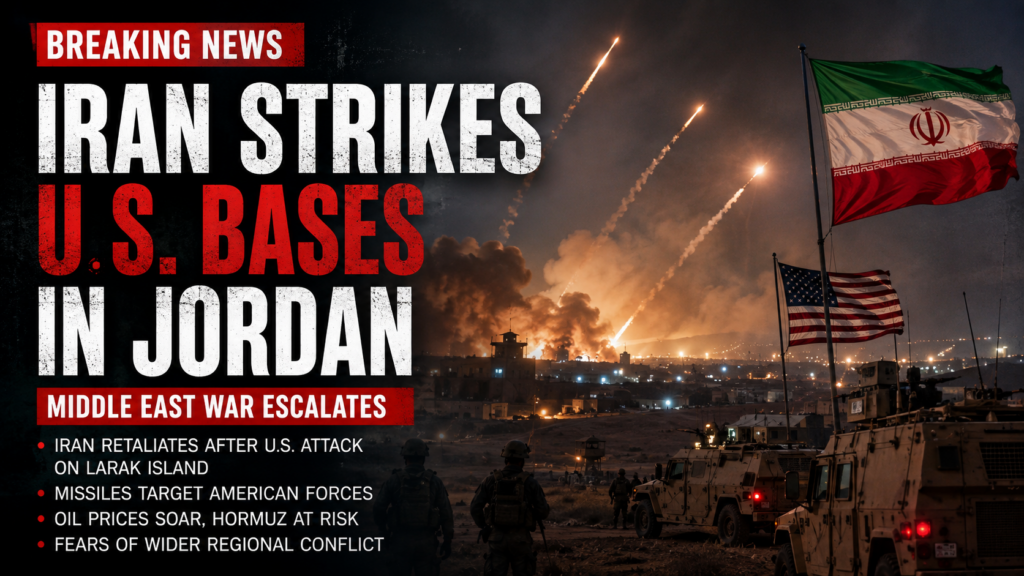
- Iran strikes U.S. bases in Jordan after Washington attacks Iranian military positions on Larak Island in the Strait of Hormuz.
- U.S.-Iran war escalation threatens to widen the six-month conflict and pull additional Middle Eastern countries into the confrontation.
- Strait of Hormuz crisis could drive oil prices higher, disrupt global shipping and intensify inflation across energy-importing economies.
Iran’s retaliatory missile strikes on U.S. military positions in Jordan have shattered the fragile calm surrounding the six-month-old U.S.-Iran war, raising the most serious question yet: is the Middle East heading back toward full-scale regional warfare?
The answer may depend on what Washington and Tehran do next. But one thing is already clear: the cycle of attack and retaliation has begun again.
Iran’s Islamic Revolutionary Guard Corps said Monday that it had launched ballistic missiles against two U.S. military bases in Jordan, describing the operation as retaliation for the American attack on Iranian military positions on Larak Island in the Strait of Hormuz.
Jordan said its air defenses intercepted eight missiles that entered its airspace. Tehran, meanwhile, claimed that the American strike caused casualties among Iranian military personnel and civilians.
CNN reported that U.S. forces had struck two Iranian launchers on Larak Island after detecting preparations to fire rockets carrying sea mines into the Strait of Hormuz. CNN’s latest report on the Larak strike
The claims of damage on both sides remain subject to independent verification. But the strategic message from Tehran is unmistakable: Iran is prepared to strike American forces outside Iranian territory when Washington attacks Iranian assets.
READ NEXT: U.S. Firepower Shortage After Iran War Raises Fears Over China and Russia
That is the real bombshell.
The confrontation that Washington had sought to contain through sanctions, maritime pressure and limited military action has once again acquired a dangerous kinetic dimension.
Larak Strike Opens a New Chapter
The escalation began Sunday when U.S. forces struck two Iranian rocket launchers on Larak Island, a strategically located Iranian island inside the Strait of Hormuz.
According to U.S. Central Command, the launchers were being prepared to fire rockets carrying sea mines into the waterway. Washington said the operation was necessary to prevent Iran from placing additional mines after U.S. forces had cleared mines from international shipping routes.
The Wall Street Journal reported that the U.S. strike marked the first American attack on Iranian positions in weeks and immediately raised the prospect of renewed conflict. Wall Street Journal: Fighting Flares in Middle East
But Tehran viewed the operation differently.
The Iranian Revolutionary Guards accused Washington of a fresh act of aggression and promised retaliation. Within hours, Iran demonstrated that its response would not necessarily be confined to the immediate battlefield.
The targets were in Jordan.
That matters enormously.
READ MORE: Fighting Flares in Middle East After U.S. Strike on Iranian Rocket Launchers
Jordan is a close American security partner and hosts thousands of U.S. military personnel. Its geography makes it an important platform for American air operations, intelligence collection and regional military logistics.
By targeting U.S. positions there, Iran demonstrated that the geographical boundaries of the confrontation remain dangerously wide.
Iran strikes U.S. bases in Jordan: The Six-Month War Is Far From Over
The latest exchange comes more than six months after the United States and Israel launched their initial attacks on Iran on February 28.
The conflict has already transformed the security architecture of the Middle East.
Iran has attacked Israel and U.S. military facilities across the region. American forces have responded with strikes against Iranian military infrastructure. Gulf states have repeatedly found themselves exposed to the consequences of a war they did not initiate.
And the Strait of Hormuz has become the central economic battlefield.
The waterway connects the Persian Gulf to the Gulf of Oman and the Arabian Sea and is one of the world’s most important energy chokepoints.
Before the current disruption, roughly one-fifth of global oil consumption normally passed through Hormuz. The Washington Post noted that Iran retains the ability to threaten shipping through the waterway with missiles, drones and other military capabilities.
The consequences of the wider war for U.S. military readiness have also become increasingly important. The Islamabad Telegraph has previously examined the pressure the conflict has placed on American weapons inventories and the wider strategic exposure created by the war.
The Islamabad Telegraph: Trump-Iran War and U.S. Ammunition Shortages
The gas equation is equally alarming.
A prolonged disruption to Hormuz would threaten not only crude oil but also liquefied natural gas shipments from the Gulf, creating a second energy shock for major Asian economies.
This means that the conflict is no longer simply a Middle Eastern security crisis.
It is a global economic crisis waiting to happen.
Hormuz Is the Pressure Point
Iran understands precisely why Hormuz gives it enormous strategic leverage.
The country does not need to destroy every tanker travelling through the waterway to affect global markets. It only needs to make shipping sufficiently dangerous, expensive and unpredictable.
That is already happening.
Commercial traffic through the strait has fallen sharply during the conflict as vessels and insurers assess the risk of missiles, drones and mines.
The Wall Street Journal has reported separately on attacks involving commercial shipping and the growing threat posed by the confrontation around Hormuz. Wall Street Journal: New Tanker Strike in Hormuz
The consequences go far beyond crude oil.
Higher tanker insurance costs increase the price of every cargo. Longer alternative routes consume more fuel and require more vessels. Refiners face uncertainty over crude availability. Airlines face higher jet-fuel costs. Chemical and fertilizer producers face higher feedstock expenses.
Eventually, those costs reach consumers.
For developing economies, the consequences can be even harsher.
Higher oil prices weaken currencies, widen current-account deficits and force governments to spend more on energy imports. Central banks then face the uncomfortable choice of tolerating inflation or keeping interest rates higher for longer.
The result can be slower economic growth at precisely the moment when governments are already struggling with debt, food insecurity and weak investment.
Washington Faces a Dangerous Choice
The Trump administration has increasingly emphasized economic pressure against Tehran.
Washington has sought to squeeze Iran through sanctions, maritime pressure and efforts to isolate its economy, while attempting to avoid returning to sustained large-scale bombing.
That strategy has now encountered a fundamental problem.
Economic warfare and military warfare are beginning to reinforce each other.
The more pressure Washington applies economically, the greater the incentive for Tehran to demonstrate that Iran still possesses military tools capable of imposing costs on the United States and its allies.
Conversely, every Iranian attack against American forces creates political pressure in Washington for retaliation.
That is the classic escalation trap.
One side believes it is responding defensively. The other sees the response as aggression. It retaliates. The first side then responds again.
The danger is not necessarily that either Washington or Tehran wants an unlimited war.
The danger is that neither side may be able to control where the next escalation stops.
Jordan Could Become a Wider Front
The Iranian decision to target U.S. military positions in Jordan is particularly significant because Jordan has traditionally been one of Washington’s most important security partners in the Arab world.
Amman now faces a difficult strategic dilemma.
Jordan wants to avoid becoming a battlefield between Iran and the United States. Yet its alliance with Washington means American military assets on Jordanian territory can make the country a potential target.
The Washington Post has previously documented Iranian attacks on U.S. forces in Jordan and the American retaliatory cycle that followed.
The latest missile interceptions demonstrate that Jordanian airspace can again become part of the conflict even when the Jordanian government itself is not seeking confrontation.
This creates a wider regional danger.
If American forces are attacked again in Jordan, Washington could retaliate against Iranian targets. If those attacks produce more Iranian casualties, Tehran could strike another U.S. facility elsewhere.
The geography of the war could expand almost overnight.
The Hidden U.S. Military Problem
There is another dimension to the crisis that deserves far greater attention.
The United States has already maintained an intense operational tempo across the Middle East for months.
That means every new round of fighting consumes aircraft hours, precision weapons, air-defense interceptors, naval resources, intelligence assets and logistical capacity.
The Islamabad Telegraph has previously examined how the prolonged Iran war has exposed vulnerabilities in U.S. military readiness and ammunition stocks.
The Islamabad Telegraph: Iran War and U.S. Military Exposure
This creates a strategic dilemma for Washington.
The United States may possess overwhelming military superiority over Iran, but a prolonged regional war can still impose significant costs on American force posture.
The longer the conflict continues, the more Washington must consider not only Iran but also China, Russia, Europe and other theaters where U.S. military resources may be required.
The World Cannot Afford Another Hormuz Shock
The greatest danger is therefore not simply another missile exchange.
It is the combination of military escalation + energy disruption + shipping insecurity + financial uncertainty.
Hormuz remains extremely difficult to replace.
Alternative pipelines can divert some Gulf oil exports, but they cannot compensate for the full volume normally transported through the waterway.
That is the uncomfortable reality facing global markets.
There is no easy substitute for Hormuz.
If the waterway becomes effectively unusable for commercial shipping for an extended period, the world cannot simply reroute all the lost oil and LNG.
The consequences would ripple through Asia first because Asian economies are major consumers of Gulf energy. But Europe and the United States would eventually feel the shock through global commodity and financial markets.
Oil Is Sending the Warning
The renewed military confrontation has already placed upward pressure on energy markets.
The Wall Street Journal reported that Brent crude and U.S. crude futures rose after the latest U.S. strike, reflecting renewed fears about disruption in the world’s most important oil-transit corridor.
That distinction is important.
Oil prices do not need to reach extraordinary levels to create serious economic damage. A sustained period of elevated crude prices can increase transportation, manufacturing and food costs while placing additional pressure on inflation.
For countries dependent on imported energy, the consequences can be severe.
Pakistan, India, Turkey, Japan, South Korea and much of Europe would all face different forms of economic pressure if Gulf energy supplies were disrupted for an extended period.
Diplomacy Has Suddenly Become More Urgent
The latest escalation also exposes the weakness of the current diplomatic framework.
Previous mediation efforts involving regional actors helped create periods of reduced fighting and temporary ceasefire arrangements. But the fundamental U.S.-Iran confrontation was never fully resolved.
The latest strikes demonstrate why a temporary reduction in hostilities is not the same thing as peace.
A sustainable settlement would need to address several interconnected issues: Iran’s nuclear programme, U.S. sanctions, Iranian security guarantees, the future of the Strait of Hormuz, the status of U.S. forces in the region and mechanisms for preventing attacks on commercial shipping.
Without such a framework, every military incident can reopen the entire war.
The Next 72 Hours May Matter Most
The most dangerous period may now be beginning.
Iran has demonstrated that it can respond to an American strike with attacks against U.S. military infrastructure outside Iran.
Washington has demonstrated that it is willing to strike Iranian military assets when it believes Tehran threatens freedom of navigation in Hormuz.
That combination creates a highly combustible equation.
The question is no longer whether the U.S.-Iran war can escalate.
It already has.
The real question is whether Washington and Tehran can stop the next retaliation before it becomes another retaliation—and whether regional powers can prevent the Strait of Hormuz from becoming the trigger for a global economic shock.
The missiles fired toward Jordan may have been intercepted.
But the strategic warning they carried was not.
The Middle East is once again standing on the edge of a much wider war—and the global economy is standing dangerously close to the same cliff.