


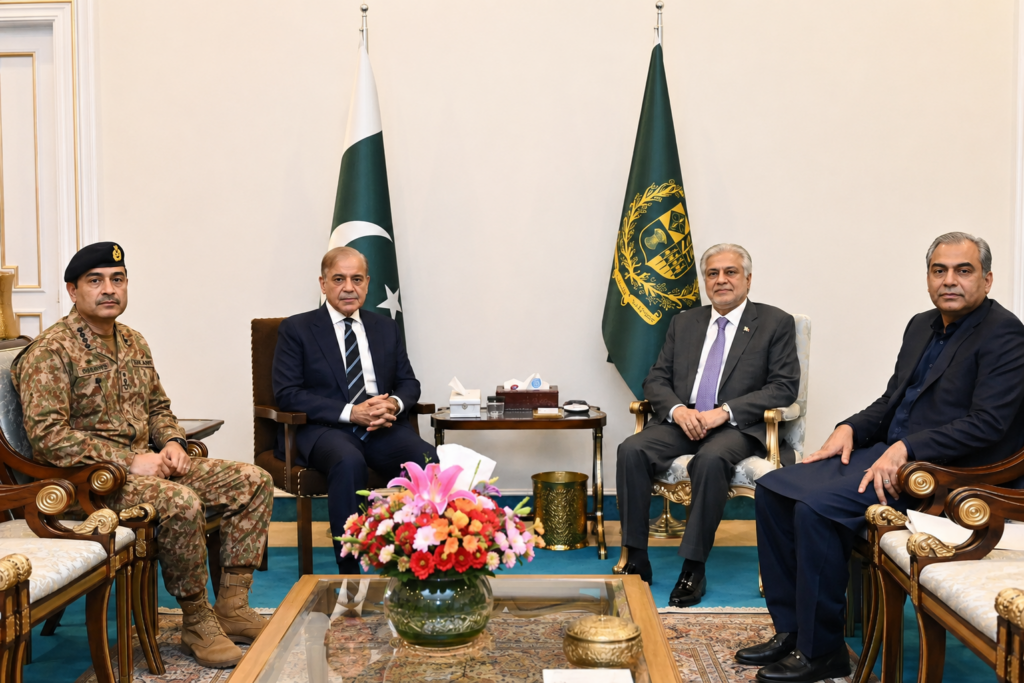
- Iran US Pakistan deal heroes include Pakistan’s top civil-military leadership driving backchannel diplomacy.
- The Iran US Pakistan deal heroes narrative highlights Islamabad’s role in preventing regional escalation.
- Global markets react positively as the Iran US Pakistan deal heroes help secure a breakthrough MoU.
- Field Marshal Asim Munir and PM Shehbaz Sharif emerge as central figures among the Iran US Pakistan deal heroes.
The turning point, as later described in diplomatic corridors stretching from Tehran to Washington, did not come in a press conference or a formal negotiation room. It came on a night when Field Marshal Asim Munir arrived in Tehran under conditions so tightly controlled that even seasoned observers in the region only learned of the visit after it had already reshaped the course of the war.
The Middle East at that moment was suspended between escalation and exhaustion. Air corridors were tense, shipping lanes were fragile, and intelligence channels were overloaded with warnings of an expanding conflict between the United States and Iran. Yet behind this volatility, a quieter sequence of engagements had already begun—one that would later be credited with transforming confrontation into negotiation.
What changed everything, according to senior diplomatic accounts later circulated in Islamabad, was not force but timing. The Field Marshal’s visit opened a narrow but decisive channel to Tehran at a moment when mistrust had reached its peak. It was the first time in weeks that Iranian leadership engaged directly with a high-level intermediary carrying both security and political authority from Islamabad. That engagement, though discreet, set the tone for what would gradually evolve into a structured US–Iran dialogue framework.
From that moment, Pakistan’s role expanded rapidly—not as a passive observer, but as an active conduit between opposing capitals.
Asim Munir Iran War Diplomacy: How Pakistan’s Field Marshal Convinced Trump to Delay Strike on Iran
While the world waited anxiously for a ceasefire that seemed perpetually out of reach, a small group in Islamabad was working under extraordinary pressure. Long nights replaced public statements. Backchannel messages replaced press briefings. According to accounts later shared in diplomatic circles, the effort was coordinated through what came to be informally described as the “Quad”:
Field Marshal Asim Munir, Prime Minister Shehbaz Sharif, Foreign Minister Ishaq Dar, and Interior Minister Mohsin Naqvi.
Iran US Deal Strait of Hormuz: Shipping Resumes as Global Markets Rebound Amid Rising Political Tensions
Each carried a distinct burden. Each operated under immense external pressure. And each, according to supporters of the process, played a role in keeping the fragile diplomatic thread from snapping.
The effort was not linear. At multiple points, negotiations nearly collapsed. Security incidents in the region repeatedly threatened to undo progress. In Washington, skepticism persisted about whether Tehran could be brought to a binding framework. In Tehran, distrust of Western intentions remained deeply rooted. Yet Islamabad persisted in maintaining contact with both sides, absorbing political heat while continuing to relay proposals that gradually narrowed the gap.
Israel-Hezbollah Clashes Put Iran Deal Under Early Pressure
It was during this period that former US President Donald Trump—according to accounts circulated among diplomatic aides and regional intermediaries—referred to Asim Munir in unusually warm terms, once remarking that he was his “favourite field marshal.” The comment, whether strategic or personal, became symbolic of Pakistan’s unusual positioning: trusted enough to speak to both sides, yet distant enough to be accepted by neither camp as an adversary.
The next phase unfolded in silence.
As ceasefire discussions began to take shape, Pakistan hosted a series of discreet meetings in Islamabad that brought together technical teams from both sides indirectly. The term “Islamabad Talks” began appearing in internal briefs, though no official confirmation was issued at the time. What mattered was not terminology but continuity—keeping dialogue alive when political conditions were unstable.
Field Marshal Munir’s second and third engagements with Iranian counterparts, according to the same diplomatic reconstruction, focused on de-escalation architecture: maritime security, border stability, and indirect communication channels with Washington. These discussions did not produce immediate breakthroughs, but they laid down the procedural skeleton for what would later become a formal negotiation track.
Meanwhile, Shehbaz Sharif maintained steady contact with global leaders, reinforcing Pakistan’s position as a facilitator rather than a participant in the conflict. Ishaq Dar expanded outreach to key capitals including Beijing, Ankara, and Cairo, ensuring that regional stakeholders were aligned with the idea of de-escalation rather than escalation. Mohsin Naqvi, operating in a less visible but crucial capacity, reportedly carried messages related to internal security guarantees and confidence-building arrangements, particularly concerning cross-border risks.
Pakistan’s Army Chief Meets Top Iranian Leader in Tehran
It was not diplomacy in the traditional sense. It was diplomacy under pressure—fragmented, exhausting, and constantly at risk of collapse.
By the time the framework for a US–Iran understanding began to take shape, the nature of Pakistan’s role had already evolved. It was no longer merely a messenger state. It had become a stabilizing intermediary.
The final round of negotiations, as reconstructed from diplomatic briefings, took place under conditions of extraordinary secrecy. The United States sought guarantees regarding maritime stability and verification mechanisms. Iran sought assurances regarding sanctions relief and sovereignty protections. Pakistan’s role was to ensure that neither side walked away.
In those final weeks, exhaustion defined the process. Officials involved described “sleepless nights” and continuous recalibration of proposals. Each clause of the emerging agreement required alignment across multiple political sensitivities.
Pakistan Premier to Meet Regional Leaders in Mediation Effort
At one critical juncture, when talks risked collapsing over enforcement mechanisms in the Strait of Hormuz, it was reportedly Pakistani mediation that proposed a phased de-escalation model—linking security guarantees with incremental implementation. That framework, according to participants in the process, became the backbone of the final understanding.
The signing of the Memorandum of Understanding marked the end of a long and uncertain arc.
The document—described in later accounts as the US–Iran–Pakistan facilitated MoU—formalized a commitment to de-escalation, maritime stability, and structured diplomatic engagement. It did not erase decades of hostility, but it created a mechanism for managing it.
In the aftermath, recognition began to circulate informally. In Tehran, there was acknowledgment of Pakistan’s persistent diplomatic engagement. In Washington, praise was directed at the channels that had made indirect negotiation possible. And in Islamabad, the four key figures were increasingly described as the architects of a difficult peace.
Field Marshal Asim Munir’s early intervention was seen as the opening move that made dialogue possible. Shehbaz Sharif’s political stewardship ensured continuity at the highest level. Ishaq Dar’s international outreach widened the diplomatic corridor. Mohsin Naqvi’s operational coordination ensured that communication lines remained intact even during periods of heightened tension.
Together, they formed a rare convergence of military authority, political leadership, diplomatic engagement, and internal coordination.
History, especially in moments of crisis, rarely moves in straight lines. It moves through pressure points—decisions made under uncertainty, risks taken without guarantees, and conversations that happen far from public view.
In this reconstructed account of the Iran crisis and its resolution, Pakistan’s role emerges not as that of a dominant power, but as a persistent intermediary operating at the edge of breakdown. Whether through military diplomacy, political negotiation, or quiet logistical coordination, the effort was sustained long enough to keep the process alive until agreement became possible.
And in that fragile space between war and peace, the names that repeatedly surfaced were the same four:
Asim Munir. Shehbaz Sharif. Ishaq Dar. Mohsin Naqvi.
Not as solitary actors, but as part of a coordinated effort that, according to this narrative record, helped prevent a regional conflict from expanding beyond control.
In the end, the Memorandum of Understanding did more than halt escalation. It demonstrated that even in a deeply fractured geopolitical environment, sustained mediation—however exhausting, however politically costly—can still produce an opening where none seemed to exist.
And for those who followed the process from its earliest days, the story begins the same way it ends: in Tehran, with a visit that changed everything.