


- Iran War Humanitarian Crisis leaves millions without access to food and medicine worldwide
- Critical aid shipments to Gaza, Afghanistan, and Sudan remain blocked due to route closures
- UAE holds abundant supplies but cannot deliver amid escalating regional insecurity
- Global hunger could surge by 45 million if the conflict continues, aid agencies warn
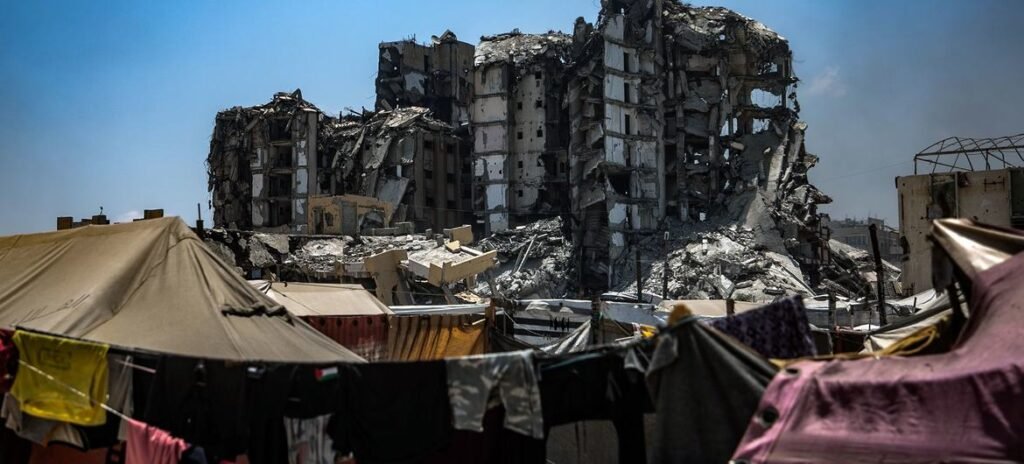
DUBAI / GAZA — The war centered around Iran is no longer confined to battlefields and airspace. It is now being felt in the quietest, most vulnerable corners of the world — hospital tents, refugee camps, and food distribution lines — where survival hinges not on strategy, but on access.
Seven-year-old Ibrahim’s story captures the human cost behind the geopolitical rupture.
Rushed into a makeshift tent hospital in Gaza Strip after sustaining severe injuries, Ibrahim’s life hung by a thread. Doctors and paramedics, working voluntarily under extreme conditions, faced an unthinkable reality: no anaesthesia, no proper surgical tools, and rapidly depleting medical supplies.
They made a choice no medical professional should ever have to make.
They operated anyway.
Inside the dimly lit tent, Ibrahim’s cries pierced through the suffocating heat as surgeons, their own eyes filled with tears, worked desperately to save him. Outside, his mother wept helplessly, listening to every scream. The surgery succeeded — Ibrahim survived — but the haunting echoes of that moment have become a symbol of a much larger global failure.
According to reporting by The Washington Post, the ongoing conflict has severely disrupted global supply chains, cutting off food and medicine to millions across multiple continents. What began as a regional war has spiraled into a full-scale humanitarian emergency.
The numbers are staggering.
The World Food Programme says nearly 10,000 tons of food intended for hundreds of thousands of children in Afghanistan remain undelivered. The World Health Organization has been unable to dispatch a $6 million shipment of essential medicines to Gaza. Meanwhile, Save the Children warns that up to 90 primary healthcare facilities in Sudan risk running out of critical supplies.
At the heart of this logistical breakdown lies a strategic choke point: the Strait of Hormuz.
The narrow passage — through which a significant portion of global trade flows — has been effectively paralyzed due to escalating hostilities and fears of retaliatory strikes. Shipping routes have been disrupted, insurance premiums have skyrocketed, and cargo vessels are being rerouted thousands of miles away, adding both time and cost.
The ripple effects are global.
Aid organizations report that approximately 70,000 tons of food are currently stranded on cargo ships, unable to reach populations already teetering on the brink of famine. If the conflict continues, projections suggest that an additional 45 million people could face acute hunger, pushing the global total far beyond already alarming levels.
Iran’s attacks on Gulf neighbors cut off food and medicine for millions
The crisis has also exposed a paradox in the global humanitarian system.
The United Arab Emirates — particularly Dubai — has long served as a critical logistics hub for international aid. With its vast ports, tax-free zones, and one of the world’s busiest airports, it has been a lifeline for humanitarian operations.
Today, it sits on the frontline of vulnerability.
Despite having abundant food reserves and signaling readiness to assist, the UAE finds itself constrained by geography and conflict. Iranian drone and missile activity has targeted key infrastructure, while uncertainty across regional airspace and maritime routes has rendered large-scale distribution efforts increasingly difficult.
In essence, there is food — but no safe way to deliver it.
This contradiction underscores a deeper geopolitical reality: modern wars are no longer just fought with weapons. They are fought through supply chains, economic pressure points, and strategic blockades that disproportionately affect civilians far removed from the battlefield.
Experts warn that the humanitarian system, already weakened by funding cuts from Western donors, is now approaching a breaking point. The war has not only increased demand for aid but simultaneously crippled the mechanisms designed to deliver it.
“This could become catastrophic,” analysts caution, particularly in regions like the Horn of Africa, where famine risks were already high before the conflict began.
Back in Gaza, Ibrahim’s survival offers a fragile glimmer of hope — but also a stark indictment.
His life was saved not because systems worked, but because individuals chose to act in the absence of those systems. His cries, echoing through that tent hospital, are a reminder that behind every delayed shipment, every blocked route, and every political calculation, there are human lives suspended in uncertainty.
The Iran war has redrawn more than geopolitical lines. It has redrawn the boundaries of suffering — extending them far beyond the frontlines, into places where the only battle is the fight to stay alive.
And unless supply routes reopen and tensions ease, Ibrahim’s story may soon become the rule, not the exception.