


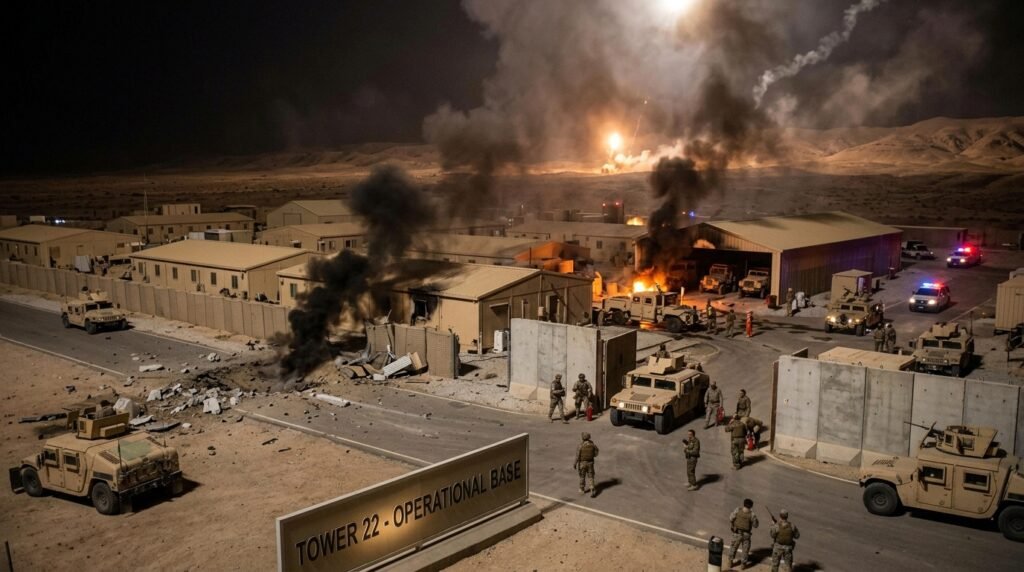
- Iranian attack on a U.S. base in Jordan marks another dangerous expansion of the U.S.-Iran conflict across the Middle East.
- Saudi Arabia and other Gulf states are increasingly exposed as Iranian and Iran-backed forces target energy infrastructure, military facilities and shipping.
- With Brent crude approaching $100 a barrel, direct Gulf retaliation against Iran could transform the current war into a full-scale regional conflict.
The Middle East is entering a far more dangerous phase of the U.S.-Iran war: what began as a confrontation between Washington and Tehran is increasingly becoming a regional war involving oil infrastructure, shipping lanes, American bases and the sovereign territory of U.S. allies.
The latest escalation came after the United States destroyed five Iranian oil tankers, including vessels struck in the Gulf of Oman and near Kharg Island, Iran’s principal oil-export terminal. Washington said the tankers were linked to an IRGC-financed “shadow network” and acted after Iranian missiles targeted a U.S. warship. Tehran responded by firing ballistic missiles at a U.S.-used base near Al Azraq in Jordan. Jordan said it intercepted 18 of 20 missiles, with the remainder falling in unpopulated areas.
But the Jordan strike is only one part of a much larger and increasingly dangerous picture.
Iran and Iran-aligned forces have, over the course of the war, expanded the battlefield from Iranian territory and the Strait of Hormuz into the Gulf monarchies and neighboring states. Kuwait, Bahrain and Jordan have faced Iranian attacks or threats, while Saudi Arabia has been repeatedly targeted by the Iran-backed Houthis. The UAE has also condemned Iranian attacks across the region.
READ MORE: Houthi Attacks Put Saudi Arabia at a Crossroads: Can MBS Fight a War and Still Deliver Vision 2030?
The most significant development may now be occurring inside the Gulf states themselves.
Sources familiar with regional discussions have told The Islamabad Telegraph that senior Kuwaiti officials have urged regional governments to reconsider a strategy centered primarily on absorbing and defending against Iranian attacks. According to these sources, Kuwait’s message has been that continued defensive restraint may no longer be sufficient and that regional states should consider responding to Iranian attacks in a comparable manner. The Islamabad Telegraph could not independently verify the reported exchanges.
If accurate, that would represent a major psychological shift.
For months, Gulf governments have attempted to prevent the war from becoming a direct Arab-Iranian confrontation. They have generally distinguished between supporting U.S. security arrangements and entering the war themselves. But that calculation becomes increasingly difficult when oil facilities, civilian infrastructure, commercial shipping and national territory are repeatedly exposed to attack.
Saudi Arabia is already confronting the consequences. Iran-backed Houthi forces launched a major wave of attacks against southern Saudi Arabia on Tuesday, striking or targeting locations around Jazan, Abha, Najran and Khamis Mushait. Saudi authorities said 73 people were wounded and energy installations were damaged.
This is the point at which the conflict could change character.
The United States is attacking Iran’s oil lifeline. Iran is attempting to impose costs on American military power and the commercial system supporting it. Iranian-aligned groups are simultaneously increasing pressure on U.S. partners. The result is a widening strategic equation in which every attack creates incentives for another attack somewhere else.
READ MORE: U.S. Strikes Iranian Oil Tankers in Response to Tehran’s Attacks on Navy Ships
The oil market is already delivering the warning.
Brent crude approached the psychologically important $100-a-barrel threshold, reaching around $99.48 in Asian trading on Wednesday. The significance is not simply the number itself. It is what lies behind it: uncertainty over how much Gulf oil can reliably reach international markets if the Strait of Hormuz, the Red Sea and alternative export routes all become contested.
And the danger extends beyond oil.
The Gulf is simultaneously becoming a battlefield for naval warfare, missile warfare, drone warfare and economic warfare. Iran has threatened vessels linked to Kuwait and Bahrain, while the Houthis have demonstrated that attacks can reach deep into Saudi territory. AP reported that Iranian-aligned Houthi and Iraqi militias are developing increasingly coordinated pressure against Saudi Arabia and other U.S. partners.
The prophecy: the next war may not be launched by Washington or Tehran
The most dangerous possibility now is regional self-defence becoming regional retaliation.
If Saudi Arabia, Kuwait, the UAE, Bahrain or Jordan conclude that defensive interception is no longer enough, they could begin striking Iranian military infrastructure, naval assets or proxy networks directly. That would remove one of the last political barriers preventing the war from becoming a collective Gulf-Iran confrontation.
The consequences would be enormous.
Iran could respond against Gulf energy facilities. The Houthis could intensify attacks on Saudi shipping. The United States would almost certainly reinforce its regional military posture. Israel could exploit the widening battlefield. And oil could move decisively above $100, with a prolonged conflict potentially pushing prices substantially higher; analysts cited by the Financial Times have warned of scenarios reaching $120.
The Middle East therefore stands at a dangerous crossroads.
The next stage may not be about whether Iran can survive American pressure. It may be about whether America’s Arab partners decide they can survive without directly answering Iran themselves.
If that decision is made, the six-month-old U.S.-Iran war could enter its most consequential phase yet: a Gulf war in which the regional states stop being the battlefield—and become combatants.