


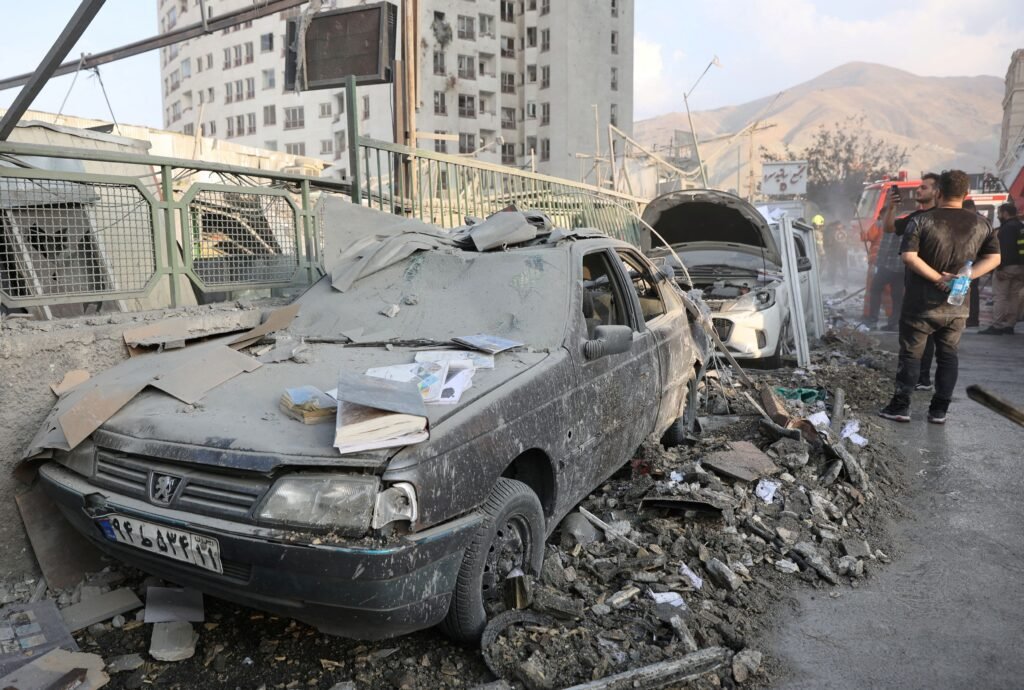
- Israel attacks Iran, launching pre-emptive missile strikes targeting Tehran.
- Explosions reported near University Street and Jomhouri district in Iranian capital.
- Strike signals dramatic escalation from shadow conflict to direct confrontation.
- Analysts warn retaliation risks could trigger wider Middle East war.
The first explosion came just late in the morning, a deep, rolling blast that echoed through central Tehran and rattled apartment windows across the city. Within minutes, another detonation followed, then another — each louder than the last — sending residents rushing to balconies and streets as sirens and emergency vehicles cut through the capital’s evening traffic.
From my position near central Tehran, thick columns of smoke could be seen rising above the skyline toward University Street and the Jomhouri district, two densely populated areas known for government offices, commercial centers, and constant civilian movement. The air carried the sharp smell of burning material as crowds gathered cautiously at intersections, many filming the scene while others hurried home amid growing panic.
Will Trump Attack Iran: March 2, 2026 Deadline Raises Fears of Imminent U.S. Military Strike
Iranian media outlets quickly confirmed that several missiles had struck the area. The semi-official Fars News Agency reported impacts along University Street and parts of Jomhouri, while emergency responders sealed off multiple roads leading toward the blast zones. Security forces established checkpoints within minutes, urging civilians to disperse.
Israel launches attack on Iran, explosions in downtown Tehran
Shortly afterward, Israel publicly acknowledged responsibility for the attack. Israeli Defence Minister Israel Katz declared that Israel had launched a “pre-emptive attack” against Iran to eliminate threats to Israeli security — an announcement that transformed what residents initially feared was an accident into a moment of historic geopolitical escalation.
Residents here reacted with disbelief more than immediate fear. Tehran has long lived under the shadow of confrontation with Israel, yet few expected direct missile strikes inside the capital itself. “We always heard threats on television,” said one shopkeeper standing near a partially shuttered storefront. “But hearing explosions yourself — that is different.”
According to early international reports, including information cited by the Associated Press, at least one strike occurred near administrative offices connected to Iran’s Supreme Leader, Ayatollah Ali Khamenei, dramatically raising the political stakes of the attack. Iranian authorities have not yet confirmed casualties, but ambulances continued moving toward affected districts hours after the explosions.
A City on Edge
As news spread, Tehran’s normally crowded streets began to empty. Cafés lowered shutters early, and ride-share drivers reported sudden surges in requests as families attempted to return home before any potential follow-up strikes.
Mobile networks slowed briefly as residents rushed to contact relatives. Social media platforms filled with videos showing flashes in the sky and smoke rising above residential blocks, though authorities urged citizens to avoid sharing sensitive footage.
Air defense activity was visible shortly after the initial blasts, with flashes seen in the distance suggesting interception attempts or defensive fire. Officials have yet to release operational details.
Despite the tension, daily life has not completely halted. Bakeries remained open in some neighborhoods, and small groups gathered quietly in public squares, discussing what many here described as an unprecedented moment.
Strategic Shockwaves
Israel’s decision to openly claim responsibility signals a major shift from years of covert confrontation between the two adversaries. Previous incidents — cyberattacks, assassinations, and mysterious explosions — were often shrouded in ambiguity. Tonight’s events were unmistakably direct.
Regional analysts believe the strike may be linked to growing Israeli concerns over Iran’s missile and nuclear capabilities, particularly as diplomatic negotiations surrounding Tehran’s nuclear program appeared increasingly uncertain in recent weeks.
Here in Tehran, however, political analysis feels secondary to immediate uncertainty. Rumors circulate rapidly — some predicting imminent retaliation, others expecting a measured response designed to avoid all-out war.
What Tehran Expects Next
Iranian state television has condemned the attack as aggression and promised a response, though officials have not yet outlined its scope or timing. Military analysts suggest Iran possesses multiple avenues of retaliation, ranging from direct missile strikes to actions through allied regional groups.
The greatest fear among residents is escalation. Conversations across the city tonight revolve around one question: will this remain a limited exchange, or is the region entering a broader conflict?
Global consequences could be swift. Any sustained confrontation between Israel and Iran risks disrupting energy routes through the Persian Gulf, shaking financial markets, and drawing international powers into a rapidly expanding crisis.
For now, Tehran waits — tense but watchful. The smoke still hangs faintly above parts of the city, illuminated by emergency lights and helicopters circling overhead. What began as a series of explosions has become something far larger: a moment that may redefine the balance of power in the Middle East and determine whether diplomacy survives or gives way to open confrontation.