


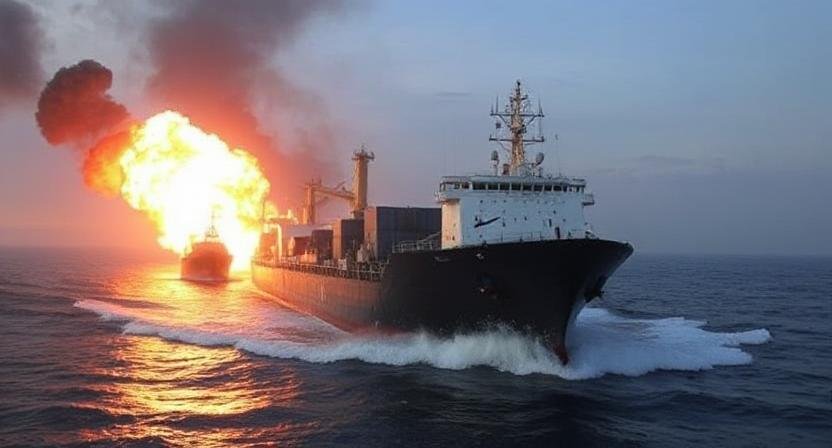
- Strait of Hormuz Under Threat: U.S. officials warn that Iran could mine the crucial oil chokepoint if the U.S. joins Israel’s military campaign, risking global energy chaos.
- U.S. Navy on High Alert: Pentagon deploys contingency plans as Iran retains advanced naval mines and regional operatives despite Israeli strikes on its military assets.
- Europe Pushes for Ceasefire: European diplomats meet in Geneva urging Iran to return to talks, amid fears of a regional explosion and disruption to global trade.
- Trump Holds Back Final Order: While Israel urges U.S. strikes on Iran’s nuclear facilities, President Trump remains undecided, saying he prefers “last-minute” decisions.
As Israel escalates its blistering military campaign against Iranian nuclear and military targets, global powers are scrambling to contain a war that could plunge the Middle East into chaos. While European diplomats are quietly pressing for de-escalation, the United States is laser-focused on a more immediate concern: the strategic Strait of Hormuz—a chokepoint for a quarter of the world’s oil.
In recent closed-door meetings at the White House and Pentagon, top American defense officials have begun to game out nightmarish scenarios: What if Iran, weakened yet still dangerous, decides to mine the Strait of Hormuz in retaliation for Israeli strikes—or worse, for any future American involvement?
It’s not an abstract worry. The Islamic Republic retains a formidable arsenal of naval mines, missiles, and underwater sabotage capabilities. “Iran is strategically weaker but operationally still lethal,” said Brian Katulis, a senior fellow at the Middle East Institute. “And Americans still have troops across that part of the world.”
The Hormuz Gambit
The Strait of Hormuz is just 90 miles wide at its narrowest point. It’s a vital artery for global energy markets—through which nearly 21 million barrels of oil pass daily. Any disruption there would send crude prices skyrocketing and imperil the fragile global economy.
Iran’s ability to block the strait has long been its trump card. “Mining the Strait of Hormuz is not just a threat—it’s a capability Iran has already demonstrated,” said Gen. Joseph Votel, former commander of U.S. Central Command. He pointed to the 1988 incident during the Iran-Iraq war when a U.S. frigate was nearly sunk by an Iranian mine.
Today, Iran has an even deadlier toolkit. In addition to limpet mines placed by frogmen, Iran possesses advanced “bottom” mines that sit undetected on the seafloor until triggered by magnetic or acoustic signatures. Some can deliver explosive yields of hundreds of pounds.
Despite Israel’s campaign destroying many of Iran’s missile sites and high-value military assets, Tehran’s navy remains largely intact. U.S. military officials now warn that American vessels in the Persian Gulf could be trapped if Iran decides to act.
READ MORE: Live Updates: Europe Pushes for De-escalation After Nearly 1 Week of War
“Think about what happened after Trump killed Suleimani—and now multiply that by 100,” said Katulis. The risk isn’t just to naval hardware. Over 40,000 U.S. troops are stationed across the Middle East, many within missile range of Iran’s proxies and ballistic arsenals.
While the U.S. Navy maintains four minesweepers in the Gulf and has invested in autonomous mine-hunting drones, experts say that clearing the strait would take weeks and expose U.S. sailors to lethal threats. “You can’t robotically disarm all of these,” said one former naval officer. “Diving teams will still have to go in, manually.”
Iran-Israel Conflict: Europe’s Quiet Mediation
Meanwhile, across the Atlantic, European diplomats are racing against time to halt the slide into a broader regional war. After nearly a week of deadly Israeli airstrikes and Iranian missile barrages, officials from Germany, France, and the UK have convened an emergency summit in Geneva.
Sources close to the meeting confirmed that European envoys are pressuring Iran to return to diplomatic talks—despite Iran’s fury over Israeli strikes on its nuclear and military infrastructure.
MUST READ: EXCLUSIVE: Trump Edges Toward War with Iran as Khamenei Defies Call for Surrender
The EU’s influence has waned considerably in the region, but diplomats hope to leverage what’s left of the 2015 nuclear deal framework and their economic ties with Tehran. “We have limited leverage, but we must try,” said a senior European official. “If the Strait of Hormuz is mined, our economies will suffer too.”
The urgency of European diplomacy was underscored by Thursday’s developments: Israel launched new strikes deep inside Iran, including on the Arak nuclear complex and missile production centers. Iranian state media confirmed the attacks but denied major damage. Tehran responded by firing a barrage of missiles, one of which hit a hospital complex in southern Israel, prompting public outrage.
Israel’s Defense Minister Israel Katz vowed more. “We will dismantle every threat to Israel’s security—permanently,” he declared.
Trump Holds the Cards
Caught in the middle of this dangerous calculus is President Donald Trump. His comments have remained deliberately ambiguous. “I have ideas,” he said cryptically. “But I like to make a final decision one second before it’s due.”
Yet behind the scenes, Israel is lobbying hard for American participation. Specifically, Israeli officials want the U.S. to use bunker-busting munitions to destroy underground nuclear facilities at Natanz and Fordow—targets that Israel cannot hit effectively alone.
Tehran has warned that such a move would invite “irreparable consequences” for the United States. Ayatollah Ali Khamenei has signaled that while Iran’s economy would be further damaged by war, regime survival will trump all other concerns.
A Ticking Clock
“The Iranians are calculating costs—mining the Strait would be economically suicidal,” said Admiral Kevin Donegan, a former commander of U.S. naval forces in the region. “But they may judge it necessary if the regime’s survival is at stake.”
This is the paradox now confronting Washington and Europe: Iran’s most dangerous moves would also hurt itself. Yet in the fog of war and desperation, strategic logic may give way to martyrdom.
“The danger,” said Vali Nasr of Johns Hopkins University, “is not just that things will go wrong. It’s that all sides think they’re in control—until they aren’t.”
As the world watches oil prices creep upward and markets brace for volatility, diplomats and generals alike know the next move might not come from a war room—but from the murky depths of a narrow strait in the Persian Gulf.