


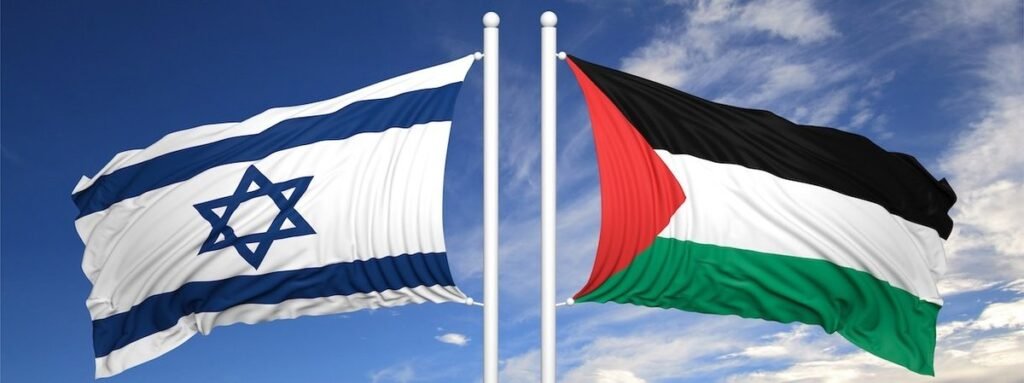
- Britain, Canada, Australia, and Portugal officially recognized Palestine on Sunday.
- France and other European nations expected to announce recognition at U.N. summit.
- Israel and the United States boycott, with Israel calling the summit a “circus.”
- Netanyahu hints at West Bank annexation as retaliation, risking ties with UAE.
- Germany and Italy refuse recognition, insisting on a negotiated peace process.
The long-stalled idea of a two-state solution is back in the spotlight as several world leaders moved this week to recognize Palestine as an independent state. Britain, Canada, Australia, and Portugal announced recognition on Sunday, while France and other European nations are expected to follow suit at a summit convened by France and Saudi Arabia in New York.
The coordinated recognition comes as Israel intensifies its war in Gaza, where more than 65,000 Palestinians have been killed according to local health officials. For Palestinians, the international backing is a symbolic victory, though many remain doubtful it will bring tangible change on the ground.
“This is not just about symbolism,” said French Foreign Minister Jean-Noel Barrot. “It is a political declaration that affirms France’s unwavering commitment to the two-state solution.”
Israel Dismisses Move as “Circus”
Israel has rejected the summit outright. U.N. Ambassador Danny Danon denounced it as a “circus,” while Prime Minister Benjamin Netanyahu vowed there would “never be a Palestinian state.”
Israel and the United States boycotted the gathering, highlighting deep divisions in the West. Netanyahu hinted Israel may respond with annexation of parts of the occupied West Bank, a step that risks alienating Arab partners such as the United Arab Emirates, which has warned that such actions would undermine the Abraham Accords.
Europe Divided Over Timing
While a majority of European states now recognize Palestine, key players such as Germany and Italy remain reluctant. Berlin insists recognition should come only after a negotiated peace agreement, while Rome has warned that unilateral recognition could prove “counterproductive.”
Still, France’s decision to lead the push has added weight to a movement once driven mostly by smaller nations in the Global South. President Emmanuel Macron framed the move as a matter of urgency to preserve the last vestiges of the two-state option.
Russia Reaffirms Two-State Approach
Russia, increasingly seeking a diplomatic role in the Middle East, reaffirmed that a two-state solution is the “only possible way” to resolve the crisis. Kremlin spokesperson Dmitry Peskov said the conflict had entered its “most acute and tragic stage,” underscoring Moscow’s call for partition as the only viable framework.
Palestinians Gain Symbolism, Not Security
For Palestinians, recognition offers global moral support but little immediate security. Displaced Gaza resident Nabeel Jaber expressed skepticism: “Even if countries like Australia, Canada, and France recognize Palestine, there will still be no serious pressure on Israel to grant us our rights.”
The war, triggered by Hamas’s October 2023 attack on Israel, has erased any short-term prospect of negotiations. Israeli settlements continue to expand, and settler violence in the West Bank has escalated, eroding the land base for a future Palestinian state.
On the Israeli side, many argue that Palestinians have repeatedly rejected peace offers. “We’ve offered them peace about five times,” said 25-year-old Tel Aviv student Tamara Raveh. “They never chose peace. Why should we give them a state now?”
A Narrowing Window for Peace
Despite pessimism, global leaders argue that recognition keeps alive a principle that has anchored international diplomacy since the 1993 Oslo Accords. “Recognition will not end the war in Gaza,” a senior European diplomat acknowledged. “But it sends a signal that the world will not accept endless occupation and displacement as the status quo.”
Whether the recognition drive will reshape realities on the ground remains uncertain. Netanyahu’s defiance, U.S. reluctance, and Hamas’s continued presence all cast doubt on peace prospects. Yet the symbolism of major Western nations recognizing Palestine has pulled the two-state solution—long pronounced dead—back to the center of global diplomacy.