


- Trump publicly vowed to block Israeli annexation of the West Bank, defying far-right Israeli demands.
- Over 65,000 Palestinians have been killed in Gaza’s two-year war, fueling global outrage.
- France, Britain, Canada, Australia, and Portugal recently recognized Palestine to salvage the two-state solution.
- International aid flotillas and European naval escorts challenge Israel’s blockade, signaling rising global resistance.
For the first time in years, Palestinians allowed themselves a rare sigh of relief. When U.S. President Donald Trump stood before reporters and declared he would not allow Israel to annex the West Bank, it was a statement that cut against the grain of Israeli expansionism and momentarily revived faint hopes for a Palestinian state. In rejecting calls from Israel’s far-right politicians, Trump signaled that unchecked aggression has limits, even from America’s closest ally in the Middle East.
But while words matter in diplomacy, the reality on the ground remains bloodied and brutal. Israel’s invasion of Palestinian territories—through military raids, settlement construction, and an unrelenting war in Gaza—continues to extinguish lives and hopes in equal measure. Trump’s declaration, while welcome, does little to alter the facts of occupation.
Israeli Prime Minister Benjamin Netanyahu, now cornered by both domestic ultranationalists and mounting international criticism, has been pressing to annex the West Bank. His coalition partners, such as Finance Minister Bezalel Smotrich, openly boast that the idea of a Palestinian state has been “erased from the table.” The arrogance is emboldened by decades of impunity, with settlements expanding deep into Palestinian lands seized in the 1967 war. These outposts—home to over 700,000 settlers—are carved into a landscape where 2.7 million Palestinians struggle under military occupation.
The E1 settlement project, given final approval in August, threatens to bisect the West Bank and sever East Jerusalem from any future Palestinian state. It is a dagger pointed at the very heart of the two-state solution. France, Britain, Canada, Australia, and Portugal responded by recognizing Palestine in recent days, a powerful gesture meant to salvage peace from the wreckage of Israel’s ambitions. Predictably, Israel condemned these recognitions, dismissing them as empty politics. But for Palestinians, the symbolism matters: the world is no longer silent.
Trump’s refusal to endorse annexation also carries weight. It comes as Arab leaders—gathered on the sidelines of the United Nations General Assembly—warned Washington of the catastrophic consequences such a move would unleash. Saudi Foreign Minister Prince Faisal bin Farhan Al-Saud insisted that Trump “understands very well” the regional dangers annexation would trigger. The message is clear: the region will not stand idle as Israel redraws the map with bombs and bulldozers.
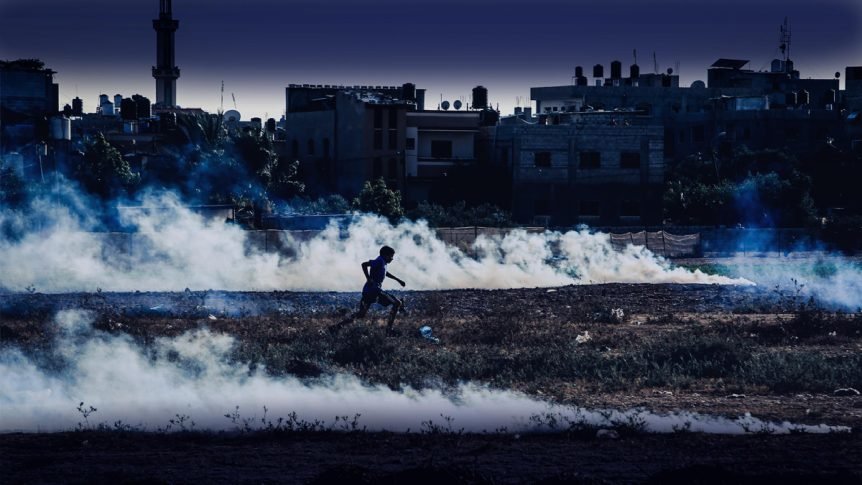
Yet, even as Trump spoke, the reality of invasion was unfolding in real time. Israeli armored vehicles rolled through Tubas in the West Bank. Warplanes struck Gaza City, killing civilians and reducing neighborhoods to rubble. Nearly two years into the Gaza war, more than 65,000 Palestinians are dead, according to local health authorities. A famine grips parts of the besieged enclave, where Israel’s blockade starves civilians as surely as bombs kill them. International condemnation grows louder, yet the bombs keep falling.
The world has begun to push back in tangible ways. Italy and Spain deployed naval ships to escort the Global Sumud Flotilla—a fleet of 50 civilian boats attempting to break Israel’s naval blockade and deliver food and medicine to Gaza. These vessels, attacked by drones on their humanitarian mission, represent the moral conscience of a world unwilling to normalize collective punishment.
At the United Nations, the United States unveiled a 21-point peace plan, offering yet another blueprint for ending the Gaza war and freeing the hostages still held since the Hamas attack of October 2023. Trump expressed optimism that “a deal could happen soon,” pointing to his talks with Arab leaders and Netanyahu. Optimism is cheap; the test is whether the U.S. will finally apply real pressure on Israel to end its war machine.
Netanyahu’s government clings to its narrative of security and biblical entitlement, insisting that settlements are lawful and essential. But the international community knows better. Under international law, these settlements are illegal. They are instruments of dispossession, designed to fracture Palestinian territory until no viable state remains. They are not about security—they are about domination.
What Trump’s refusal to greenlight annexation reveals is that even Israel’s staunchest allies see a breaking point. The United States cannot afford a Middle East perpetually ablaze. The Arab world cannot tolerate endless humiliation. And Palestinians cannot endure perpetual invasion.
History may remember Trump’s Oval Office remark not as a turning point, but as a warning shot: Israel’s impunity is not infinite. The nations that have recognized Palestine in recent days are building momentum for accountability. The flotillas sailing toward Gaza are not merely ships—they are symbols of defiance against the machinery of occupation.
The road to Palestinian freedom remains long, bloody, and uncertain. Yet for the first time in months, a flicker of political hope has pierced the darkness of war. If Trump’s words are backed by real American leverage, and if Europe’s recognition of Palestine gathers force, then Israel may find that its days of annexing, invading, and erasing with impunity are finally numbered.
Palestinians deserve not just survival, but dignity. And dignity begins with the world refusing to allow Israel to finish the job of conquest.