


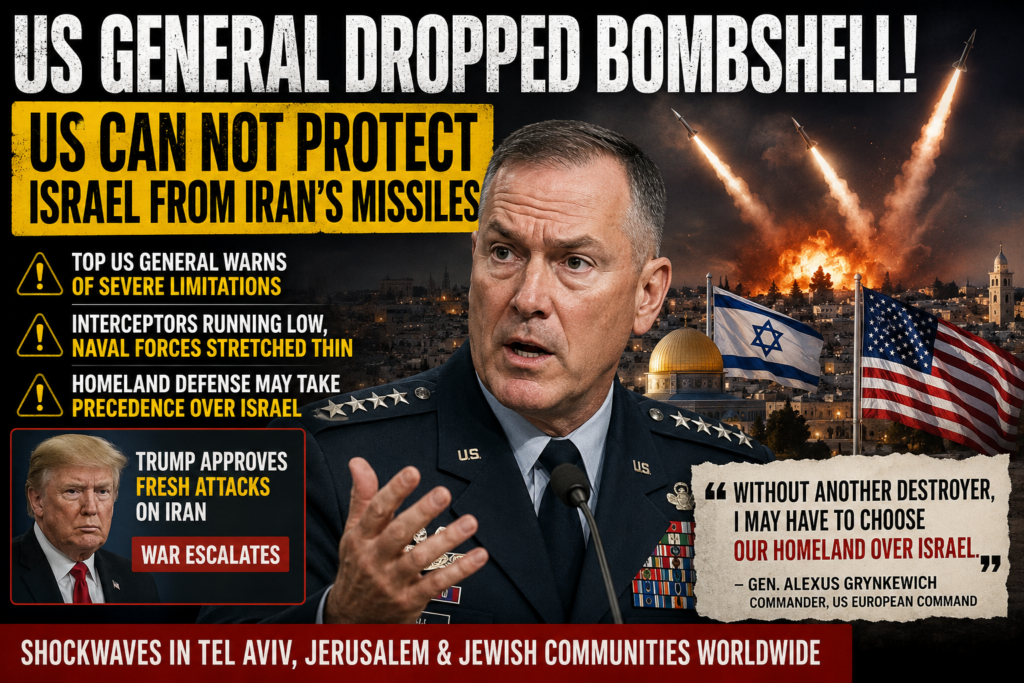
- U.S. limitations protecting Israel have triggered shockwaves in Tel Aviv, Jerusalem, and Jewish communities worldwide
- A senior U.S. general warned of critical shortages in naval assets and missile interceptors
- Trump’s approval of fresh strikes on Iran has intensified pressure on already overstretched U.S. forces
There are moments in geopolitics when the illusion of control quietly collapses—not with explosions, but with words spoken behind closed doors. This week, one such moment unfolded in Washington, where a senior U.S. general delivered a warning so stark that officials in the room were left, by one account, “visibly shaken.”
The message was simple, but devastating in its implications: the United States may no longer be able to fully shield Israel from Iran’s missiles.
In the language now circulating through defense circles, the phrase is unavoidable—U.S. limitations protecting Israel.
Is Israel Helpless? A Disclosure That Shook Allies
The disclosure came on the heels of President Donald Trump’s decision to authorize fresh strikes on Iran, a move that has reignited one of the most volatile phases of the five-month conflict. As American warships tightened their presence across the Mediterranean and Arabian Sea, and as Iranian missile launches resumed with renewed intensity, the expectation in Israel was clear: the United States would hold the line.
Instead, what emerged was a far more fragile reality.
According to officials familiar with the matter, the commander responsible for U.S. military operations in Europe warned the Pentagon that without additional naval reinforcements—specifically another missile-capable destroyer—he may soon be forced to prioritize the defense of the U.S. homeland over Israel.
The room, a source said, fell silent.
Within hours of the warning filtering into policy and media channels, the impact was felt far beyond Washington. In Tel Aviv, security officials began urgent consultations. In Jerusalem, political leaders sought immediate reassurances. Across Jewish communities worldwide, the disclosure reverberated as a profound psychological shock.
READ NEXT: Trump Approves US Strike on Iran in Major Escalation
For decades, the assumption of American protection had been foundational. Now, U.S. limitations protecting Israel were no longer hypothetical—they were operational.
The Mechanics of a Strained Shield
Israel’s missile defense system is often described as among the most advanced in the world. Yet what is less frequently acknowledged is the extent to which it relies on American support.
U.S. naval destroyers stationed in the eastern Mediterranean serve as a critical outer layer of defense. Equipped with advanced radar systems and interceptor missiles, these vessels have quietly intercepted threats long before they could reach Israeli skies. High-altitude defense systems, deployed by the United States, add another layer—one that has proven essential against Iran’s increasingly sophisticated ballistic arsenal.
But systems, no matter how advanced, depend on supply.
And supply is running thin.
The Iran war has evolved into a war of attrition—one measured not just in territory or casualties, but in interceptors fired, ships deployed, and maintenance cycles deferred. American forces have been intercepting missiles at a pace that planners did not anticipate. Naval assets are being stretched across multiple theaters. Equipment is aging faster than it can be repaired.
READ MORE: U.S. general warns Pentagon he lacks sufficient forces to protect Israel
The result is an uncomfortable truth: U.S. limitations protecting Israel are emerging as a defining feature of the conflict.
A Military Stretched Across the Map
The challenge is not confined to Israel. The same command responsible for coordinating missile defense in the Mediterranean must also remain vigilant against potential Russian threats in Europe. NATO commitments cannot simply be paused. Strategic deterrence must be maintained.
At the same time, U.S. forces are deeply engaged in the waters surrounding Iran. The Trump administration’s blockade of Iranian ports—implemented after Tehran’s closure of the Strait of Hormuz—has drawn additional naval assets into the Arabian Sea. Aircraft carriers, destroyers, and support ships are now tasked with enforcing maritime security, protecting global shipping lanes, and deterring escalation.
Each mission draws from the same finite pool of resources.
Each mission reinforces the same reality: U.S. limitations protecting Israel are inseparable from the broader strain on American military power.
Shockwaves in Tel Aviv and Beyond
In Israel, the psychological impact of the disclosure has been profound. The idea that the United States might one day be forced to choose between defending its own homeland and protecting Israel strikes at the core of the strategic partnership between the two nations.
In Tel Aviv, where daily life continues under the shadow of missile alerts, the news has intensified a sense of vulnerability. In Jerusalem, officials are grappling with the implications for long-term defense planning.
But the shock has not been confined to Israel. Jewish communities around the world—particularly in North America and Europe—have reacted with alarm. For many, the notion of U.S. limitations protecting Israel challenges deeply held assumptions about security and alliance.
The Cost of Sustained War
Beyond the battlefield, the war is exacting a heavy economic toll. The disruption of shipping through the Strait of Hormuz has rattled global markets, driving up energy prices and straining supply chains. In the United States, the financial burden of sustained military operations is becoming increasingly difficult to ignore.
Billions of dollars are being spent on deployments, munitions, and logistics. Lawmakers from both parties are questioning the long-term sustainability of the war. Public support is showing signs of fatigue.
And as the costs mount, so too does the pressure to confront the reality of U.S. limitations protecting Israel.
A Strategic Inflection Point
What makes this moment particularly significant is not just the warning itself, but what it represents: a shift in the strategic landscape.
For years, American military dominance allowed policymakers to assume that multiple commitments could be sustained simultaneously. That assumption is now under strain. The Iran war has exposed the limits of even the most powerful military in the world.
Several paths now lie ahead.
Washington could surge additional resources, reinforcing its commitment to Israel while risking further overstretch. It could push for renewed diplomacy, seeking to de-escalate a conflict that is consuming resources at an unsustainable rate. Or it could recalibrate its priorities, placing greater emphasis on homeland defense.
Each option is shaped by the same underlying constraint: U.S. limitations protecting Israel.
The Flicker Before the Shift
Wars often reveal truths that peacetime obscures. In this case, the truth is not that the United States cannot defend Israel—but that its ability to do so is not unlimited.
The general’s warning did not signal an immediate collapse of defenses. The ships are still at sea. The interceptors are still being launched. The alliance remains intact.
But something has changed.
The certainty has given way to calculation. The assumption has given way to contingency.
And in that shift, the phrase that once seemed unthinkable now defines the moment: U.S. limitations protecting Israel.