


- Exclusive Investigative Insights: Unveils leaked subcontracts and photographic evidence linking major Israeli defense systems manufacturers to Qatar and Saudi Arabia.
- Geopolitical Threat Response: Details how these covert defense acquisitions were accelerated following Iran’s aggressive regional drone and missile attacks.
- Advanced Military Capabilities: Breaks down the tactical integration of high-tech hardware, including Elbit’s C-MUSIC laser jamming systems and JHMCS pilot helmets.
- Future Security Forecasts: Examines the shifting regional dynamics and the emergence of a decentralized, technology-led defensive alliance in the Middle East.
In a significant revelation highlighting shifting dynamics in the Middle East, Qatar and Saudi Arabia have acquired highly sophisticated defense technology from Israel to empower and bolster their national defense capabilities. The acquisition marks a quiet but substantial evolution in regional security alignment.
According to an investigative report published by Haaretz, public documents and open-source analysis of images have exposed multimillion-dollar subcontracts and equipment installations linking major Israeli defense manufacturers directly to the military hardware deployed by Riyadh and Doha.
This advanced technology was acquired following Iran’s unjustifiable attacks on Qatar, Iran, Saudi Arabia, the UAE, and other nations across the Middle East. As Tehran escalated its regional assertiveness through drone warfare, ballistic missile capabilities, and proxy aggression, the Gulf states found themselves facing unprecedented threats to their sovereignty, critical infrastructure, and airspace.
Read More: Delegation from Iran arrives in Saudi Arabia
The necessity to counter these evolving aerial threats drove an urgent demand for top-tier defense innovations, compelling the procurement of battle-tested Israeli technologies despite the lack of formal diplomatic relations.
The Acquired Equipment and Technical Specifications
The Haaretz report details the specific high-tech components integrated into the military and royal fleets of both Gulf nations. The equipment primarily focuses on specialized electronic warfare, active protection systems, and advanced pilot interfaces.
Out of the Qatari royal family’s fleet of eleven aircraft, three have been fitted with Elbit Systems’ C-MUSIC (Commercial Multi-Spectral Infrared Countermeasures) air defense system. Publicly available photographs analyzed in the report reveal that these pods were installed between 2020 and 2022 during scheduled aircraft maintenance in Basel, Switzerland. C-MUSIC is an advanced laser-based system designed to protect aircraft against shoulder-fired surface-to-air missiles (MANPADS) by jamming their optical tracking systems.
Must Read: Advanced Israeli Systems Sold to Qatar and Saudi Arabia, Documents and Photographs Reveal
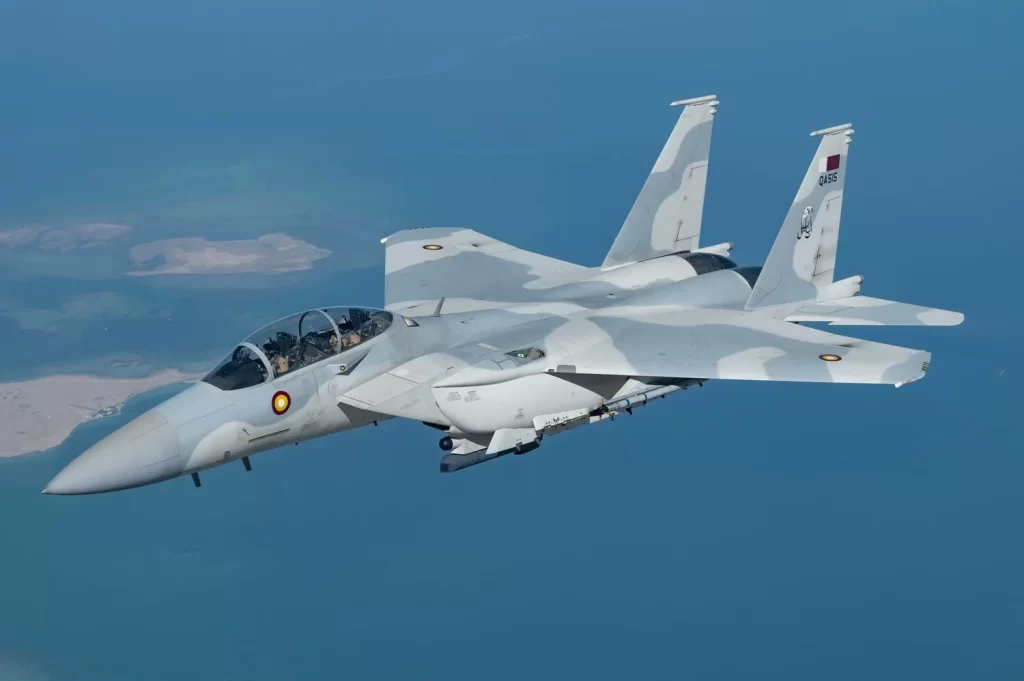
Furthermore, procurement documents traced back to a 2017 U.S.-Qatar agreement for F-15QA Ababil fighter jets show that Israeli defense firms successfully won tenders for subcontracts valued between $150 million and $250 million. Through these U.S.-brokered contracts, Qatar supplied its air force with 160 Joint Helmet Mounted Cueing Systems (JHMCS) and AN/AVS-9 night vision goggles. The JHMCS helmets, valued at approximately $200,000 each, allow pilots to aim onboard weapons simply by looking at the target.
Saudi Arabia acquired identical capabilities through parallel channels. The report cites a 2010 U.S. Department of Defense statement indicating that a Boeing contract to sell F-15SA jets to Riyadh included 462 JHMCS helmets and 462 AN/AVS-9 night vision glasses manufactured by Israeli firms. Open-source video footage and official imagery confirm that Saudi pilots are actively utilizing these helmets today.
Significance and Strategic Effectiveness
The integration of these specific technologies holds immense tactical significance for the defense infrastructure of Saudi Arabia and Qatar. In an era where asymmetrical warfare dominates the Middle East—characterized by drone swarms and high-speed missile strikes—the speed of engagement is critical.
The JHMCS computerized battle helmet significantly enhances pilot lethality and situational awareness. By projecting critical flight data, targeting cues, and threat assessments directly onto the helmet visor, it reduces the pilot’s cognitive workload and allows for instantaneous weapon locks during high-G aerial maneuvers. This capability is exceptionally effective for intercepting low-flying drones and cruise missiles, threats that Saudi Arabia and its neighbors have repeatedly faced.
Similarly, Elbit’s C-MUSIC system represents the pinnacle of active aviation protection. By detecting incoming thermal signatures of missiles and instantly directing a disruptive laser beam to blind the missile’s seeker head, it ensures absolute protection for high-value transport and state aircraft without requiring manual pilot intervention. Its effectiveness has given Gulf leadership a crucial shield against non-state actors equipped with proliferation-prone anti-aircraft weaponry.
Forecasting Regional Security Alignment
The revelation of these defense contracts provides a window into the future of Middle Eastern security frameworks. While overt normalization between Israel and certain Gulf states remains complex, the pragmatic realities of a shared threat environment are driving an undeclared, technology-led defensive alignment.
Looking forward, the regional security architecture is expected to rely heavily on decentralized integration. While formal “Middle East NATO” frameworks may face political hurdles, the technical interoperability of air defense systems, subcomponents, and radar networks is already taking shape. Facing the persistent shadow of Iranian missile hegemony, Gulf nations will likely continue seeking out premier defensive tech, regardless of its origin. This technological convergence indicates that future stability in the region will increasingly be secured through shared, highly advanced defense ecosystems that transcend traditional diplomatic boundaries.