


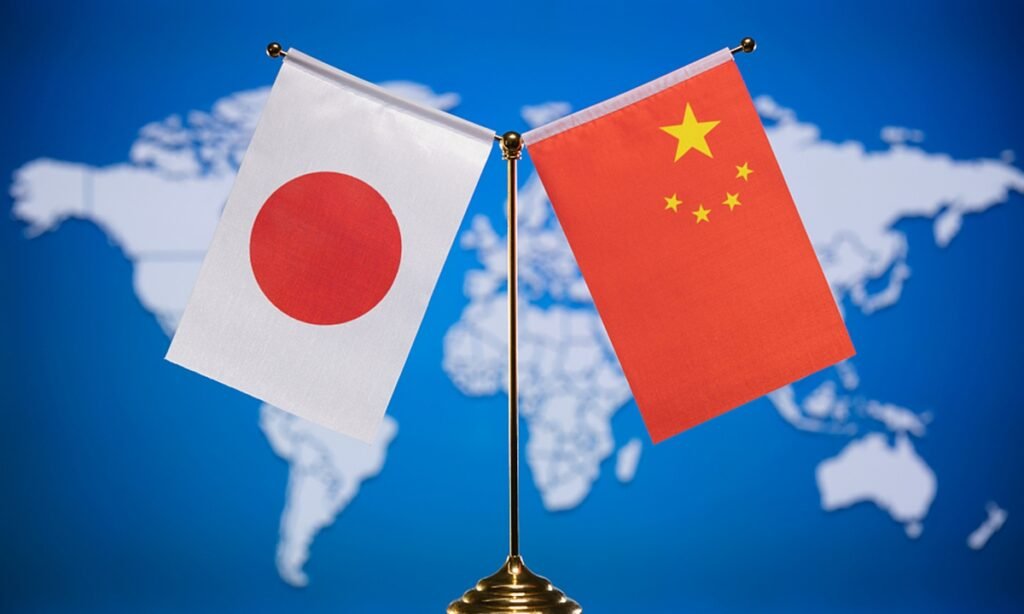
- Japan-China Tensions: The Tension over Taiwan have escalated into a multidimensional crisis, involving military deployments, diplomatic retaliation, economic pressure, and psychological warfare.
- Beijing’s stance is uncompromising: Taiwan is an inseparable part of China, and any Japanese involvement would directly challenge the One-China Policy supported by China’s global partners.
- Japan’s strategic shift—from ambiguity to assertiveness—marks its most dramatic security reorientation in decades, driven by proximity to Taiwan, PLA militarization, and U.S. alliance expectations.
- With military build-ups in the Taiwan Strait and the South China Sea, the possibility of miscalculation between Asia’s two largest powers poses a grave threat to global supply chains, energy routes, and Indo-Pacific stability.
Asia’s two great powers—China and Japan—are hurtling toward a collision that could fundamentally transform the strategic landscape of the Asia-Pacific. What began as a diplomatic spat is now accelerating into a multi-front crisis involving military build-up, strategic posturing, economic retaliation, and ideological confrontation. The flashpoint is the same as it has been for decades, but with new intensity: Taiwan, which Beijing regards as an inseparable part of China, not merely a territorial claim.
What makes the current confrontation dangerous is Japan’s unmistakable shift from strategic ambiguity to strategic activism. Prime Minister Sanae Takaichi has openly declared that a Chinese attack on Taiwan could trigger Japanese military involvement, effectively signaling a departure from Japan’s decades-old cautious approach.
Beijing responded with fury, describing Tokyo’s comments and missile deployments as a deliberate attempt to create “regional tension” and “provoke military confrontation.” For Chinese policymakers, Japan’s new posture represents not just interference—but a direct crossing of China’s sovereignty red lines.
Japan China Taiwan Tensions: Alarming Consequences of Takaichi’s Provocative Remarks
Diplomats in Washington, London, Paris, New York, and Brussels are following the situation with growing alarm. Inside the UN, analysts are quietly modeling scenarios should Japan and China—Asia’s largest economies—miscalculate their way into a conflict neither side wants, yet both are preparing for.
A New Crisis: Missiles, Militarization, and Psychological Warfare
The latest escalation began when Japan announced plans to deploy a medium-range surface-to-air missile unit on Yonaguni, an island just 110 km from Taiwan’s east coast. To Japan, this is defensive. To China, it is a “dangerous provocation.”
READ MORE: China criticises Japan’s plan to deploy missiles on island near Taiwan
Chinese foreign ministry spokesperson Mao Ning accused “right-wing forces in Japan” of steering the region toward disaster. Beijing reacted with a coordinated set of diplomatic and economic countermeasures:
- A national travel advisory urging Chinese citizens to avoid Japan
- A ban on Japanese seafood imports
- A halt to Japanese film releases in mainland China
- Increased Chinese military and coast guard patrols near the disputed Senkaku/Diaoyu Islands
Japan’s defense minister Shinjiro Koizumi defended the deployment, claiming it lowers the risk of conflict by strengthening deterrence. Taiwan, meanwhile, welcomed the move, with Deputy Foreign Minister Francois Wu calling it “helpful to the security of the Taiwan Strait.”
This alignment between Tokyo and Taipei is precisely what Beijing fears most.
PLA Signaling Intensifies — “If War Breaks Out Today…”
In response, China unleashed a wave of high-intensity military propaganda videos across platforms linked to the People’s Liberation Army (PLA). The messaging was not subtle.
ALSO READ: China–Japan Tensions Spike Over Taiwan: Asia Faces Potential Crisis
The PLA Rocket Force, which oversees China’s nuclear and conventional missile arsenal, released a chilling music-backed montage showcasing:
- ICBMs capable of carrying nuclear warheads
- Rocket brigades preparing for rapid launch
- Soldiers loading rifles and chanting,
“If war breaks out today, this is my response!” - The PLA Navy’s South Sea Fleet posted videos with soldiers declaring:
“Artillery calibrated. Ammunition ready. Coordinates locked.”
In another clip, the North Sea Fleet showed warships launching missiles in fiery salvos, accompanied by the line:
“Come, enemy—let’s have a showdown.”
This is classic Chinese military signaling: a fusion of propaganda and deterrence designed to demonstrate resolve without crossing into outright mobilization.
China’s Military Might: A Warning Tokyo Cannot Ignore
China’s military power today is not what it was a decade ago. The PLA has become a modernized, lethal, and regionally dominant force, backed by a defense budget second only to the United States.
The Modern PLA: A Snapshot of Power
- The world’s largest standing army
- A rapidly expanding blue-water navy, now the world’s largest by number of vessels
- The DF-17 hypersonic missile, designed to penetrate enemy missile shields
- The DF-21D “carrier killer,” specifically built to target U.S. and Japanese naval groups
- Fifth-generation fighter jets such as the J-20 Mighty Dragon
- A vast drone fleet, including the Wing Loong and WZ-8 high-altitude reconnaissance UAVs
- The Rocket Force’s arsenal of short-, medium-, and long-range missiles aimed at Taiwan and surrounding waters
When China holds military parades in Beijing—such as the colossal 2019 National Day parade—the message is unmistakable: China’s military rise is unstoppable, disciplined, and ready.
And central to all this is Taiwan, the core of China’s core interests.
Why China Will Never Compromise on Taiwan
For Beijing, Taiwan is non-negotiable. It is not merely a strategic priority—it is a political and civilizational imperative.
China’s position is consistent and absolute:
- Taiwan is an inseparable part of China.
- The One-China Policy is sacrosanct.
- No foreign power, including Japan, has the right to interfere.
- China’s closest partners—from Pakistan to Russia, Saudi Arabia to the UAE, and many African and Asian states—recognize and support the One-China Policy. They see Taiwan as exclusively China’s internal affair.
For Beijing, Japan’s remarks represent a threat not only to regional stability but to China’s national unity and territorial integrity.
Any misstep by Japan—intentional or otherwise—will test China’s resolve and military capabilities.
Military Tensions in the South China Sea Add Fuel to the Fire
Meanwhile, the South China Sea remains one of the most militarized zones in the world, with China fortifying its positions at an unprecedented pace.
China’s Military Expansion in the South China Sea
- Construction of fortified airbases on Fiery Cross, Subi, and Mischief Reefs
- Deployment of anti-ship and surface-to-air missiles
- Runways capable of hosting H-6 bombers and J-11 fighters
- Permanent PLA garrisons
- Radar installations covering vast maritime areas
- A powerful maritime militia patrolling contested zones
- This military architecture allows China to project power deep into Southeast Asia—and closer to Japan’s southern flank.
Any conflict involving Japan and China over Taiwan would inevitably drag in the South China Sea, turning it into a second active theater.
Japan’s Strategic Shift: Why Tokyo Is Taking a Harder Line
Japan’s assertiveness is shaped by:
- China’s growing military presence near Japanese waters
- Repeated PLA incursions around the Senkaku Islands
- Taiwan’s geographic proximity to Japanese territory
- Pressure from Washington to take a more active regional role
- The rise of the conservative LDP faction led by Takaichi
- To Tokyo, Taiwan’s security is inseparable from Japan’s own. If Taiwan falls, Japan’s western islands become the frontline.
A Collision Both Sides Fear—but May Be Unable to Avoid
The consequences of a Japan–China conflict would be devastating:
- Disruption of semiconductor supply chains
- Global market instability
- Shocks to energy shipments through East Asian sea lanes
- U.S.–China confrontation
- Polarization of ASEAN states
- Potential collapse of regional trade frameworks
Even a brief clash—accidental or intentional—could ignite a crisis far greater than either side anticipates.
A Crisis the World Cannot Ignore
China and Japan are on a dangerous trajectory. Japan’s newfound assertiveness, China’s uncompromising insistence on reunification, and Taiwan’s centrality to the Indo-Pacific balance make this a crisis of global significance.
The Asia-Pacific stands at a turning point.
What happens between China and Japan in the coming months could determine the region’s stability for decades.
The world must pay attention—because the cost of miscalculation would be catastrophic.