


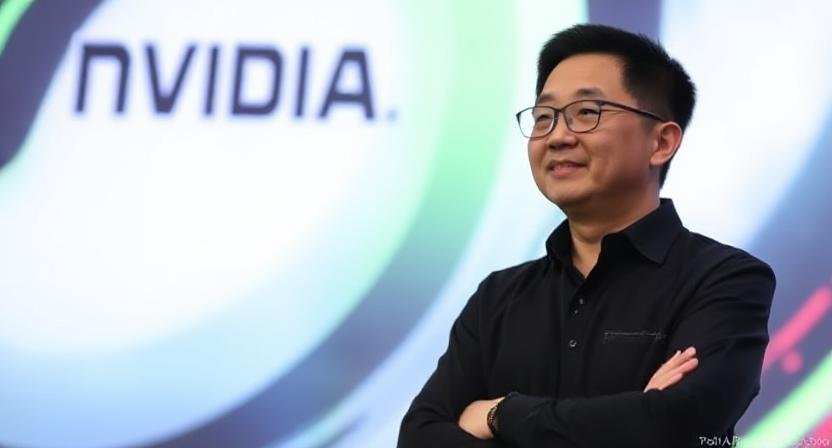
- Jensen Huang faces growing pressure as he navigates Nvidia’s future between the competing interests of Trump and China.
- The White House meeting places Jensen Huang at the heart of U.S. tech diplomacy amid rising export restrictions.
- Jensen Huang plans to offer a scaled-down AI chip to China to balance regulatory compliance with market survival.
- The delicate position of Jensen Huang could make him a strategic pawn in Trump’s renewed high-stakes game with Beijing.
As the shimmering lights of Wall Street celebrated Nvidia’s meteoric rise to a $4 trillion valuation, its CEO, Jensen Huang, quietly prepared for two of the most consequential meetings of his career—one in Washington, the other in Beijing.
Caught between the twin forces of Donald Trump’s renewed White House ambitions and the ever-tightening grip of Beijing’s tech nationalism, Huang now finds himself at the center of a geopolitical contest that could redefine the future of artificial intelligence, global supply chains, and the semiconductor industry itself.
The question many are asking in hushed tones: Is Jensen Huang becoming Donald Trump’s latest bargaining chip in America’s escalating tech war with China?
Jensen Huang & Trump: A Meeting Steeped in Strategy
On Thursday, Huang is set to meet President Trump at the White House—a rare, high-profile audience with a president whose past decisions still haunt Nvidia’s bottom line. The next day, he will fly to China to attend the International Supply Chain Expo in Beijing, where he’s expected to meet with senior Chinese leaders including Premier Li Qiang and Vice-Premier He Lifeng.
Rubio Conveys Trump’s Frustration to Russia Over Ukraine War Escalation
At stake is not just Nvidia’s access to China’s $17 billion chip market but also its role as the crown jewel of America’s AI dominance. The timing is no coincidence: Trump’s team is reportedly drafting new export restrictions targeting chip shipments through Southeast Asia—an attempt to choke off any backdoor access to sensitive AI technologies for Chinese buyers.
Against this backdrop, Huang’s dual visits are more than business trips—they’re diplomatic missions, conducted in the language of silicon wafers and circuit boards.
Nvidia: The World’s Hottest Stock with Global Headaches
Nvidia’s ascendancy has been nothing short of spectacular. From gaming graphics to the engines of the AI revolution, the company has become Wall Street’s darling and a linchpin of Western tech supremacy. Yet China, accounting for approximately 13% of Nvidia’s sales, remains both a lucrative market and a geopolitical minefield.
The AI chip Nvidia is now preparing for China—based on its powerful RTX Pro 6000 Blackwell architecture—will be stripped of advanced features to comply with U.S. export controls originally implemented during Trump’s first presidency. It is a careful, calculated compromise designed to stay within the letter of the law while preserving what remains of Nvidia’s China business.
But this is no ordinary commercial decision. It is a move heavy with geopolitical significance.
Trump’s Return: Bargaining with Silicon
The Trump administration’s early AI chip restrictions, followed by Biden’s tougher measures, have only fueled China’s drive for semiconductor self-sufficiency. As Nvidia’s H20 chips were banned earlier this year, the company lost billions. Chinese tech giants—Alibaba, ByteDance, Tencent—are now actively diversifying their chip supply, increasingly turning to domestic alternatives.
READ MORE: “It Wasn’t Me”: AI Imposter Posing as U.S. Secretary of State Rubio Shakes the Trump Administration and Stuns Global Capitals
For Trump, however, this escalating tech war presents a strategic opening.
By holding Nvidia’s market access to China hostage, Trump may seek to pressure Beijing on unrelated fronts: trade deficits, intellectual property theft, or Taiwan. It’s a page from his well-worn playbook of using economic leverage to extract geopolitical concessions.
“There’s every possibility Trump sees Jensen Huang as both a symbol of American tech leadership and a pawn in a much larger strategic chess game,” says Dr. Matthew Krane, a technology policy expert at the Carnegie Endowment for International Peace. “If Trump can dictate how and where Nvidia operates, he amplifies American influence not just over China, but over the entire AI ecosystem.”
Can Huang Walk the Tightrope?
Huang’s trip to China isn’t just about chips—it’s about survival.
In public, he has been candid in his criticism of U.S. restrictions. In May, he called Biden’s export curbs a “failure,” warning that such policies only strengthen China’s homegrown chipmakers, particularly giants like Huawei. Yet he cannot afford to alienate Washington, especially when Trump—who views technological supremacy as central to U.S. national security—has returned to the Oval Office with an even sharper anti-China stance.
ALAO READ: Nvidia CEO Jensen Huang plans Beijing trip amid AI-chip tensions
This is the diplomatic tightrope Huang must now walk: demonstrating Nvidia’s commitment to American interests while persuading Chinese officials that his company remains a reliable partner in the AI race.
His upcoming China visit, where he is expected to unveil plans for the scaled-down AI chip, is not just a market signal—it’s a geopolitical gesture. Huang is betting that by offering a “good enough” chip that complies with Washington’s rules, Nvidia can maintain its Chinese market share while sidestepping accusations of undermining U.S. strategic goals.
But the risks are enormous.
The Shadow of Decoupling
China’s ambition to decouple from U.S. tech has gathered pace. The nation is pouring billions into domestic semiconductor R&D, with companies like SMIC and Huawei accelerating chip innovation. The recent blacklisting of Huawei in Taiwan underscores how geopolitical flashpoints can instantly disrupt tech supply chains.
Even if Nvidia’s downgraded chip is accepted by Beijing, the broader trend is clear: China wants out from under the shadow of U.S. tech dependence. And for Trump, ensuring that Beijing doesn’t catch up technologically has become a key policy objective.
This places Huang in an unenviable position: maintain access to China’s AI sector without crossing a White House increasingly willing to weaponize export controls.
The Art of the Deal—or the Trap?
For Donald Trump, leveraging American tech giants has always been part of “The Art of the Deal.” From pressuring Apple over encryption to threatening tariffs on European digital companies, Trump views corporate power as an extension of state power.
With Nvidia now the undisputed leader in AI hardware—a field seen as critical to everything from national security to global economic competitiveness—Trump may well see Huang’s position as an opportunity to tighten the screws on Beijing.
“Jensen Huang may think he’s negotiating chip sales, but in Trump’s mind, this is about the global balance of power,” says former National Security Council official Lisa Carter. “The question is whether Huang will play along—or be played.”
Conclusion: A High-Wire Act with Global Stakes
As Jensen Huang shuttles between Washington and Beijing, he embodies the new reality of global tech leadership: business decisions are no longer just about markets, but about power, influence, and geopolitics.
For Trump, the Nvidia CEO could become both a symbol of American innovation and a pressure point in the wider U.S.-China rivalry. For Beijing, Huang’s visit may be the last chance to keep open a channel to the cutting-edge technology it desperately needs.
Whether Nvidia can continue to straddle this geopolitical divide—or whether Huang will be forced to choose sides—remains to be seen. But one thing is clear: in the new Cold War of chips and AI, even the world’s most valuable companies are no longer masters of their own destiny.