


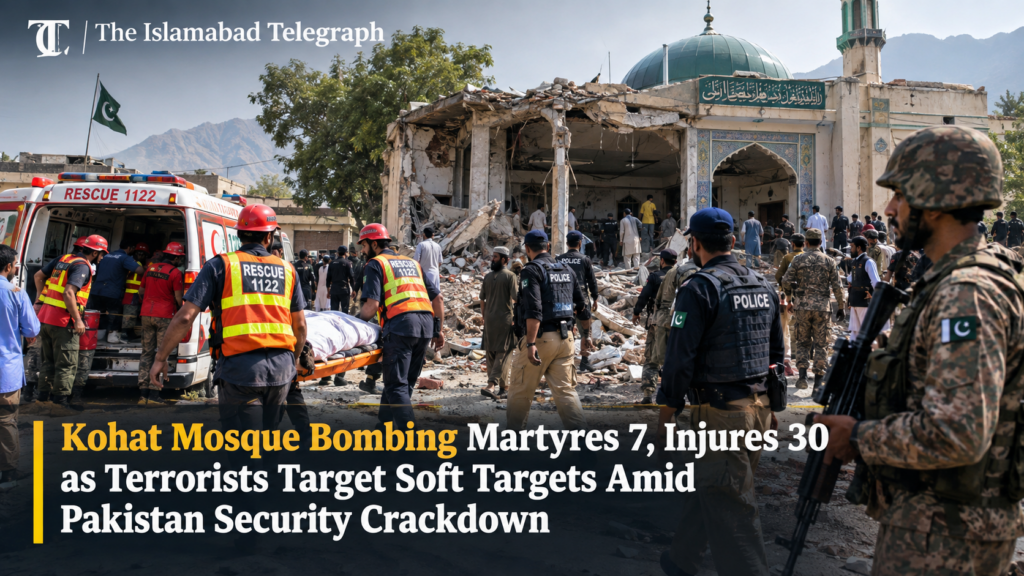
- Kohat mosque attack martyred fifteen worshippers and injured more than 50 people inside the Kohat Police Lines.
- Pakistan’s security forces have intensified counterterrorism operations across Khyber Pakhtunkhwa and Balochistan, killing hundreds of militants.
- Terrorists are increasingly targeting mosques and other soft targets as sensitive security installations and militant hideouts come under sustained pressure.
PESHAWAR: At least fifteen worshippers were martyred and more than 50 people injured when an explosion struck a mosque inside the Kohat Police Lines in Khyber Pakhtunkhwa on Friday, underscoring the changing tactics of terrorist groups operating against Pakistan.
The blast occurred near Old Police Lines during Friday prayer. Rescue teams transported dead bodies and more injured people to hospitals, while residents, police and rescuers dug through rubble to pull survivors to safety. The mosque roof and wall were badly damaged.
Initial reports indicated that an explosive-laden vehicle may have been rammed into the Old Police Lines, although authorities said the exact nature of the explosion was still being determined. An exchange of fire with armed terrorists reportedly followed the blast, suggesting that the attack was part of a wider assault rather than an isolated explosion.
READ MORE: Iran War Cost to Americans Surpasses $107 Billion as Oil Shock Hits Households
The attack has a historical echo for Kohat. In September 2010, a remote-controlled bomb exploded inside a police colony located behind the Kohat Police Lines, killing at least 20 people, mostly relatives of policemen, and injuring more than 90. That attack was similarly designed to strike a relatively vulnerable population close to a security installation.

The latest bombing comes against the backdrop of an intense nationwide counterterrorism campaign. Pakistan’s armed forces, police and other law-enforcement agencies have conducted tens of thousands of operations this year, placing militant networks under sustained pressure in Khyber Pakhtunkhwa, Balochistan and other parts of the country.
According to figures presented by the military in July, security forces had conducted more than 40,000 counterterrorism operations in 2026 and killed 2,084 militants. More than 31,000 of those operations were carried out in Balochistan, while more than 7,000 were conducted in Khyber Pakhtunkhwa. The scale of the campaign reflects the security establishment’s effort to dismantle militant networks rather than simply respond to individual attacks.
READ MORE: Bombing at mosque near police offices in Pakistan kills at least 7 and wounds more than 30
The figures from individual operations reinforce that picture. In late July, security forces killed 32 militants in operations in Khyber district and Nushki. In August, another 49 militants were killed in intelligence-based operations across several districts of Khyber Pakhtunkhwa and Balochistan, according to the Inter-Services Public Relations. Earlier in the year, dozens more militants were eliminated in intelligence-driven raids targeting hideouts, infiltration routes and operational networks.

This sustained pressure may help explain why terrorists are increasingly seeking softer and more accessible targets. Heavily protected military installations, police headquarters, strategic infrastructure and sensitive territories are considerably harder to penetrate. Mosques, markets, transport hubs and other public spaces, by contrast, are open to ordinary citizens and difficult to seal without disrupting daily life.
The Kohat attack therefore appears less like a demonstration of terrorist strength than an attempt to create fear by exploiting the openness of Pakistani society. Targeting worshippers is also intended to inflict psychological damage far beyond the immediate casualties. Terrorists seek to make ordinary Pakistanis believe that nowhere is safe, even while security forces are steadily narrowing the space available to armed groups.
That challenge requires a response that combines force with vigilance. Security forces must continue intelligence-based operations against militant commanders, facilitators, financiers and weapons networks, while police and communities must strengthen protection around vulnerable public locations.
Pakistan’s security forces have already demonstrated their ability to pursue militants across difficult terrain. From Balochistan’s vast districts to the former tribal areas and settled districts of Khyber Pakhtunkhwa, soldiers, police and intelligence personnel have repeatedly conducted operations against armed groups. Hundreds of militants have been killed in these campaigns, while weapons, explosives and improvised explosive devices have been recovered.
The Kohat tragedy will therefore test not Pakistan’s resolve, but the resilience of its counterterrorism system. The terrorists may still possess the ability to inflict pain, but their shift toward softer targets can also be read as evidence of the pressure created by sustained security operations.
For Pakistan, the immediate priority is clear: This is precisely the resilience terrorists are trying to break. protect citizens, rescue the wounded, identify every perpetrator and facilitator behind the Kohat bombing, and maintain pressure on militant networks across the country. The message from the security forces is equally clear: attacks on worshippers will not determine Pakistan’s security future.