


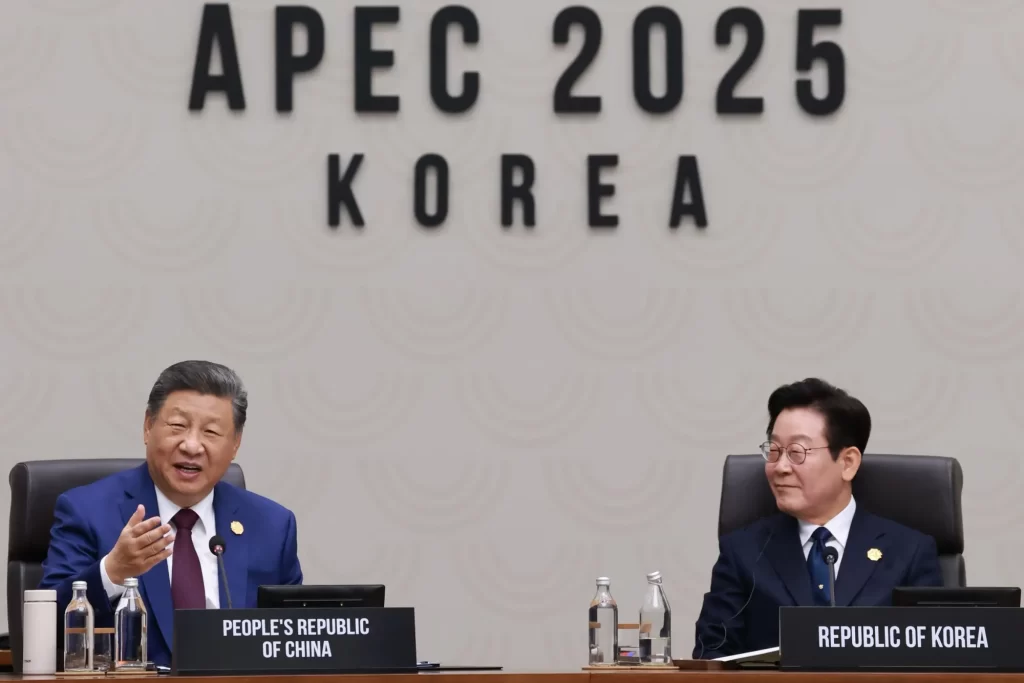
- Lee Jae-myung Xi Jinping Summit 2026: Historic Visit Timing: Lee Jae-myung’s January 4-7, 2026 state visit to China is the first by a sitting South Korean president since 2019, marking the second Xi-Lee meeting in months amid escalating China-Japan tensions over Taiwan.
- Economic Stakes High: Bilateral trade hit $328 billion in 2024; Xi likely to offer incentives in rare earths, AI (Huawei Ascend chips), and supply chains as China counters renewed Trump tariffs by targeting South Korean markets.
- North Korea Focus: Lee seeks Xi’s help to restart dialogue with Pyongyang, despite deepened China-North Korea ties and Kim Jong Un’s rejection of Seoul’s outreach.
- Balancing Act: Discussions may address US troop flexibility for Taiwan scenarios, testing Lee’s “restoration” of Beijing ties without straining the US alliance.
As South Korean President Lee Jae-myung prepares for his state visit to China from January 4-7, 2026—meeting Chinese President Xi Jinping in Beijing and Shanghai—the summit emerges as a pivotal moment in Northeast Asian geopolitics.
This marks the first state visit by a sitting South Korean leader to China since 2019 and their second encounter in mere months, following the November 2025 APEC meeting in Gyeongju. Amid rising Google searches for “Lee Jae-myung China visit 2026,” “Xi Jinping South Korea summit,” and related terms like “Trump tariffs China impact” and “Huawei AI chips Korea,” the talks highlight Seoul’s delicate balancing act between its U.S. alliance and economic ties with Beijing.Bilateral trade, a cornerstone of relations, reached around $300 billion annually in recent years, with China remaining South Korea’s top trading partner.
Seoul depends on China for nearly half its rare earth minerals—essential for semiconductors—while exporting a third of its chips to the Chinese market. Facing renewed Trump tariffs imposed in 2025 on Chinese goods, Beijing is aggressively diversifying exports, viewing South Korea as a key alternative market. Xi is expected to offer incentives in supply chains, green industries, and advanced technologies, including Huawei’s Ascend 950 AI chips rollout in South Korea in 2026 as a Nvidia alternative amid U.S. restrictions.The timing underscores strategic intent.
China-Japan tensions have escalated following Japanese Prime Minister Sanae Takaichi’s 2025 statements on potential military responses to Taiwan scenarios. Beijing’s invitation prioritizes Seoul before any Lee-Japan summit, aiming to counter U.S.-led alignments. Kang Jun-young, professor at Hankuk University of Foreign Studies, stated: “China wants to emphasize South Korea’s importance slightly more than before.
China appears to have strategically decided that it would be better to have (Lee) visit China before South Korea holds a summit with Japan again.”Security dialogues will address flashpoints. With 28,500 U.S. troops in South Korea and evolving alliance roles—including potential Taiwan contingencies as noted by U.S. Forces Korea Commander General Xavier Brunson—Lee seeks China’s constructive role on North Korea.
Pyongyang’s hawkish posture and deepened ties with Beijing (highlighted by Kim Jong Un’s 2025 parade appearance) complicate matters. Former vice defense minister Shin Beom-chul warns discussions may touch alliance modernization perceived as containing China.
A key question: Will Xi mediate inter-Korean warmth? Experts remain cautious, given China’s prioritization of its Pyongyang alliance.Cultural and tech cooperation adds optimism. Potential easing of China’s de facto K-pop ban since 2017—amid trending searches for “K-pop China comeback”—could boost exchanges, with SM Entertainment’s CEO joining Lee’s delegation.
AI partnerships align with global trends, as Google’s 2025 Year in Search highlighted Gemini and quantum computing spikes, reflecting AI’s dominance.Expert perspectives vary.
Gordon G. Chang cautions against Lee’s perceived pro-Beijing leanings, noting in posts:
“This framing places Beijing in a central coordinating role… rhetoric treats sanctions prohibitions as a technical transparency problem rather than a legal and strategic constraint.”
On the other hand, Zhan Debin of Shanghai University sees opportunities for “steady, incremental improvement” via economic complementarity.
Lee’s “restoration” of ties acknowledges interdependence while navigating U.S. pressures. Success could yield supply chain stability, AI collaborations, and North Korea progress; risks include alliance strains. As searches surge for “South Korea China relations 2026” and “Taiwan Japan tensions,” this summit tests pragmatic diplomacy in a multipolar Asia-Pacific, where economic leverage counters geopolitical containment.