


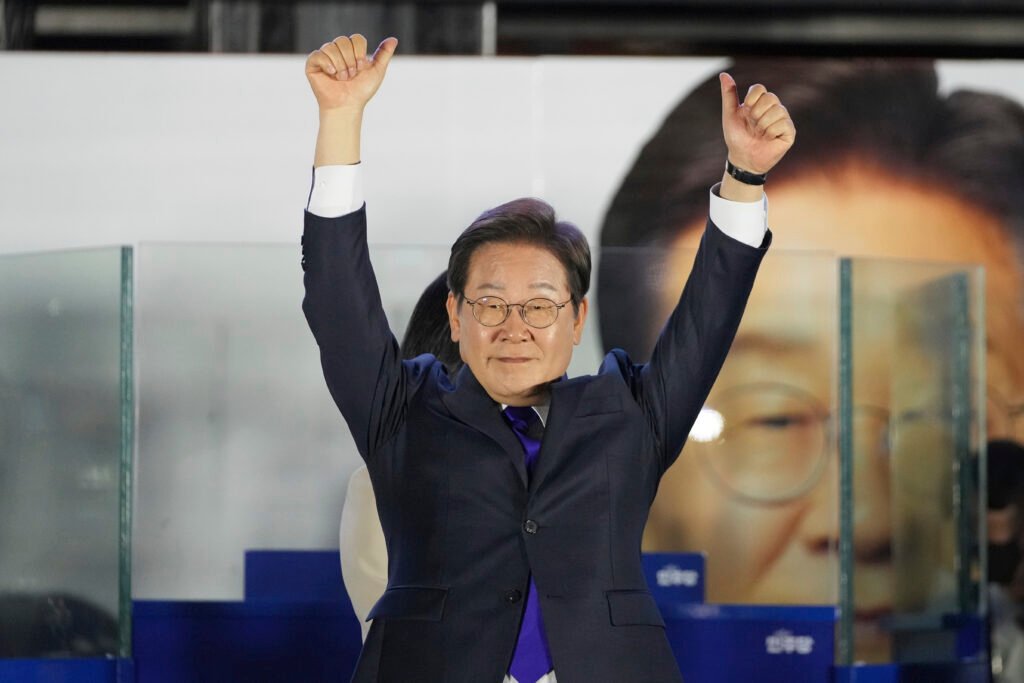
- Lee Jae-myung’s election signals a pivot to pragmatic diplomacy, balancing Seoul’s alliances with both the U.S. and China amid growing regional tension.
- Trade and security tensions with the Trump administration will test Lee’s negotiation skills, especially as tariffs on Korean exports increase.
- Lee promises dialogue with North Korea but faces a more aggressive Pyongyang, now emboldened by its alignment with Russia.
- Global reactions from the G8 are cautious but supportive, with most world leaders welcoming democratic stability but watching Lee’s next moves closely.
The election of Lee Jae-myung as South Korea’s new president is more than a domestic turning point. It carries profound consequences for the East Asian balance of power, the U.S.-South Korea alliance, and the future of diplomacy on the Korean Peninsula. With his liberal pedigree, pragmatic foreign policy stance, and firm legislative backing at home, Lee enters office at a moment of immense regional flux—and faces the daunting challenge of keeping Seoul strategically relevant between Washington and Beijing.
Lee’s landslide victory ends six months of political paralysis triggered by the impeachment and removal of his predecessor, Yoon Suk Yeol. Yoon’s attempt to declare martial law alienated broad swaths of the public and left South Korea in constitutional limbo. Lee’s mandate, forged amid turmoil, comes not only with expectations to restore stability but also to redefine Seoul’s global posture at a time of resurgent great-power rivalry and North Korea’s rising belligerence.
A Tightrope Between China and the U.S.
Lee Jae-myung is no ideologue. Unlike previous leaders from his Democratic Party who pursued engagement with North Korea at all costs, Lee has styled himself as a “foreign policy pragmatist.” His election signals an attempt to recalibrate Seoul’s role in the U.S.-China contest, which has intensified under the Trump administration’s second term.
Pakistan-India War: South Asia’s Dangerous Brinkmanship—and the Battle for the Global Narrative
His message is clear: South Korea will not become a pawn in Washington’s containment of China—nor will it fall under Beijing’s shadow. Lee’s balancing act reflects South Korea’s new reality: China remains Seoul’s largest trading partner, yet the U.S. is its irreplaceable security ally. Economic nationalism at home—embodied by Trump’s fresh round of tariffs on South Korean steel and autos—makes Lee’s diplomatic task all the more delicate.
Lee has already pledged to create a task force to navigate the looming trade war. Yet he has also sent signals of willingness to engage Washington seriously, even if begrudgingly. “I would even crawl under [Trump’s] legs if necessary,” he told a local broadcaster, underscoring his readiness to make deals while maintaining national dignity. Still, his deflection on whether South Korea would support the U.S. in defending Taiwan shows his caution in taking sides too quickly.
North Korea and the Peninsula Question
Lee’s critics wonder whether he will revive engagement with Pyongyang. His answer has been a measured yes. He has expressed interest in resuming dialogue with North Korea and seeking a breakthrough on denuclearization. But unlike previous liberal presidents who romanticized reunification, Lee recognizes the shifting sands.
READ MORE:Future of Korea-U.S. Relations Amid Leadership Crisis and Summit Uncertainty
North Korea’s leader, Kim Jong Un, has become more aggressive and isolationist. With closer ties to Russia and growing military confidence, Pyongyang no longer speaks of unification—it prepares for confrontation. In this context, Lee’s space for maneuver is limited. Diplomacy may still be an option, but its success now hinges less on Seoul’s overtures and more on North Korea’s interest—which appears minimal.
READ MORE:South Korea elects liberal president after chaotic six months
Experts like Mason Richey at Hankuk University rightly ask: “How do you talk to North Korea when North Korea doesn’t want to talk to you?” Lee may keep the door open, but whether anyone in Pyongyang is listening remains to be seen.
World Reaction: Quiet Watchfulness from the G8
World leaders, particularly in the G8, reacted to Lee’s election with cautious optimism. Japanese Prime Minister Fumio Kishida, who has worked to thaw icy ties with Seoul, expressed hope for continued trilateral cooperation with the U.S. and South Korea. President Donald Trump, however, remained characteristically terse, tweeting only, “We’ll talk. America First.” European leaders, including Germany’s Olaf Scholz and France’s Emmanuel Macron, emphasized democratic continuity and lauded South Korea’s peaceful transition of power.
China’s foreign ministry issued a congratulatory note that emphasized “mutual respect and non-interference,” a subtle dig at Yoon’s pro-American stance. Beijing views Lee’s presidency as an opportunity to rebuild damaged bilateral trust and push back against Washington’s encirclement strategy in Asia. Yet they, too, are wary of Lee’s unpredictability.
Russia offered no direct statement, but North Korean state media notably ignored Lee’s election altogether—a telling silence, given the warming ties between Pyongyang and Moscow.
The Road Ahead
Lee Jae-myung assumes office with high expectations but heavy burdens. The domestic economy is sluggish, polarization remains sharp, and Seoul’s role on the world stage is in flux. His vow to restore stability and pragmatism to Korean politics will be tested almost immediately—by Trump’s tariffs, by Pyongyang’s silence, and by Beijing’s overtures.
But Lee’s greatest test may lie in proving that a middle path is still viable in global affairs. In a world increasingly defined by zero-sum rivalry, can a mid-sized democracy like South Korea chart an independent course that balances economic realism with security commitments?
The Korean Peninsula has long been shaped by external powers. With Lee Jae-myung in charge, there is a chance—however slim—that Seoul might begin to shape the narrative itself.