


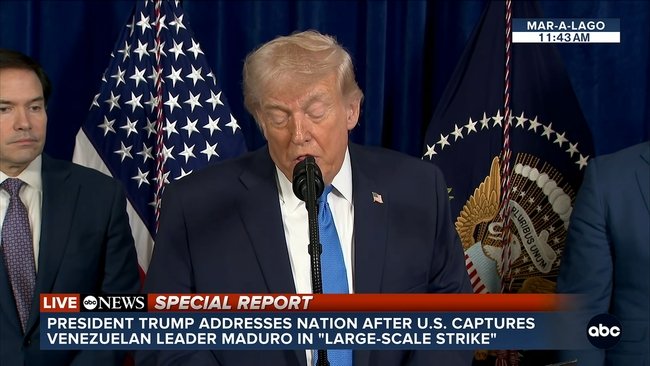
- Maduro captured alongside First Lady Cilia Flores during a 2:00 AM surgical strike in Caracas.
- President Donald Trump monitored the mission live from a secure Situation Room at Mar-a-Lago.
- The operation utilized CH-47 “Hook” helicopters and elite Delta Force operators to bypass Venezuelan radar.
- The former leader now faces federal narco-terrorism charges in the Southern District of New York.
The humidity of the Caribbean night hung heavy over the flight deck of the USS Iwo Jima as the massive rotors of the CH-47 Chinook—known to the crews simply as the “Hook”—began their rhythmic, chest-thumping thrum. It was 02:00 local time, January 3, 2026. The signal had just flashed from a deep-cover asset within the Venezuelan SEBIN: the target was at the Miraflores Palace, and the window was open.
The War Room: Mar-a-Lago
Thousands of miles away, in a secure, makeshift Situation Room at Mar-a-Lago, the atmosphere was electric. Donald Trump sat at the center of a semi-circle of monitors, flanked by Secretary of War Pete Hegseth and Secretary of State Marco Rubio. The room was bathed in the ghostly blue light of high-resolution feeds.
On the main screen, a grainy infrared feed showed the Chinooks lifting off from the carrier, ghostly shapes against the black ocean.
“This is it,” Trump murmured, his eyes locked on the screen. “The biggest show on earth. We’re going in.”
Venezuela Transition Plans: A New Era of Intervention: Analyzing the Capture of Nicolás Maduro
The Descent into Caracas
The Chinooks crossed the Venezuelan coast at low altitude, hugging the jagged terrain to avoid radar. Inside the lead bird, a Delta Force commander adjusted his night-vision goggles. His helmet camera was broadcasting live to Washington and Florida—a “kill-cam” perspective of history in the making.
“Three minutes to target,” the commander’s voice crackled over the secure link.
“You have the green light, Commander,” Trump’s voice came through, clear and authoritative. “Bring him home. Do it for the American people.”
Maduro brought to US to face charges as Trump vows to ‘run’ Venezuela and take control of oil reserves
As the palace came into view, the night exploded. Tracers from Venezuelan anti-aircraft batteries streaked across the sky like angry neon wasps. The Chinooks didn’t flinch. They hovered over the ornate roof of the Miraflores Palace, the downwash from the dual rotors shattering windows and sending debris flying.
The Siege of Miraflores
The first boots hit the roof at 02:15. The silence of the Caracas night was instantly replaced by the rhythmic pop-pop-pop of suppressed rifles. In the War Room, the feeds jumped and jittered as the soldiers sprinted toward the stairwells.
“Breaching now!”
A muffled explosion rocked the camera feed as a thermal charge blew the reinforced doors. The Delta team moved like a single organism, a lethal shadow flowing through the corridors. Maduro’s elite presidential guard, the “Casa Militar,” fought back with desperation. The halls of the palace became a kill zone. Muzzle flashes illuminated the ornate tapestries and gold-leafed furniture in staccato bursts.
“They’re in the living quarters,” Rubio whispered, leaning forward.
On the screen, a soldier’s point-of-view showed a heavy mahogany door. One kick, and they were inside. The camera panned rapidly—there, in the corner, stood a stunned Nicolás Maduro, clutching a robe, his wife Cilia Flores standing defiantly beside him.
“Target secured,” the commander barked. “We have the Big Man. And the First Lady.”
The Capture and the Flight
There was no time for ceremony. The Delta operators moved with brutal efficiency, zip-tying Maduro’s hands and fitting him with noise-canceling headphones and a blindfold. The “Hook” was still hovering, its rotors screaming as it held its position over the palace roof.
The extraction was a whirlwind of dust and adrenaline. As the soldiers hauled Maduro onto the ramp of the Chinook, the live feed showed the lights of Caracas flickering below—a city unaware that its leader had just been snatched from its heart.
Trump stood up in the War Room, a smirk playing on his lips. “Incredible. Just like I said. Faster than Bin Laden, and we didn’t even lose a helicopter.”
The Journey to New York
By the time the sun began to rise over the Atlantic, the operation was already transitioning from a raid to a legal procession. Maduro and Flores were transferred from the Chinook back to the Iwo Jima, and then onto a high-speed transport plane bound for the United States.
At 18:00 VET, the plane touched down at Stewart Air National Guard Base in New York. The world watched on live television as the man who had ruled Venezuela for over a decade was walked down the ramp in shackles, flanked by DEA agents.
The parallels to 2011 were unmistakable, yet the flavor was purely 2026. Where Obama had watched in somber silence, Trump had watched with the air of a producer overseeing a masterpiece. As Maduro was led into a black SUV to be taken to the Metropolitan Detention Center in Brooklyn, the “Mission Impossible” of the decade was complete. The “Strongman” was now a “Defendant,” and the lights of the New York skyline were the last thing he would see of the free world for a very long time.
In an unprecedented escalation of geopolitical tensions, former Venezuelan President Nicolás Maduro and First Lady Cilia Flores are currently in U.S. custody following a high-stakes predawn raid in Caracas. The couple was extracted by American forces and flown to New York, where they face federal indictments for narco-terrorism, weapons violations, and cocaine trafficking. Legal experts anticipate an initial court appearance this Monday, a landmark moment in international law involving the forced removal of a foreign head of state.
The operation was the culmination of months of meticulous intelligence gathering. Utilizing drone surveillance and high-level informants, the CIA developed a “pattern of life” profile that allowed U.S. special forces to strike with surgical precision.
US-Venezuela Oil Standoff 2026: Trump Blockade and Tanker Seizures Send Shockwaves Through Asia’s Energy Markets
President Donald Trump lauded the mission as the dismantling of a “narco-regime,” subsequently announcing that the U.S. would manage Venezuelan affairs indefinitely. Trump further suggested that Venezuela’s oil wealth would be used to recoup the costs of the intervention, a statement that has intensified fears regarding a long-term military occupation.
The Power Vacuum in Caracas
The political landscape in Venezuela shifted instantly. To prevent a total collapse of the state, the Supreme Tribunal of Justice appointed Vice President Delcy Rodríguez as acting president. In a defiant televised broadcast, Rodríguez labeled the capture a “plunderous act of imperialist aggression” and invoked emergency powers under a Decree of External Commotion. She characterized the raid as a transparent attempt by Washington to seize control of the region’s energy markets.
Military and internal leaders have called for national calm:
-
Defense Minister Vladimir Padrino López urged the population to remain steadfast and reported that the military is currently assessing civilian casualties resulting from the strikes.
-
Interior Minister Diosdado Cabello assured the public that the government maintains control of the streets, urging citizens to trust in the armed forces to repel “invaders.”
International and Domestic Backlash
The global community has reacted with a mixture of shock and condemnation. The United Nations Security Council is set to convene an emergency session to debate the legality of the raid under the UN Charter. While Spanish President Pedro Sánchez maintained his stance against Maduro’s legitimacy, he joined other European leaders in criticizing the unilateral military intervention as a breach of international sovereignty.
In Washington, the atmosphere is equally polarized. While the administration’s base views the raid as a victory against corruption, a bipartisan group of lawmakers has raised concerns over the lack of congressional approval and the risk of another “forever war.” As Maduro prepares for his day in court, the future of the hemisphere remains uncertain, with the survival of the Venezuelan state and the stability of global oil markets hanging in the balance.