


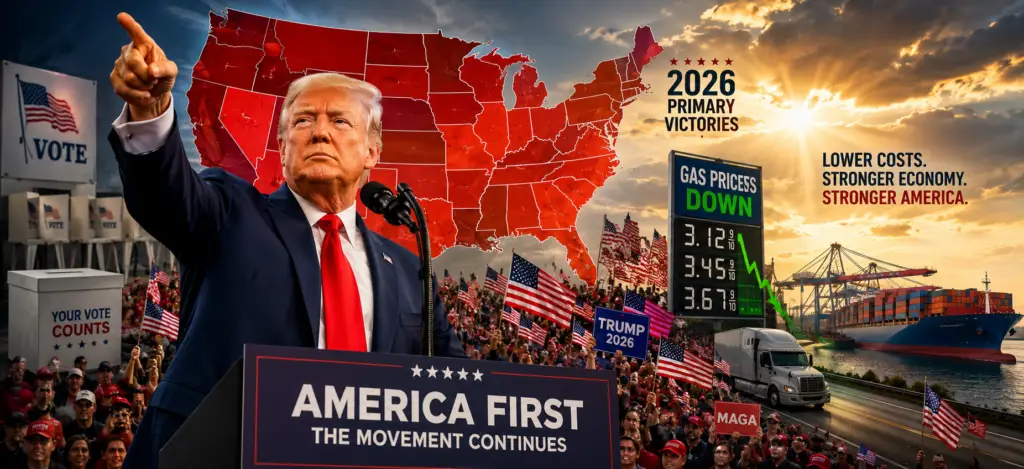
- MAGA movement 2026: Trump-backed candidates are outperforming expectations in multiple 2026 Republican primaries
- MAGA movement shows strong cohesion despite years of decline narratives
- Endorsements continue to drive voter turnout and grassroots momentum
- Republican voter base remains aligned with Trump’s political messaging
For years, legacy media outlets have insisted that the MAGA movement is losing steam—an
exhausted political current supposedly shrinking with each election cycle. Yet the 2026 primary
landscape tells a different story. President Trump’s endorsement record, once treated as a
political curiosity, has again become a decisive force in Republican contests across the country.
Early primary outcomes show Trump-backed candidates outperforming expectations,
consolidating support in rural strongholds, exurban districts, and even competitive suburban
regions. The pattern is consistent and unmistakable: the coalition is not eroding. It is stabilizing.
This is not what a declining movement looks like. This is what a durable political identity looks
like.
Endorsements That Still Move Voters
Trump’s endorsement strategy has always been unconventional—aggressive, personal, and
unapologetically direct. Critics predicted that this approach would eventually alienate the base.
Instead, it has done the opposite.
Candidates he elevates continue to benefit from a turnout surge
that traditional consultants still fail to model accurately. In several states, Trump-backed
challengers have overtaken establishment incumbents who entered their races with more money,
more institutional backing, and more favorable early polling.
Trump Brokers Breakthrough: Israel–Hezbollah Ceasefire Signals Strategic Shift in Iran–U.S. Deal
The explanation is straightforward: Republican voters still treat Trump’s endorsement as a signal
of authenticity. It is a shorthand for ideological alignment, outsider posture, and a willingness to
confront institutions that many voters believe have drifted too far from their interests. That signal has not weakened. If anything, it has become more efficient.
A Movement That Refuses to Follow the Script
Legacy media continues to frame MAGA as a shrinking faction—loud but numerically limited.
But the electoral data contradicts that storyline. The movement’s reach remains broad, and its
internal cohesion is stronger than many analysts expected after years of political turbulence.
Three dynamics explain why:
- The base has not fractured. Predictions of splintering never materialized. The core
coalition—working-class voters, rural conservatives, and a growing bloc of
nontraditional Republican voters—remains aligned around Trump’s instincts and posture. - The messaging ecosystem is decentralized and resilient. MAGA does not rely on a
single media outlet or personality. Its communication channels are diffuse, adaptive, and
capable of bypassing traditional gatekeepers. - The movement’s strategy is still offensive, not defensive. Trump’s political approach is
not built on preserving ground. It is built on taking it. That aggressiveness continues to
energize supporters who believe the political environment is fundamentally adversarial.
Movements decline when they lose either numbers or momentum. MAGA has lost neither.
The External Variable: Ending the Iran War
The final piece of the midterm equation lies outside the primary map: the trajectory of the Iran
war. For months, the conflict has exerted upward pressure on global energy markets, shipping
costs, and consumer prices. Political volatility is one thing; economic strain is another. Relief at
the pump and in the supply chain would immediately shift voter psychology.
No, MAGA is not divided on the Iran war
If the conflict winds down before the midterms, two outcomes follow almost immediately:
- Gas prices fall. Even a modest decline reshapes household sentiment. Energy costs
remain the most visible economic indicator for working families. - Overseas goods stabilize. Shipping lanes reopen, insurance premiums drop, and the cost
of imported goods begins to normalize.
The administration understands this. Ending the conflict is not just a foreign policy objective—it
is a domestic political accelerant. A rapid de-escalation would give the White House the final
economic tailwind needed to convert primary momentum into general-election advantage.
A Movement Still Writing Its Own Trajectory
Trump’s endorsement success is not an isolated phenomenon. It is a barometer of a political
movement that remains structurally intact, culturally influential, and strategically aggressive. The
base has not retreated. The coalition has not thinned. The energy has not dissipated.
If the Iran conflict resolves in time to ease economic pressure on voters, the midterm landscape
shifts again—this time in Trump’s favor. And once more, the narrative of MAGA’s decline will
collide with the reality of its persistence.
The movement is not fading. It is evolving, consolidating, and preparing for its next phase.