


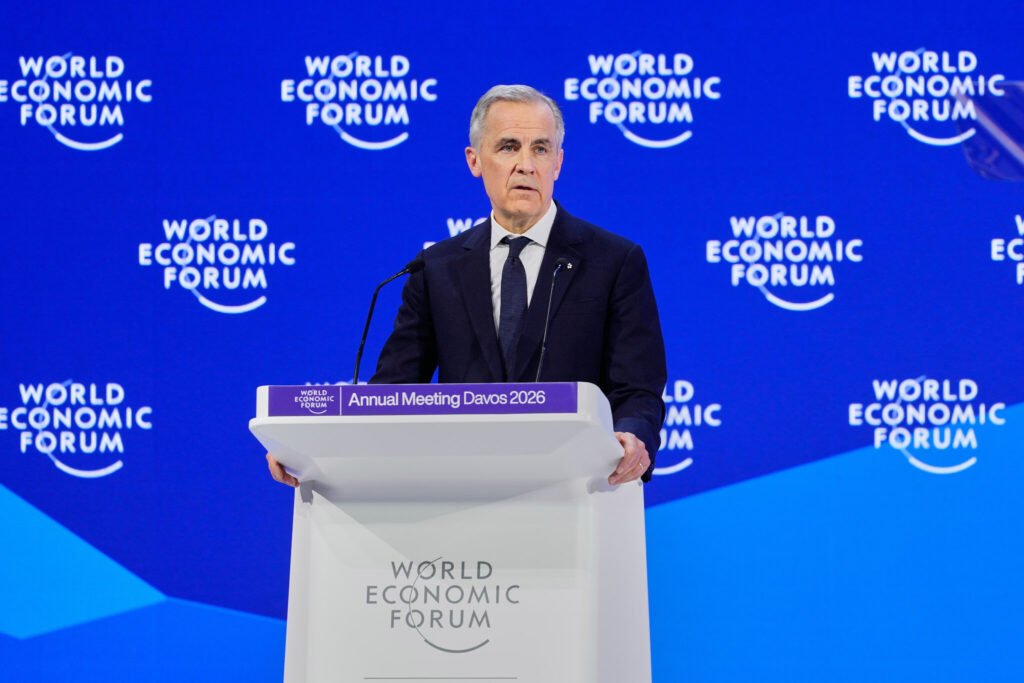
- The Mark Carney Davos speech labeled the current international rules-based order a “fiction.”
- Carney called for a “Third Path” for middle powers to avoid being sidelined by great-power rivalries.
- The address highlighted a permanent “rupture” in global geopolitics rather than a temporary shift.
- Response from the U.S. was swift, leading to a diplomatic tension regarding the “Board of Peace.”
The 2026 World Economic Forum (WEF) will likely be remembered as the moment the “Davos Man” finally stopped pretending. While President Donald Trump provided the theatrical spectacle—complete with Greenland-shaped cakes and the “Board of Peace”—it was Canadian Prime Minister Mark Carney who provided the intellectual autopsy of the 20th-century geopolitical order. By labeling the “rules-based international order” a convenient fiction, Carney did more than just “steal the show”; he performed a high-stakes pivot from idealism to radical realism.
The Death of the “Rules-Based” Myth
Carney’s address was a direct assault on the polite hypocrisy that sustains global summits. For decades, the West has invoked a “rules-based order” as a shield, even while the most powerful actors—most notably the U.S.—bypassed those rules when national interests dictated (e.g., the 2003 invasion of Iraq). Carney’s brilliance lay in his refusal to mourn this decay. Instead, he framed the current era not as a temporary “cycle” of populism, but as a permanent “rupture.”
His speech identified a shift from global integration to geopolitical coercion. By acknowledging that the strongest now use economic ties as weapons, Carney stripped away the veneer of “win-win” globalization that Davos usually champions. He moved the conversation from “how do we fix the system?” to “how do we survive its collapse?”
The Rise of the “Middle Power” Bloc
The most strategically significant portion of Carney’s address was his call to arms for “Middle Powers.” His warning—“if we’re not at the table, we’re on the menu”—resonated deeply with leaders from Nigeria to Germany. This wasn’t just rhetoric; it was a blueprint for a “Third Path.” By urging medium-sized economies to combine their collective heft, Carney proposed a hedge against the bipolar gravity of a U.S.-China rivalry. This vision suggests a future defined by:
- Diversification of Interests: Moving away from a singular reliance on the U.S. security and economic umbrella.
- Collective Agency: Utilizing multilateral trading systems as a defense mechanism rather than just a growth engine.
- Pragmatic Coalitions: Forming “alliances of the willing” on specific issues like climate and tech regulation, independent of “great-power” blessing.
A High-Stakes Gamble
Carney’s realism, however, comes with significant risks. By “calling it what it is,” he effectively signaled to the United States that its traditional allies are actively looking for the exit. Trump’s immediate reaction—rescinding Canada’s invitation to the Board of Peace and reminding Carney that “Canada lives because of the United States”—underscores the volatility of this approach.
Furthermore, while Carney reclaimed “agency” for middle powers, the actual execution of this “Third Path” remains a tall order. Can a fragmented group of middle powers truly coordinate effectively against the sheer economic gravity of the “titans”? Carney’s speech provided the diagnosis and the medicine, but the patient—the global multilateral system—is still in critical condition.
Ultimately, Carney’s address succeeded because it was the only one that matched the “moral earnestness” of the moment. He replaced the empty pieties of the past with a cold, calculated look at the future, marking a definitive end to the era of globalist wishful thinking.
Carney’s address signaled the end of globalist illusions, forcing leaders to trade nostalgic rhetoric for raw realism. By championing a “Third Path,” he provided the middle powers a vital blueprint to survive the Mark Carney Davos speech era.