


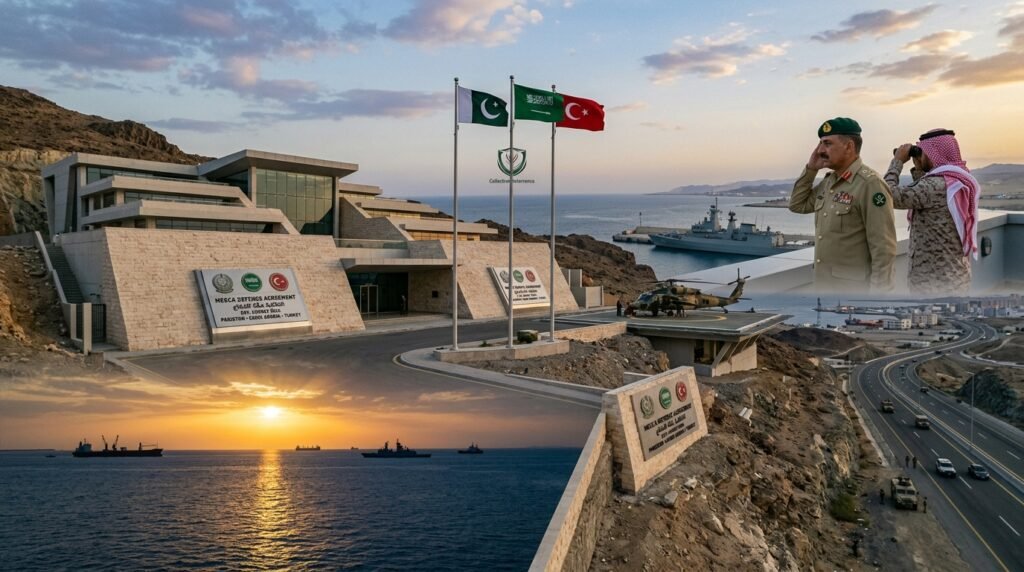
- Mecca Defence Agreement Framework: The Mecca Defence Agreement serves as a strategic deterrent rather than an automated expeditionary pact, defining clear boundaries between territorial defense and offensive regional warfare.
- Geopolitical Risk Analysis: Escalating Houthi strikes on Saudi energy routes highlight the Kingdom’s critical vulnerabilities following disruptions at the Strait of Hormuz and Bab el-Mandeb.
- Strategic Military Roles: While Pakistan offers air defense and military depth, Turkey provides technological capabilities, ensuring Riyadh receives defense support without full military involvement in Yemen.
- Diplomatic Balancing Act: Islamabad and Ankara must balance their defense commitments to Saudi Arabia with their diplomatic relations with Tehran to maintain regional stability.
When Prime Minister Shehbaz Sharif dialed Saudi Arabia’s Crown Prince Mohammed Bin Salman on Sunday, the diplomatic message conveyed from Islamabad was unambiguous: Pakistan stands in resolute solidarity with the Kingdom. Accompanied in spirit and strategy by Chief of Defence Forces and Chief of the Army Staff Field Marshal Asim Munir, alongside Foreign Minister Ishaq Dar, the premier assured Riyadh of Pakistan’s unyielding efforts to defuse escalating regional hostilities.
Yet behind the warm diplomatic exchanges lies a stark geopolitical reality. Saudi Arabia is traversing one of the most critical security periods in its modern history. With Yemen’s Houthi rebels tightening their grip on the Bab el-Mandeb strait and drone strikes forcing the shutdown of the crucial 750-mile East-West oil pipeline to Yanbu, the Kingdom’s energy infrastructure faces unprecedented vulnerability.
READ MORE: Saudi Arabia Faces Its First Mecca Defense Pact Test
The strategic pressure is acute. But for all the promise of the landmark defence agreement signed in Mecca on August 7 by Saudi Arabia, Pakistan, and Turkey, Riyadh may soon realize that its partners are structured to offer a shield, not an offensive sword.
The Fine Print of Collective Deterrence
The Mecca Defence Pact—a historic tripartite framework aimed at mutual deterrence—contains a crucial clause: an armed attack against one member state is treated as an attack against all three. However, as the Pakistani Foreign Office explicitly clarified, the treaty remains strictly defensive in nature. Operational details are still being firmed up, and Islamabad has firmly dismissed speculation regarding joint military strikes inside Yemen.
The distinction between collective defence and automated military intervention is vital:
- Strategic Depth over Boots on the Ground: Pakistan provides immense military depth, intelligence sharing, air defence support, and training capacity. It does not, however, offer an expeditionary force ready to enter a complex Yemeni campaign.
- Industrial and Technological Shield: Turkey brings advanced drone technology, naval capabilities, and defence-industrial capacity designed to fortify Saudi borders rather than fuel open-ended regional combat.
- Diplomatic Equilibrium: Both Islamabad and Ankara maintain crucial, delicate diplomatic balances with Tehran. Direct offensive action against Houthi forces risks inviting asymmetric retaliation and dismantling fragile regional dialogues.
The Shifting Maritime Order
The operational bottleneck for Saudi exports has shifted dramatically. With the Strait of Hormuz increasingly volatile and the East-West pipeline temporarily offline following drone strikes, the Houthis’ capture of strategic choke points like Perim Island in the Bab el-Mandeb creates a severe double-pincer on global energy supplies.
READ MORE: Mecca Defence Alliance ‘Defensive’ in Nature, Expansion Currently Not on Cards, Says FO
+-------------------------------------------------------------------+
|                   SAUDI ENERGY SECURITY DILEMMA                   |
+-------------------------------------------------------------------+
|  [East-West Pipeline] ------> Offline due to drone attacks       |
|  [Strait of Hormuz]   ------> High-risk / Disrupted shipping      |
|  [Bab el-Mandeb]      ------> Houthi maritime blockade        |
+-------------------------------------------------------------------+
                                  |
                                  v
           Riyadh Seeking Deterrence via Mecca Defence Pact
For Riyadh, the immediate impulse is to project force to reopen its primary economic lifelines. Yet if Saudi Arabia initiates a wide-scale offensive deep into Yemeni territory, both Islamabad and Ankara could validly maintain that such measures cross beyond the defensive threshold of the Mecca pact.
The Path Ahead: Containment vs. Escalation
Islamabad’s primary strength lies in its ability to act as a stabilizing pillar without becoming bogged down in foreign battlefields. Rather than deploying troops to foreign frontiers, Pakistan can bolster Saudi security through critical infrastructure protection, maritime security operations, and integrated air-defence coordination.
Ultimately, the Mecca Defence Pact was forged to construct a long-term security architecture capable of deterring non-state actors and hostile regional alignments. It was never designed to operate as a rapid-reaction mechanism for pre-emptive warfare. As crisis tests the coalition, the success of the alliance will depend on whether Saudi Arabia, Pakistan, and Turkey can maintain a unified defensive posture—defending the Kingdom’s sovereignty while ensuring the agreement does not drag the region into an unending cycle of war.