


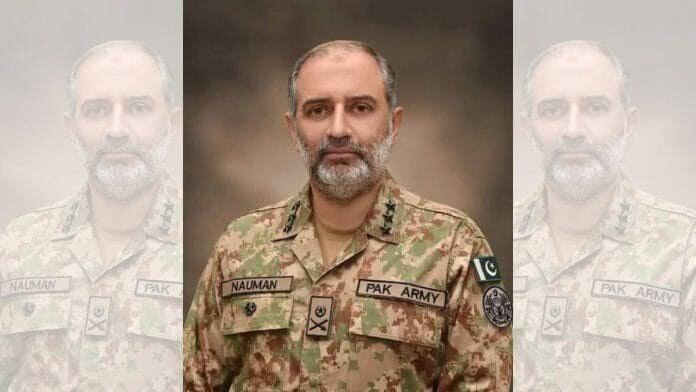
Mecca Defence Allianceappoints retired Lt Gen Nauman Mahmood as its first Secretary General to lead the newly established Riyadh secretariat.- The trilateral agreement integrates Turkish unmanned aerial technology and electronic warfare arrays with seasoned Pakistani military manpower and counter-insurgency doctrine.
- General Mahmood’s extensive operational background in North Waziristan and intelligence analysis equips the alliance to contain Houthi proxies while projecting structural deterrence against Iran.
When Riyadh, Ankara, and Islamabad decided to turn a defense pact into an operational shield, they didn’t dispatch a career diplomat to head the secretariat; they sent a general who perfected the art of hunting guerrillas in the world’s most dangerous mountains.
The appointment of retired Lieutenant General Nauman Mahmood as the first Secretary General of the Makkah Defence Alliance Secretariat marks a decisive, calculation-driven shift in regional security architecture. The decision, coming after over a month of high-stakes deliberations between the three capitals, places a battle-tested commander at the helm of an emerging trilateral security bloc.
Announced officially by Pakistan’s Foreign Office on Wednesday, Mahmood’s immediate mission in Riyadh is to construct the institutional machinery of an alliance designed to project hard power and stabilize contested frontiers.
The strategic synergy at the heart of the Makkah Defence Alliance is a masterclass in modern force design: marrying Türkiye’s cutting-edge defense-industrial machinery with Pakistan’s battle-hardened military manpower, backed by Saudi Arabia’s strategic footprint and capital.
READ NEXT: Why the Red Sea Matters as Iran and Houthis Tighten Global Energy Vise
Ankara enters the triad as the technological engine room. Over the last decade, Turkish defense firms have dominated the asymmetric domain with high-altitude long-endurance (HALE) unmanned aerial vehicles, loitering munition countermeasures, advanced signal intelligence arrays, and naval engineering platforms. Under the alliance framework, Turkish technology provides the persistent sensor-to-shooter net required across critical maritime chokepoints like the Red Sea and Bab al-Mandab.
Yet, sophisticated hardware is useless without operational doctrine and boots on the ground—and that is precisely where Pakistan’s military footprint becomes indispensable. Bringing the battlefield experience of the world’s sixth-largest standing army, Islamabad provides the raw operational core. Under General Mahmood’s direction, Pakistani forces are being embedded into advisory, joint planning, and specialized operational roles across the Riyadh command hubs. Pakistani officers, trained extensively in counter-insurgency and high-intensity warfare, serve as the tactical backbone operating and integrating Turkish-supplied defense systems.
READ MORE: https://www.arabnews.pk/pakistan/pakistan-names-ex-general-nauman-mahmood-as-head-of-defense-alliance-with-saudi-arabia-turkiye-3002105
This fusion of Turkish tech and Pakistani manpower addresses the immediate threat hovering over Gulf security: Yemen’s Houthi movement. As an actor reliant on asymmetric warfare, loitering drone swarms, and terrain concealment, containing the Houthis demands an integrated counter-guerrilla blueprint. Mahmood’s background—having led frontline infantry divisions in North Waziristan and commanded XI Corps during the turbulent U.S. withdrawal from Afghanistan—gives him the exact operational operational matrix needed to dismantle non-state proxy networks.
Beyond the immediate horizon of the Houthis, however, lies the shadow of Tehran. Western intelligence circles and regional analysts recognize that Mahmood’s appointment equips the Riyadh secretariat with deterrence capabilities aimed directly at Iran. His former role as Director General of Analysis at the ISI provided him with a granular understanding of state-sponsored proxy networks and grey-zone conflict dynamics across the Middle East. By pairing Turkish defense innovation with Pakistani operational depth under a unified command, the Makkah alliance signals a stark message: the tri-nation bloc is now fully prepared to counter both proxy threats and regional state-level aggression.
The appointment of retired Lieutenant General Nauman Mahmood as Secretary General of the Makkah Defence Alliance is not merely an administrative milestone; it is the opening move in a high-stakes recalibration of Eurasian power.
Over the next three years, Mahmood’s tenure in Riyadh will transform a paper pact into an integrated operational tripod combining Turkish defense-industrial autonomy, Pakistani tactical depth, and Saudi strategic capital. In the short term, the alliance will prioritize counter-asymmetric warfare against non-state proxies like the Houthis. By synchronizing Turkish long-endurance drones and signal intelligence with Pakistani counter-insurgency doctrine, the secretariat will establish a automated sensor-to-shooter shield across the Red Sea corridor.
Looking further ahead, the alliance’s true trajectory points toward structural deterrence against state-level aggression, specifically from Iran. As Ankara, Islamabad, and Riyadh construct unified command-and-control hubs, joint intelligence networks, and shared air-defense systems, the Middle East will see the emergence of an autonomous Sunni security pillar. This tripartite bloc will incrementally reduce reliance on Western umbrellas, redrawing the geopolitical map from the Gulf to South Asia.