


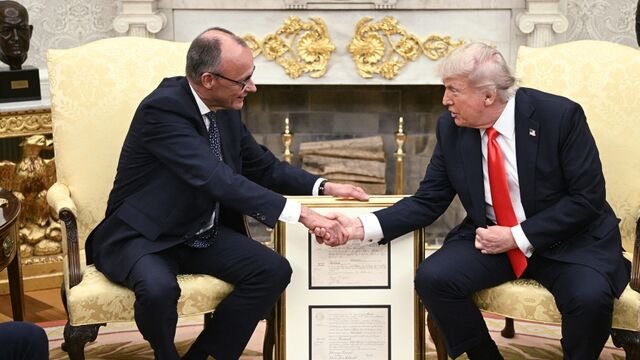
- Merz Trump Meeting marks the first European leadership engagement with Washington since the US-Israel strikes on Iran.
- Germany may emerge as a diplomatic intermediary and logistical partner as the Middle East conflict expands.
- Europe faces economic and security fallout despite being sidelined from initial military decision-making.
- Talks will test transatlantic unity amid NATO tensions, trade disputes, and rising global energy risks.
As German Chancellor Friedrich Merz flies toward Washington for what may become one of the most consequential diplomatic meetings of his young premiership, Europe finds itself once again pulled into a crisis it did not start but cannot avoid.
His Tuesday meeting with U.S. President Donald Trump comes at an extraordinary moment: the United States and Israel are locked in open confrontation with Iran following strikes that killed Supreme Leader Ali Khamenei, triggering regional retaliation, economic shockwaves, and fears of a wider war.
Merz will be the first European leader to sit face-to-face with Trump since the conflict erupted—an encounter that European officials privately describe as both an opportunity and a test.
A Decisive Week in the U.S.–Iran War: Military Escalation, Energy Security, and Global Power Shifts
The German leader arrives fresh from a carefully calibrated visit to China that Berlin framed as economically productive and strategically balanced, but Washington now expects clarity: where does Germany stand as the Middle East edges toward full-scale war?
A Diplomatic Tightrope
Merz’s public messaging so far reflects deliberate ambiguity. Speaking shortly after returning from Beijing, he acknowledged the strategic dilemma confronting Western governments. Germany, he said, understands the frustrations that decades of diplomacy failed to halt Iran’s nuclear ambitions or regional behavior. Yet he stopped short of explicitly endorsing the U.S.-Israeli military campaign.
“We recognize the dilemma,” Merz said, adding that Berlin would not “lecture” its allies while also avoiding unconditional support.
That careful wording signals the central challenge awaiting him in Washington. Trump’s administration, emboldened by early military successes, is expected to press European allies for tangible backing—political legitimacy, logistical cooperation, and potentially economic or security contributions.
For Merz, agreeing too openly risks domestic backlash and fractures within the European Union. Refusing outright could strain transatlantic relations at a moment when Germany still relies heavily on U.S. security guarantees.
Europe Sidelined—Again
The war has revived a familiar European frustration: strategic marginalization. Despite being directly exposed to the economic consequences—energy shocks, disrupted trade routes, refugee risks, and aviation chaos—Europe had little visible role in the decision-making preceding the strikes.
Alongside French President Emmanuel Macron and British Prime Minister Keir Starmer, Merz issued a cautious joint statement expressing readiness to work with Washington to defend shared interests. But European capitals remain wary that the United States is once again defining security realities unilaterally.
Diplomats in Brussels note that Europe now faces the consequences of a conflict unfolding along vital economic arteries—from Gulf energy flows to international aviation routes—without having shaped its initial strategy.
Germany’s Potential Role in the War
Behind closed doors, analysts expect discussions to revolve around three areas where Germany could become indispensable.
1. NATO and Strategic Logistics
Germany hosts critical U.S. military infrastructure and remains a logistical hub for transatlantic operations. Washington may seek expanded use of German bases for coordination, intelligence sharing, or force mobility linked indirectly to Middle East operations.
Germany’s Merz to hold crisis talks with Trump in Washington
Merz, a lifelong Atlanticist, has already acknowledged that American criticism of Europe’s defense spending was justified—a message he delivered earlier at the Munich Security Conference. His government has pledged unprecedented borrowing to rebuild Germany’s armed forces after decades of underinvestment.
Supporting alliance logistics would allow Berlin to assist without direct military involvement in combat operations—a politically safer option domestically.
2. Diplomatic Intermediary
Germany may also emerge as a crucial diplomatic bridge. With communication channels between Washington and Tehran effectively shattered following the assassination of Iran’s leadership and negotiators, European intermediaries could regain relevance.
Berlin historically maintained working diplomatic channels with Iran even during periods of heightened tension. Trump may quietly encourage Germany to test backchannel communications while publicly maintaining pressure.
Such a role would allow Merz to present Germany as a stabilizing actor rather than a combatant.
3. Economic and Energy Stabilization
Perhaps most urgently, Germany could lead European efforts to mitigate economic fallout. The conflict has already disrupted oil shipping lanes and triggered aviation shutdowns across the Gulf, threatening supply chains central to Europe’s export-driven economy.
Berlin may coordinate emergency energy diversification measures, shipping insurance guarantees, and financial stabilization policies within the European Union to prevent recessionary spillover.
Trump’s Expectations
Trump’s approach to allies has historically blended pressure with transactional bargaining. European officials expect him to link cooperation on Iran to broader disputes—defense spending, trade imbalances, and tariffs that have rattled Germany’s export sector.
Merz’s visit was initially meant to reset transatlantic relations after months of friction over tariffs and immigration rhetoric. Instead, the war has transformed the meeting into a crisis summit.
Trump is likely to argue that Europe must share responsibility for maintaining global security if it wants continued American protection through NATO. Merz, meanwhile, is expected to emphasize alliance unity while resisting commitments that could draw Germany directly into conflict.
A New Strategic Era
The meeting also reflects a broader shift in European thinking. Russia’s war in Ukraine exposed Europe’s dependence on U.S. military power; the Iran conflict now exposes its vulnerability to American strategic decisions elsewhere.
Merz has repeatedly argued that Europe must become more capable of acting independently while preserving the Atlantic alliance. His message in Washington is expected to be clear: Germany wants NATO to remain the central pillar of Western security—but as a partnership, not a hierarchy.
High Stakes in Washington
The symbolism of the visit may prove as important as its outcomes. With global markets volatile, oil prices rising, and regional warfare spreading from the Gulf toward South Asia, allies are searching for signals of cohesion—or fracture—within the Western alliance.
If Merz succeeds, Germany could position itself as Europe’s primary diplomatic broker and economic stabilizer during the crisis. If talks falter, the perception of a divided West could embolden adversaries and deepen geopolitical uncertainty.
As his aircraft approaches Washington, Merz carries more than Germany’s diplomatic agenda. He carries Europe’s attempt to regain influence in a war reshaping global order—one conversation at a time.