


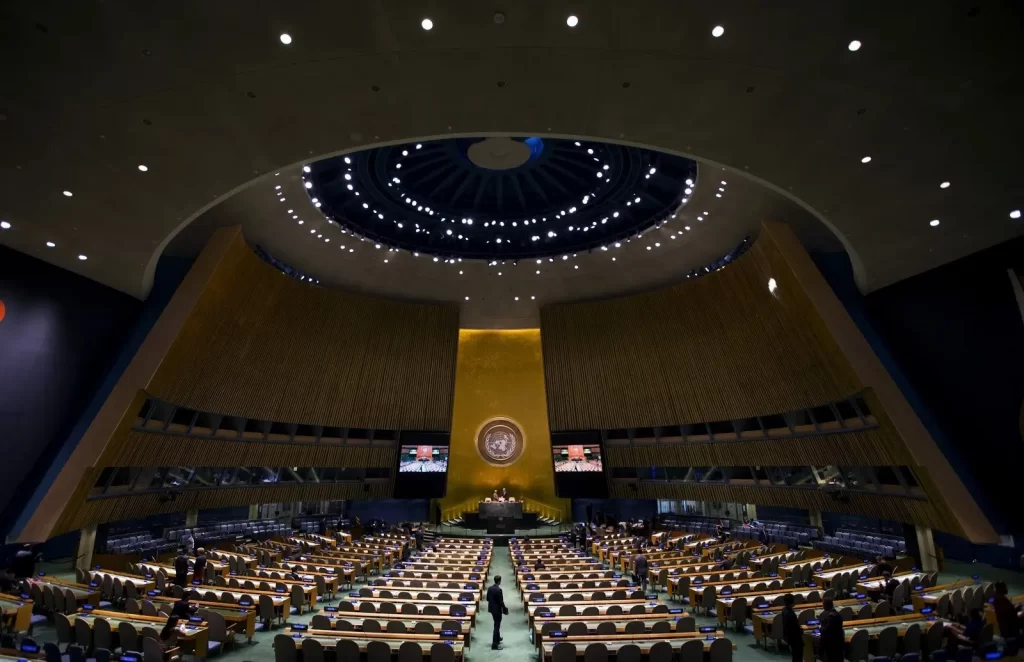
- Middle East Peace Resolutions: UNGA approves Palestine resolution with 151 votes in favour; U.S. criticizes it as “one-sided.”
- Israel rejects the resolution, citing Hamas, security threats, and Palestinian Authority reforms.
- Syrian Golan resolution passes with 123 votes; Türkiye and Syria stress illegality of occupation.
- Humanitarian agencies and South Africa call for rebuilding infrastructure and enforcement of ICJ rulings.
The United Nations General Assembly this week delivered a striking illustration of the entrenched divides in international politics over the Middle East. Member States voted on two key resolutions — one addressing the “Peaceful settlement of the question of Palestine” and another on “The Syrian Golan.” While both resolutions passed with substantial majorities, the debates surrounding them underscored the persistent tension between legal norms, humanitarian imperatives, and political realities on the ground.
Majority Supports Resolutions, U.S. Calls Them “One-Sided”
The Palestine resolution passed with 151 votes in favour, 11 against, and 11 abstentions, reaffirming the international community’s longstanding support for Palestinian rights and statehood. Yet the session was far from harmonious.
The Kashmir-Palestine Parallel: Accountability Gaps And Strategic Implications For Pakistan
The United States criticized the General Assembly for issuing what it described as “one-sided resolutions” that fixate on Israel without contributing to meaningful progress.
The U.S. delegate emphasized that such resolutions:
- Distract from real diplomacy necessary for regional peace
- Fail to reflect current realities and recent U.S. efforts to drive tangible change
- Risk undermining a historic moment when concrete progress could be possible
Washington’s statement highlights its ambition to reassert influence in the Middle East, presenting itself as the arbiter capable of translating symbolic gestures into actionable agreements.
READ MORE: Subscribe to notifications Get the latest news and updates from Dawn Not Now Allow Notifications UNGA adopts resolution demanding Israeli withdrawal from occupied Palestinian territory
Israel Stresses Security Concerns and Hamas Threat
Israel’s representative rejected the resolution outright, arguing that the text fails to address the central obstacles to peace. Specifically, the resolution:
- Omits condemnation of Hamas and the 7 October attacks
- Ignores the need to dismantle militant infrastructure in Gaza
- Makes no mention of the Israeli hostages
- Contradicts Security Council Resolution 2803 (2025), which calls for Palestinian Authority reforms before governance
Israel’s position underscores a fundamental challenge: peace cannot be achieved without directly addressing security threats and governance reforms alongside humanitarian and political considerations.
Syrian Golan Resolution Passes with Wide Support
The resolution on the Syrian Golan was approved with 123 votes in favour, 7 against, and 41 abstentions, reaffirming the UN’s consistent position that Israel’s occupation is illegal under international law. Türkiye’s delegate stressed that lasting security cannot be achieved while Israel maintains control over the Golan, highlighting that the occupation obstructs Syrian efforts to restore prosperity, social cohesion, and regional stability.
ALSO READ: A Fragile Ceasefire, A Shared Celebration: Why Palestinians See the Peace Deal as a Step Toward Justice
Syria’s representative, in turn, declared the Golan’s status non-negotiable, insisting that the territory must be restored to the 4 June 1967 lines, as guaranteed by international law. Egypt, introducing the draft resolution, reinforced the principle of the inadmissibility of acquiring territory by force and urged Israel to withdraw in line with Security Council positions.
Middle East Peace Resolutions: Humanitarian and Legal Dimensions
Beyond politics, delegates highlighted the importance of humanitarian and legal imperatives. The Pan African Intergovernmental Agency for Water and Sanitation noted that access to essential services in Palestine remains severely damaged, stressing that rebuilding civilian infrastructure and regional cooperation on water resources are integral to sustainable peace.
South Africa emphasized legal accountability, calling for firm action to enforce International Court of Justice (ICJ) rulings against Israel’s occupation, warning that ceasefires alone risk creating a misleading sense of normalcy while humanitarian conditions remain dire.
Symbolism vs. Action
The UNGA session illustrates the enduring tension between symbolic resolutions and actionable diplomacy. While the overwhelming support for the Palestinian and Golan resolutions reaffirms the world’s legal and moral stance, key players such as the U.S. and Israel caution that symbolic gestures cannot substitute for measures addressing governance, security, and militant threats.
Humanitarian warnings from Africa and South Africa underscore that political agreements alone are insufficient; lasting peace requires investments in infrastructure, human dignity, and compliance with international law. The sharp contrast between legal and humanitarian imperatives versus political realities presents a persistent challenge for mediators and regional powers alike.
Decades of Disputes
The international community has long grappled with the Palestinian question and the status of the Syrian Golan. UN resolutions dating back decades consistently condemn Israel’s occupation of both territories. The 1981 Israeli annexation of the Golan, never recognized internationally, and the repeated humanitarian crises in Gaza underscore the profound complexity of negotiating peace in the region. Previous U.S.-led initiatives, European interventions, and regional dialogue efforts have all struggled to reconcile territorial disputes with security and governance imperatives.
Future Perspectives
The votes this week, while largely symbolic, may set the stage for future negotiations anchored in international law and humanitarian imperatives. For the U.S., which is positioning itself as a central diplomatic actor, the challenge will be translating consensus into tangible agreements that address security threats, governance reforms, and economic reconstruction.
For Israel and Syria, the Golan remains a flashpoint, while the Palestinian territories continue to require a balance of political recognition, humanitarian support, and security assurances. The Assembly’s resolutions, in this context, highlight a moment of opportunity — yet one fraught with complexity, demanding coordinated diplomacy, regional cooperation, and a willingness to bridge symbolic gestures with practical action.
The Middle East remains at a critical crossroads: the UNGA’s decisions reaffirm legal and moral positions, but the real test lies in implementation, enforcement, and reconciliation. Whether Member States can convert these resolutions into actionable strategies will define the region’s trajectory for years to come.