


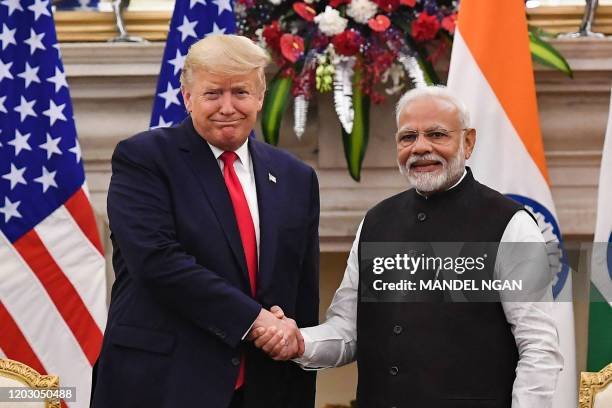
- US-India Trade Surge: Both leaders pledged to double bilateral trade by 2030, replacing China as Washington’s key Asian partner.
- Defense Boost: India eyes F-35 stealth jets, strengthening its military stance against regional rivals.
- Energy Expansion: India’s US energy imports set to rise to $25 billion, reducing reliance on Russia.
- Strategic Power Shift: Washington’s pivot sidelines Pakistan, amplifying India’s influence in Asia.
- Tech & AI Collaboration: Elon Musk rumored to have facilitated key discussions on AI and emerging technologies.
In a decisive move that underscores the United States’ shifting geopolitical priorities, former President Donald Trump met with Indian Prime Minister Narendra Modi at the White House in February 2025. This meeting marked a pivotal moment in US-India relations and showcased how India has positioned itself as Washington’s key strategic partner in Asia. With China facing increasing pushback from the US and Pakistan finding itself sidelined, Modi’s administration has played its cards masterfully, ensuring India emerges as the preferred ally.
Strengthening Bilateral Ties
The February 2025 meeting between Trump and Modi was more than a diplomatic formality; it was a defining moment in Indo-American relations. The two leaders agreed to launch negotiations for a comprehensive trade agreement, focusing on reducing trade barriers and boosting defense cooperation. In a joint statement, they announced India’s commitment to purchasing more American oil, gas, and military equipment, marking a significant shift in global trade dynamics.
Trump’s Choice in Asia: How Modi’s India Has Outclassed China and Pakistan
During their discussion, Trump praised Modi’s economic reforms and his administration’s willingness to lower tariffs on American goods. “Prime Minister Modi recently announced reductions to India’s unfair, very strong tariffs that limited us access to the Indian market,” Trump said. “And really, it’s a big problem, I must say.”
Both leaders also discussed illegal immigration, artificial intelligence, and security cooperation in the Indo-Pacific, a clear sign of Washington’s intent to counterbalance China’s growing influence in the region. India’s Foreign Secretary, Vikram Misri, confirmed that the trade deal could be finalized within seven months, signifying a new era of economic partnership.
The Rise of US-India Trade Relations
One of the key takeaways from the Trump-Modi meeting was the commitment to enhancing bilateral trade. Currently, the US enjoys a $45.6 billion trade deficit with India, but Washington sees New Delhi as a more reliable partner than Beijing. India is looking to double trade with the US by 2030, and in pursuit of this goal, has pledged to significantly increase its energy and defense purchases from America.
Five key takeaways from Modi-Trump talks
Trump’s administration has actively sought to replace China with India as its primary trade partner in Asia. India’s energy imports from the US are set to rise to $25 billion in the near future, up from $15 billion last year. This shift aligns with Washington’s long-term strategy to reduce dependence on China while strengthening economic ties with nations that align with its broader security objectives.
One of the most significant announcements from the meeting was the potential sale of F-35 stealth fighter jets to India. While no formal agreement has been signed, this move would not only solidify military cooperation but also bolster India’s defense capabilities against regional adversaries like China and Pakistan.
Trump, ever a businessman, framed the trade partnership in terms of reciprocal benefits. “Whatever India charges, we charge them,” he stated, emphasizing his desire for balanced trade relations. Meanwhile, Modi echoed the sentiment, reinforcing India’s commitment to keeping national interests at the forefront.
India’s Strategic Victory Over China and Pakistan
India’s strengthening ties with the US are a strategic masterstroke that outclasses both China and Pakistan in the region. China, once America’s largest trading partner, now faces growing isolation due to escalating trade tensions, security concerns, and its assertive military posture in the Indo-Pacific.
Trump’s Choice in Asia: How Modi’s India Has Outclassed China and Pakistan
Trump’s push to replace China with India as a major trading partner is a direct threat to Beijing’s economic dominance. With India buying more American oil, gas, and defense equipment, China’s influence is waning. Furthermore, India’s active participation in joint security initiatives with the US has alarmed Chinese officials, who see this as a potential counterbalance to Beijing’s Belt and Road Initiative (BRI).
Pakistan, on the other hand, finds itself in an increasingly precarious position. With its economy struggling and diplomatic ties with the US weakening, Islamabad lacks the leverage to counter India’s growing clout. Washington’s decision to deepen relations with New Delhi is a clear indication that Pakistan is no longer a priority in America’s strategic calculus.
A Strategic Chess Move or Geopolitical Posturing?
A significant factor in this diplomatic realignment is the role of business magnate Elon Musk, who, sources suggest, has been instrumental in bringing Trump and Modi closer together. Musk, with substantial investments in both countries, reportedly facilitated discussions on technology and energy cooperation, further cementing India’s role as a preferred partner.
A Pragmatic Deal-Making Affair
Indian Prime Minister Narendra Modi’s first visit to Washington under Donald Trump’s second term was a no-nonsense, business-driven event. Unlike the spectacle of a state visit, this meeting was laser-focused on trade, defense, and strategic interests.
What Modi and Trump Stand to Gain
For Trump:
- A massive defense deal, including potential F-35 sales, reinforcing his ‘America First’ policy by boosting U.S. arms exports.
- Increased oil and gas sales to India, narrowing the trade deficit.
- A clear commitment to reciprocal tariffs, allowing him to press other trading partners for similar deals.
- Domestic political leverage by securing the extradition of Tahawwur Rana, a key suspect in the 2008 Mumbai attacks, catering to Indian-American voters.
For Modi:
- A commitment to negotiate a trade deal, offering India a chance to reduce tariffs and secure better U.S. market access.
- Expansion of India’s defense cooperation with the U.S., reducing dependence on Russian arms.
- The possibility of securing investments from Tesla and other U.S. firms in AI, electric vehicles, and emerging tech.
- Reaffirming India’s global trade ambitions by working towards a $500 billion trade target with the U.S.
Challenges & The Road Ahead
Despite the warm rhetoric, unresolved issues linger. Trump’s tariff threats, India’s reluctance on the F-35, and bureaucratic hurdles in arms transfers could slow progress. Meanwhile, securing a trade deal by 2025 remains a tall order. Still, both leaders appear ready to ride the momentum toward a deeper economic and strategic partnership.
Trump’s invitation to Modi was not just a diplomatic gesture—it was a statement of intent. India has successfully positioned itself as the US’s go-to partner in Asia, effectively replacing China and leaving Pakistan out in the cold. With robust trade agreements in the pipeline and a commitment to deepening security cooperation, India is poised to become a dominant player in the region.
For China, this shift presents a significant challenge, as its once-unquestioned economic stronghold over global trade faces competition from an ambitious and increasingly influential India. For Pakistan, the reality is even starker—its longstanding alliance with the US has eroded, leaving it scrambling for new allies.
As India continues to capitalize on its relationship with the US, the global balance of power in Asia is shifting. The Modi administration’s calculated moves have ensured that India is not just an emerging power, but a dominant force on the world stage.