


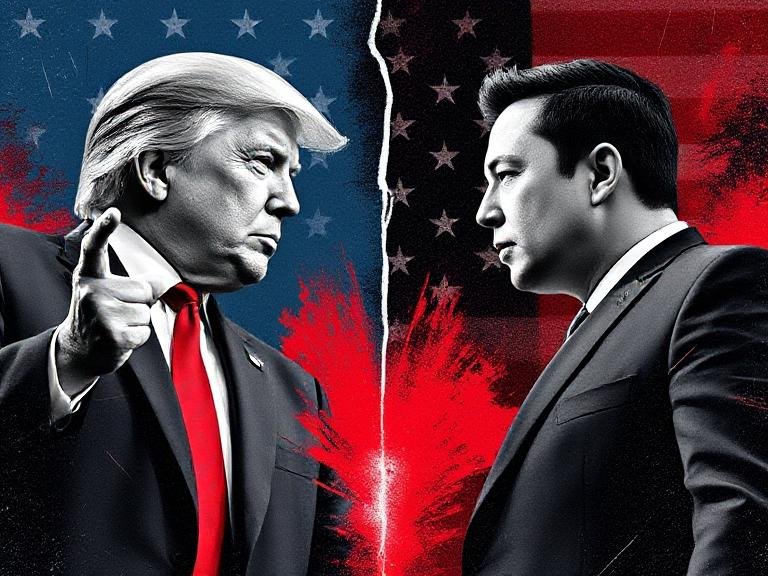
- The Trump-Musk feud marks a rare political clash between a sitting president and a tech titan once considered a loyal adviser and ally.
- Tensions escalated over Musk’s criticism of Trump’s tax bill, tariffs, and attempts to undermine his influence in government.
- Trump threatened Musk with “serious consequences,” hinting at government contract cancellations and political retaliation.
- Musk’s potential formation of an “America Party” signals a seismic shift that could splinter the Republican base ahead of the 2026 midterms.
The public falling-out between President Donald Trump and Elon Musk has become more than just a clash of egos; it marks a seismic rupture between two of the most powerful—and polarizing—figures in contemporary American life. What began as an ambitious partnership between a populist president and an iconoclastic tech billionaire has devolved into a toxic feud with potentially wide-reaching consequences for U.S. politics, the tech sector, and the cultural landscape.
Where Is the Trump-Musk Conflict Headed?
At the heart of the Trump-Musk feud is not just personal betrayal but a fundamental ideological divergence. Their initial alliance was transactional: Trump saw Musk as a tech savant who could help streamline government inefficiencies through the DOGE Service, while Musk viewed proximity to Trump as a gateway to unchecked influence in Washington, particularly in areas like space exploration, deregulation, and defense contracts.
From SpaceX to the White House: How Elon Musk Became Trump’s Biggest Asset
But the alliance was always precarious. Musk’s disdain for bureaucracy, coupled with his erratic management style and contrarian ideology, clashed with the rigid, loyalty-driven structure of Trump’s administration. The final rupture—sparked by Musk’s criticism of Trump’s “One Big Beautiful Bill” and his support for a potential third party—signals not just the end of their partnership but the beginning of an open conflict.
Now, with Musk openly questioning Trump’s fitness to govern and even floating the idea of impeachment, Trump has responded in kind, threatening federal scrutiny of Musk’s government contracts and warning of “very serious consequences” if Musk funds Democratic candidates. What was once a whispered feud is now a scorched-earth war.
READ MORE:Trump threatens ‘very serious consequences’ if Musk backs Democrats
This feud is heading toward mutual political sabotage. Musk has the resources and platforms—particularly his control of X (formerly Twitter)—to influence public opinion and potentially fund alternative candidates. Meanwhile, Trump’s grip on the GOP and federal regulatory bodies gives him the leverage to attack Musk’s companies through investigations or defunding. Reconciliation appears unlikely in the short term, especially with Trump now openly mulling punitive action against SpaceX and Starlink.
Political Fallout: GOP Turmoil and a Potential Party Schism
For the Republican Party, the Trump-Musk rift presents a nightmare scenario. On one side is a sitting president with cult-like popularity among the MAGA base. On the other is a billionaire disruptor with global reach and the ability to bankroll candidates, dominate social media narratives, and siphon support from libertarian-leaning Republicans and independents.
Musk’s hint at launching a third party—dubbed the “America Party”—has rattled conservative operatives who fear a Ross Perot-style scenario in 2028, splitting the right-wing vote and handing the White House to a Democrat. Already, the failed Musk-backed Supreme Court campaign in Wisconsin showed his political instincts may not align with the GOP’s grassroots.
This conflict also underscores deeper divisions within the Republican coalition. Musk represents Silicon Valley libertarianism: pro-innovation, anti-regulation, and increasingly globalist. Trump’s base, in contrast, champions economic nationalism, cultural conservatism, and personal loyalty. The more Musk attacks Trump’s tariff-heavy trade policies or accuses him of political hypocrisy, the more he alienates the very voters Trump galvanized in 2016 and 2020.
READ MORE:The Trump-Xi Call: A Tactical Thaw in a Strategic Freeze
If Musk continues to criticize Trump from the right or center, he could become a lightning rod for a new faction within American conservatism—tech-forward, issue-driven, and ideologically non-aligned. Whether this movement becomes electorally viable remains to be seen, but its potential to fragment the conservative vote is real.
Cultural and Societal Implications: A Battle for Influence
Beyond the political battlefield, the Trump-Musk drama is exposing the dangerous overlap between celebrity, governance, and social media power. Both men are larger-than-life personalities who have weaponized platforms like X to shape narratives, stir controversy, and maintain relevance. Their feud is not just about policy or power—it’s about control over public discourse.
Musk’s use of personal attacks, amplified by his own platform, is drawing increasing criticism. His flirtation with conspiracy theories, such as tying Trump to Epstein without evidence, mirrors the same tactics once used by Trump against opponents. In this sense, Musk has adopted Trump’s playbook—and turned it against its author.
This raises ethical and regulatory questions about whether tech magnates should be allowed to simultaneously influence governance while controlling the infrastructure of political communication. Trump’s campaign to investigate Musk’s contracts may be politically motivated, but it also spotlights genuine concerns about accountability and conflict of interest in the tech-government nexus.
Moreover, this feud is deepening the country’s polarization. For millions of Americans, it’s no longer about policy differences but about loyalty to personalities. The Trump-Musk drama has become a microcosm of the country’s broader culture war—pitting populism against elitism, order against disruption, and traditionalism against futurism.
Conclusion: A Dangerous Escalation with No Clear Winner
The Trump-Musk conflict is still in its early stages, but the damage is already visible. A once-cozy alliance has exploded into a public feud with legal, political, and societal ramifications. The likely outcome is not a clean victory for either side but a mutually assured destruction scenario in which both lose credibility, influence, and allies.
For Trump, alienating Musk risks losing a powerful technological voice and donor. For Musk, the more he antagonizes the president and MAGA loyalists, the more he becomes a pariah to the very movement he once supported.
In the end, this isn’t just a spat between two egos—it’s a defining moment in America’s evolving power structure, where billionaires and presidents no longer coexist in uneasy alliances but collide in open battle for dominance over the nation’s future.