


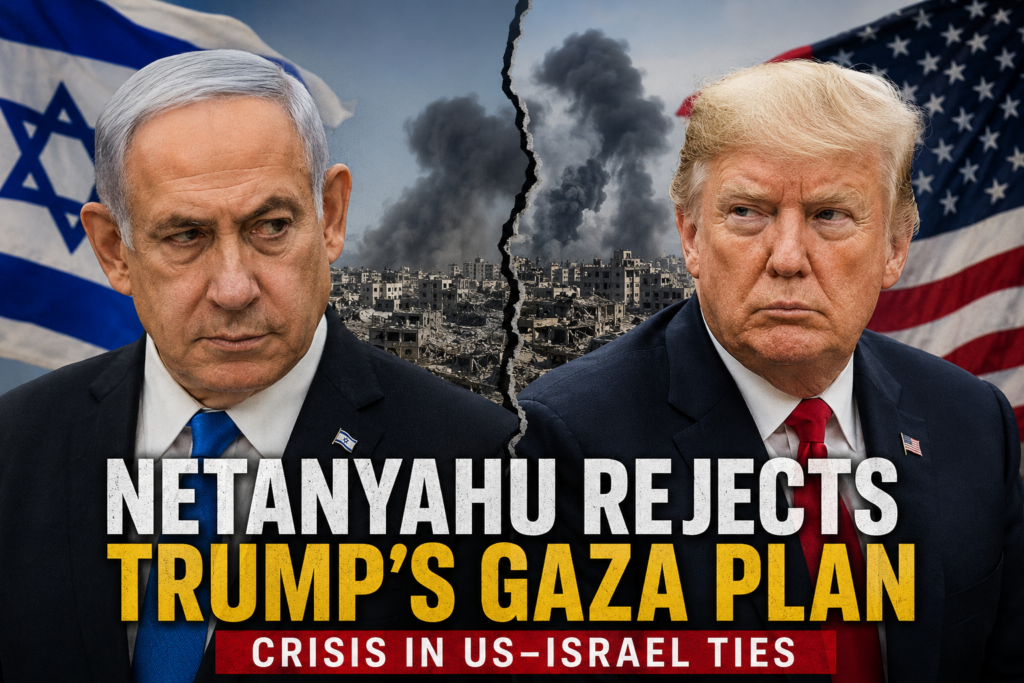
- Netanyahu rejects Trump Gaza plan, prioritizing full Hamas disarmament over phased Israeli withdrawal.
- Domestic political pressure and hardline coalition dynamics are shaping Israel’s strategic decisions.
- The rejection risks straining US-Israel ties and weakening Trump’s Middle East diplomacy.
In a rare and consequential rupture in U.S.–Israel relations, Israeli Prime Minister Benjamin Netanyahu has publicly rejected President Donald Trump’s Gaza peace plan—an initiative once hailed by Washington as a cornerstone achievement of Trump’s second term.
The decision has sent shockwaves across diplomatic circles, raising urgent questions: Is Netanyahu safeguarding Israel’s security doctrine, or is he maneuvering for domestic political survival? And more provocatively—has Israel deliberately embarrassed its most powerful ally at a moment of global instability?
At the heart of the disagreement lies a fundamental divergence over sequencing. Trump’s plan proposed a synchronized process: Hamas would disarm while Israel would gradually withdraw from Gaza. Netanyahu, however, has drawn a hard red line—no withdrawal, under any circumstances, until Hamas is completely disarmed.
This is not merely a tactical disagreement. It is a strategic clash rooted in distrust, political pressure, and competing visions of security and sovereignty.
Security Doctrine or Political Calculus?
Netanyahu’s justification is anchored in Israel’s long-standing security doctrine: never concede territorial or military advantage without eliminating existential threats. The memory of the October 7, 2023 Hamas attacks—still deeply etched into Israel’s national psyche—makes any concession appear risky, if not reckless.
Yet, beneath this security rationale lies a more immediate and pressing reality: politics.
Israel is heading toward a critical election cycle, and Netanyahu faces mounting pressure from his hard-right coalition partners. For these factions, any withdrawal from Gaza—even phased or conditional—is politically toxic. They view territorial control not as a bargaining chip, but as a non-negotiable pillar of Israeli security.
By rejecting Trump’s plan, Netanyahu may be consolidating support among nationalist and hardliner voters who perceive compromise as weakness. In this reading, the Gaza decision is less about Hamas and more about ballots.
Netanyahu rejects Trump Gaza plan: A Calculated Snub to Washington?
The public nature of Netanyahu’s rejection is striking. Historically, disagreements between Washington and Tel Aviv have been managed behind closed doors. This time, however, the Israeli prime minister chose to make his opposition explicit—during a cabinet meeting and in a televised statement.
This raises an uncomfortable question: was this a deliberate diplomatic snub?
Trump had personally invested political capital into the Gaza plan, branding it as a “historic agreement.” For Netanyahu to reject it so openly risks undermining Trump’s credibility—not just domestically, but on the global stage. At a time when the U.S. is already deeply entangled in the Iran war, the collapse of a parallel peace initiative in Gaza weakens Washington’s broader Middle East strategy.
READ NEXT: U.S.–Iran War Middle East Impact: Gaza Forgotten as Trump’s Peace Plan Stalls and Lebanon Burns
Some analysts argue this is not a humiliation, but a recalibration. Netanyahu may believe that Trump—despite public frustration—will ultimately prioritize strategic alignment with Israel over any temporary diplomatic setback. In other words, Israel is betting that the alliance is too critical for Washington to retaliate in any meaningful way.
Trump’s Dilemma: Pressure or Pragmatism?
For President Trump, Netanyahu’s rejection presents a delicate balancing act.
On one hand, Trump has built his foreign policy brand on deal-making and strong leadership. Allowing a key ally to derail a flagship peace initiative risks projecting weakness. On the other hand, applying excessive pressure on Israel—particularly during an election season—could alienate pro-Israel constituencies in the United States.
Trump’s likely response will be a mix of public restraint and private pressure. Washington may attempt to renegotiate the sequencing of the deal, offering Israel stronger guarantees on Hamas disarmament while preserving the broader framework of the agreement.
READ NEXT: Israel Rejects Next Phase of Trump’s Gaza Peace Plan
However, if the deadlock persists, Trump could pivot—either by sidelining the Gaza plan temporarily or by seeking alternative diplomatic wins elsewhere in the region, particularly within the evolving dynamics of the Iran conflict.
Global Reactions: Fractures and Fatigue
The international community is unlikely to view Netanyahu’s decision in isolation. For many countries—especially in Europe and the Global South—the rejection reinforces a long-standing perception: that peace in Gaza remains hostage to political calculations on all sides.
Arab states, some of which had cautiously supported the U.S.-brokered framework, may interpret Israel’s stance as a lack of commitment to de-escalation. This could complicate emerging regional alignments, particularly at a time when Gulf countries are recalibrating their security partnerships amid the Iran war.
Meanwhile, humanitarian organizations will see this as yet another setback in efforts to stabilize Gaza. The proposed plan included not just disarmament and withdrawal, but also governance reforms and the deployment of an international stabilization force—elements now thrown into uncertainty.
Even within Western capitals, patience is wearing thin. While support for Israel’s security remains firm, there is growing unease about the absence of a viable political endgame in Gaza.
The Bigger Picture: A Crisis of Trust
Ultimately, the collapse of Trump’s Gaza plan underscores a deeper and more troubling reality: a profound crisis of trust.
Israel does not trust Hamas to disarm in good faith. Hamas does not trust Israel to withdraw once it begins disarming. And increasingly, allies do not fully trust each other’s intentions.
In this environment, even the most carefully constructed peace frameworks struggle to survive.
Netanyahu’s decision may yield short-term political dividends at home, but it risks long-term strategic costs. It strains relations with Washington, complicates regional diplomacy, and prolongs instability in Gaza.
For Trump, the challenge is equally stark: to salvage a diplomatic initiative without appearing compromised, and to manage an ally that is both indispensable and increasingly assertive.
Conclusion: Strategy or Stalemate?
Is Netanyahu playing a political game? Almost certainly. But it is a game shaped by genuine security concerns, electoral pressures, and a shifting geopolitical landscape.
Is this an attempt to humiliate Trump? Unlikely in intent—but undeniably so in effect.
And how will the world react? With a mix of concern, frustration, and resignation.
The Gaza question, once again, remains unresolved—not for lack of plans, but for lack of alignment. In the high-stakes arena of Middle East geopolitics, even allies can become adversaries of circumstance.
And in that fragile space between strategy and stalemate, peace continues to slip further out of reach.