


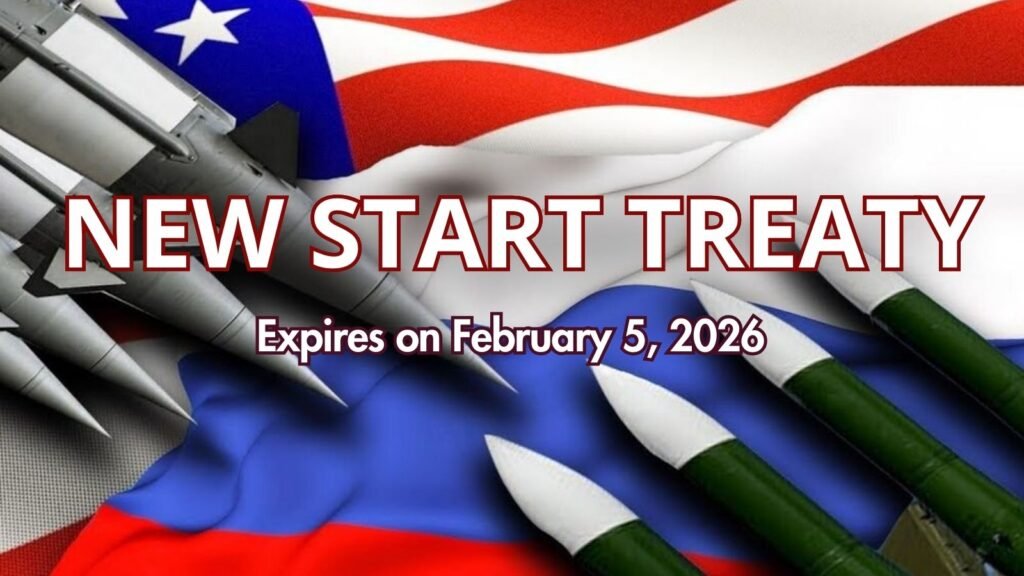
- New START treaty expiration ends over 50 years of U.S.-Russia nuclear arms control, raising fears of a renewed arms race
- China urges Washington to resume strategic stability talks with Moscow to prevent global nuclear disorder
- Experts warn the loss of inspections and transparency increases risks of miscalculation and escalation
- The collapse weakens the global non-proliferation system and could embolden other nuclear powers
China on Thursday expressed deep regret over the expiration of the New START treaty between the United States and Russia, warning that the collapse of the last remaining nuclear arms control agreement threatens global strategic stability and could accelerate a new era of unconstrained nuclear competition.
The New START treaty formally expired at the close of Wednesday, ending more than five decades of legally binding limits on the world’s two largest nuclear arsenals. The agreement had capped deployed strategic nuclear warheads at 1,550 each and placed restrictions on delivery systems such as intercontinental ballistic missiles, submarines, and heavy bombers, alongside a robust inspection regime.
Speaking in Beijing, Chinese Foreign Ministry spokesperson Lin Jian said the treaty had played a crucial role in maintaining the global nuclear balance.
“China regrets the expiration of the New START Treaty, as the treaty is of great significance to maintaining global strategic stability,” Lin said. “The international community is generally concerned that the expiration of the treaty will have a negative impact on the international nuclear arms control system and the global nuclear order.”
Russia has signaled that it remains open to security discussions, suggesting both sides could continue honoring the treaty’s core limits even without a formal agreement. Moscow, however, warned it would “resolutely counter” any new threats to its security. Beijing urged Washington to respond constructively.
“China calls on the United States to respond positively, handle the treaty’s follow-up arrangements responsibly, and resume strategic stability dialogue with Russia as soon as possible,” Lin added, describing renewed talks as a broad international expectation.
The Chinese foreign ministry also reiterated Beijing’s long-standing nuclear posture, emphasizing its policy of no first use of nuclear weapons and its commitment to keeping its arsenal at the minimum level required for national defense. Lin stressed that China’s nuclear forces remain far smaller than those of the U.S. and Russia and reaffirmed that Beijing would not join bilateral arms reduction negotiations at this stage.
Why the treaty’s expiration is a global disaster
The end of New START marks the first time since the early 1970s that Washington and Moscow are no longer bound by any treaty limiting their strategic nuclear weapons. Analysts warn this opens the door to a potentially dangerous arms race, with both sides free to expand warhead numbers, deploy new delivery systems, and reduce transparency.
One of the treaty’s most important features was its verification mechanism. On-site inspections, data exchanges, and notifications provided each side with insight into the other’s nuclear forces, reducing the risk of miscalculation and worst-case assumptions. Without these safeguards, mutual suspicion is likely to rise.
“This is not just about numbers,” said a European arms control expert quoted in regional media. “It’s about predictability. When you lose transparency, you increase the chances of misunderstanding, escalation, and strategic instability.”
The treaty’s collapse also weakens the broader global nuclear arms control framework, already under strain after the U.S. withdrawal from the Intermediate-Range Nuclear Forces (INF) Treaty in 2019 and the erosion of other non-proliferation mechanisms.
Implications for the world
The immediate consequence could be an acceleration of nuclear modernization programs in both the United States and Russia. Washington has already committed hundreds of billions of dollars to upgrade its nuclear triad, while Moscow has introduced new systems such as hypersonic glide vehicles and nuclear-powered torpedoes.
Without legal limits, both sides may increase deployed warheads to strengthen deterrence, potentially prompting other nuclear powers to follow suit.
For China, which maintains a much smaller nuclear force, the unraveling of arms control agreements raises strategic concerns. While Beijing insists its arsenal is defensive, U.S. officials have increasingly pointed to China’s nuclear expansion as a justification for broader arms competition.
The absence of U.S.-Russia constraints could also undermine the Nuclear Non-Proliferation Treaty (NPT), which rests on the promise by nuclear-armed states to pursue disarmament. Non-nuclear countries may question the credibility of that commitment as major powers abandon formal reductions.
In volatile regions, the end of New START could indirectly fuel insecurity. Countries such as North Korea and Iran may perceive weakening arms control norms as evidence that nuclear weapons remain the ultimate guarantor of security, complicating diplomatic efforts to curb proliferation.
A shrinking window for diplomacy
China’s call for renewed U.S.-Russia dialogue reflects growing international anxiety over the direction of global nuclear policy. While informal commitments could temporarily prevent immediate buildup, experts stress that only legally binding agreements with verification can restore stability.
The geopolitical environment — marked by the Ukraine war, rising U.S.-China tensions, and deepening mistrust between Washington and Moscow — makes new negotiations difficult. Yet many analysts argue that the risks of inaction are far greater.
As the last pillar of Cold War-era arms control falls away, the world now faces a future where nuclear restraint depends largely on political goodwill rather than enforceable rules — a fragile foundation for global security in an increasingly polarized international system.
The expiration of New START, Beijing warns, is not merely a diplomatic setback. It is a turning point that could reshape the nuclear order for decades to come, with consequences extending far beyond Washington and Moscow to every corner of the globe.