


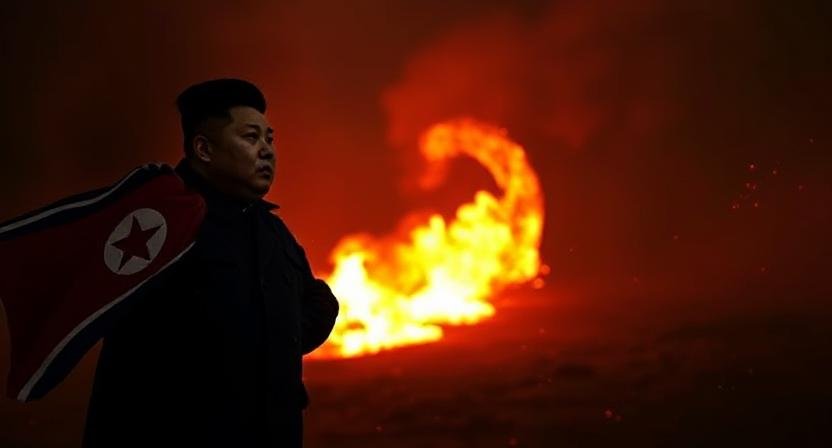
- North Korea accelerates construction at Sohae Satellite Launching Station with a new seaport for rapid delivery of rocket components.
- Russia’s space technology transfer could cut North Korea’s satellite program timeline from a decade to just 1–2 years.
- A functioning spy satellite network would dramatically improve Pyongyang’s missile precision and regional military posture.
- The Russia–North Korea alliance signals a long-term strategic shift challenging U.S. and allied intelligence dominance in Asia.
The world has been distracted by the noise of Ukraine’s battlefields and the shadowboxing between Washington and Beijing, but a quieter, more dangerous development is unfolding on the Korean Peninsula. North Korea is accelerating its race to space—not to plant flags or study cosmic dust, but to sharpen the eyes of its missile arsenal. And it is doing so with Russia’s open hand guiding it.
Recent satellite imagery of the Sohae Satellite Launching Station on North Korea’s west coast should set off alarm bells in every defense ministry from Tokyo to Washington. The construction is not cosmetic—it is transformative. A new seaport capable of receiving large rocket components by sea replaces the slower, more conspicuous railroad deliveries. Alongside it, new buildings, expanded rail lines, and an enlarged rocket assembly center point to one conclusion: Kim Jong Un wants operational military satellites in orbit faster than the world expects.
This is not a solo sprint. The fingerprints of Moscow are all over the launchpads and the plans. Since Kim pledged military support to Vladimir Putin’s war in Ukraine, Russia has repaid him not just with drones and air-defense systems but with something far more strategic: space technology. In the calculus of modern warfare, a spy satellite is not a trophy—it’s a targeting tool. It turns a crude missile threat into a precise strike capability, including against the U.S. mainland.
As one Seoul-based analyst put it, Russian help could compress a decade of North Korean trial-and-error into a mere one or two years. That is a terrifying acceleration for any nation in range of Pyongyang’s ambitions, which is to say, nearly all of them.
Critics may argue that North Korea’s capabilities are still rudimentary—low-resolution cameras, questionable transmission systems, satellites that may or may not even function. But that is missing the point. The history of military technology teaches us that regimes with political will, external expertise, and no moral guardrails can leapfrog stages of development. North Korea has already rewritten its space laws to strip away the fig leaf of “peaceful use.” It has declared openly that satellites will serve military ends. It has learned from its launch failures. And it has a superpower partner willing to sidestep U.N. sanctions to see this project succeed.
The strategic implications are profound. A functioning North Korean space-reconnaissance network would challenge the intelligence advantage the U.S., South Korea, and Japan currently enjoy. It would embolden Pyongyang’s military posture in the region and strengthen its deterrence—not just against its traditional foes but also against international pressure campaigns. And in a broader geopolitical sense, it would cement a Russia-North Korea technology alliance that undermines decades of nonproliferation efforts.
This is not just about satellites in the sky; it’s about shifting the balance of power on Earth. If the West treats this as a technical curiosity rather than a security crisis, it risks waking up to a North Korea that can see everything it wants to hit—and hit it with confidence.
The uncomfortable truth is that Russia’s willingness to share space technology with Pyongyang is not a temporary transaction—it’s a strategic alignment born of mutual isolation and mutual need. Moscow gets artillery shells and political solidarity; Pyongyang gets the eyes in the sky it has coveted for decades. This partnership will not dissolve when the war in Ukraine ends—it will endure because it is built on shared defiance of the current global order.
The question for the international community is whether it is willing to watch this happen in slow motion or act before North Korea’s ambitions are no longer theoretical. Sanctions alone will not suffice; Moscow has already proved it will ignore them. Diplomatic isolation will not work; both regimes have already embraced their pariah status. This is a challenge that will require unconventional thinking—economic levers, technological countermeasures, and perhaps a new regional security framework that recognizes the Russia-North Korea axis for what it is: a dangerous, mutually reinforcing threat to stability in Asia and beyond.
Because once Kim Jong Un has a constellation of spy satellites overhead, the rules of the game will change—not in theory, but in practice. And by then, it may be too late to do anything about it.