


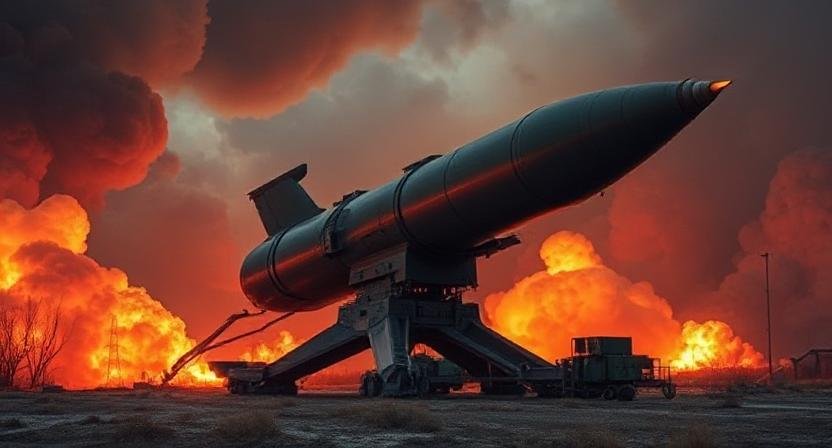
- Ukraine’s 1990s disarmament is now seen as a catastrophic blunder that left the nation exposed to Russian aggression.
- North Korea’s nuclear success has emboldened its aggression and made it immune to military retaliation.
- U.S. allies, fearing abandonment under Trump-era policies, are openly considering building their own nuclear arsenals.
- The global nonproliferation regime is unraveling, as countries like Iran and Turkey weigh the benefits of going nuclear.
In a world torn between unresolved wars and fragile alliances, the nuclear question is no longer a matter for rogue states alone. Once a red line carefully guarded by international consensus, the pursuit of atomic weapons is now back on the agenda—from Seoul to Warsaw, Ankara to Tokyo. The shadows of Ukraine and North Korea cast an ominous contrast: one gave up its weapons and was invaded, the other built them and now fires missiles with impunity.
This reversal is stark and instructive. In the 1990s, the United States had two primary nuclear objectives: persuade newly independent Ukraine to relinquish its Soviet-era arsenal, and prevent North Korea from obtaining a nuclear bomb. The first mission succeeded—at least temporarily. Ukraine, home to the world’s third-largest arsenal at the time, agreed under Western pressure to disarm in exchange for paper promises of sovereignty. But today, Ukraine is fractured, occupied, and bleeding. The second objective failed: Pyongyang went nuclear, weaponized diplomacy, and became untouchable. It now bombards Ukraine alongside Russian forces, emboldened by the knowledge that no one dares confront a nuclear power head-on.
This is the new nuclear reality, and it’s inspiring dark calculations among America’s allies and adversaries alike. Across Europe and Asia, previously unthinkable debates about domestic nuclear capability are now entering the political mainstream. Allies like South Korea, Japan, Germany, Poland, and Turkey have begun quietly asking the same question: Can we still trust the U.S. nuclear umbrella—or must we build our own?
That doubt is not born in a vacuum. Former President Donald Trump shook the foundations of the post-Cold War order. His open contempt for NATO, repeated threats to pull U.S. forces from South Korea, and transactional approach to foreign policy have fueled fears of abandonment. Polls in South Korea now show a majority of citizens want their country to develop nuclear weapons. And it’s not just conservatives—center-left voters and lawmakers, including President Lee Jae-myung, now support the idea.
READ MORE: Israel Takes Control of Iran’s Skies—a Feat That Still Eludes Russia in Ukraine
Robert E. Kelly, a political science professor in South Korea, believes the shift is rational. “Trump is certainly not going to take nuclear risks for allies,” he said. “Nobody believes South Korea would launch a nuclear weapon unprovoked. These are democracies. If they build them, it’s fine. It’s only American arrogance that says we’re the only ones who can be trusted.”
The North Korea paradox looms large over these discussions. Its transformation from starving dictatorship to nuclear-armed disruptor is now a model for survival in a hostile world. Kim Jong Un, once viewed as a volatile pariah, now stands as a defiant symbol of deterrence. Unlike Iran, which is under Israeli military assault for its nuclear program, Pyongyang launches missiles and joins foreign wars without consequence. It is a chilling but effective playbook.
Iran’s experience is notably different. Its nuclear program, framed as civilian but widely believed to be military in intent, has cost the country an estimated $1 trillion in lost trade and sanctions. Israel, unconvinced by Tehran’s claims, is now waging war to stop what it calls an imminent nuclear breakout. Yet that hasn’t stopped nuclear advocates from spinning Iran’s dilemma differently. Some argue the mistake wasn’t that Iran pursued nuclear weapons—but that it didn’t do so fast enough.
MUST READ: U.S. and Iran Establish Direct Contact Amid War — But Tehran Rejects Negotiations
This dangerous logic is gaining ground in Turkey, where nationalist voices are calling for nuclear arms to match Israeli power in the region. Gérard Araud, former French ambassador to the U.S. and the UN, put it bluntly: “If I were a Turkish strategist, I’d consider going nuclear. Israel has changed the rules of the game.”
France, for its part, feels vindicated. President Charles de Gaulle’s decision in the 1960s to develop an independent French nuclear deterrent, against U.S. wishes, is now seen as visionary. “We never wanted to outsource our security,” said Defense Minister Sébastien Lecornu. Still, he offered a sobering reminder that nuclear weapons are not a cure-all: “Russia, despite being a nuclear power, has failed in Ukraine. Nuclear deterrence doesn’t win ground wars.”
Ukraine’s case remains the most emotionally and geopolitically potent. In 1994, it surrendered its nukes under the Budapest Memorandum, in return for security assurances from the U.S., U.K., and Russia. Those promises turned to dust in 2014 with the annexation of Crimea, and again in 2022 with the full-scale invasion. Steven Pifer, who helped negotiate the deal, now concedes that Kyiv had few good choices. “Keeping the nukes would have isolated Ukraine from NATO and the EU,” he said. “But giving them up left it defenseless.”
The regret is no longer whispered. Retired General Valeriy Zaluzhniy, now Ukraine’s ambassador to London, remarked this year that his country remains Europe’s bulwark “for now, without nuclear weapons.” Some heard that as a warning: Ukraine could reconsider its disarmament.
Elsewhere, the breakdown of global nuclear consensus continues. The 1968 Non-Proliferation Treaty (NPT), which sought to freeze the number of nuclear states, is cracking. North Korea withdrew in 2003. Iran skirts the line. Russia’s actions have made a mockery of its commitments. Ukraine’s former foreign minister Pavlo Klimkin said the NPT “is not dead, but in crisis mode.”
That crisis is spreading. The economic and political cost of going nuclear remains high—estimated in the billions and risking sanctions or military strikes. But nations are increasingly willing to pay that price for sovereignty. As Brian Mast, chairman of the House Foreign Affairs Committee, said: “Everyone wants to fight above their weight class. Nuclear weapons let you do that.”
South Korea may soon test the limits of that ambition. North Korea’s growing arsenal now threatens the U.S. mainland, making Washington’s willingness to defend Seoul increasingly uncertain. The strategic logic resembles the question Charles de Gaulle once posed to John F. Kennedy: Would the U.S. risk New York to save Paris?
Kennedy never gave a definitive answer. And today, neither does America. That silence may echo louder than any missile test.