


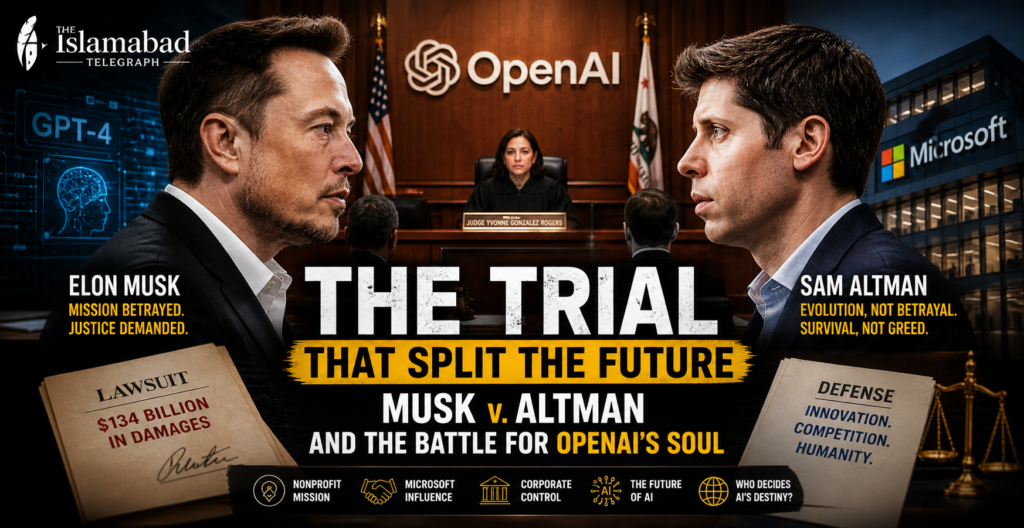
- OpenAI trial highlights a legal battle over the future of artificial intelligence
- Elon Musk alleges OpenAI violated its nonprofit founding principles
- Sam Altman argues restructuring was necessary to compete globally
- Microsoft’s role emerges as a determining factor in the courtroom
The courtroom in Oakland has become the unlikely stage for a philosophical knife fight over the future of artificial intelligence — and over the truth of what OpenAI was ever meant to be. Elon Musk and Sam Altman, once coarchitects of a nonprofit AI lab built to “benefit humanity,” now stand on opposite sides of a civil case that threatens to unravel the most influential AI institution on the planet.
At its core, the lawsuit is not just about money — though the numbers are staggering — but about whether OpenAI betrayed its founding mission and whether one of the most powerful technologies in human history has already been captured by corporate gravity.
Musk’s Argument: A Mission Betrayed
Musk’s case rests on a simple but explosive claim: OpenAI was founded as a nonprofit, and Altman and Greg Brockman deceived him into funding it under that premise. Musk contributed roughly $38 million in donations, not investments, because he believed the organization would remain opensource, transparent, and insulated from commercial capture.
According to Musk, the pivot to a forprofit structure — and the deep entanglement with Microsoft — represents a breach of charitable trust and an unjust enrichment of OpenAI’s leadership. He is seeking up to $134 billion in damages, not for himself, but to be returned to OpenAI’s nonprofit arm.
What Does Musk $1 trillion pay package Mean for Trump—and Musk’s Empire of the Future?
Musk’s testimony has been characteristically blunt. He told the court that allowing OpenAI’s restructuring to stand would signal that “it’s OK to loot a charity,” a line that drew immediate objection but captured the emotional core of his argument.
Sam Altman says the quiet part out loud, confirming some companies are ‘AI washing’ by blaming unrelated layoffs on the technology
He also claims that OpenAI’s exclusive licensing deal with Microsoft — granting the tech giant privileged access to GPT4 — violated the original agreement that no private entity should benefit from the organization’s work.
Iran US Talks Islamabad Resume Without VP JD Vance as High-Stakes Negotiations Enter Critical Phase
Altman’s Defense: Evolution, Not Betrayal
Altman’s team counters with equal force: Musk knew about and supported the idea of a forprofit structure as early as 2017, and his lawsuit is less about principle and more about rivalry — specifically, slowing down a competitor to Musk’s own AI company, xAI.
OpenAI argues that the nonprofit model simply could not raise the billions required to compete with Google and other AI giants. The forprofit subsidiary, they say, was a necessary adaptation to survive the escalating arms race in AI development.
They also insist Musk’s contributions were taxdeductible donations, not investments, and therefore confer no ownership or governance rights.
OpenAI trial: Scrutiny on Altman: A Pattern of Turbulence
Altman enters this trial with a complicated public record. His abrupt firing by OpenAI’s board in 2023, followed by a dramatic reinstatement after employee revolt and Microsoft’s intervention, remains a stain on his leadership narrative. The board never fully disclosed the reasons for his removal, fueling speculation about transparency and internal governance failures.
This history matters because Musk’s legal team is painting a portrait of Altman as a leader willing to bend rules, restructure organizations, and consolidate power — even at the cost of institutional stability.
And then there is Microsoft.
OpenAI trial: Microsoft’s Shadow Over the Case
No entity looms larger in this trial than Microsoft, whose multibilliondollar investment and deep integration into OpenAI’s infrastructure have effectively made it the organization’s gravitational center.
Microsoft CEO Satya Nadella is expected to testify, underscoring how central the company has become to OpenAI’s operations.
Musk argues that OpenAI has become a de facto Microsoft subsidiary — a far cry from the independent, open nonprofit he helped build. Altman’s team counters that Microsoft’s involvement is strategic, not controlling, and that the partnership accelerated innovation rather than compromising mission.
What the Jury Must Decide
The jury’s advisory verdict will guide Judge Yvonne Gonzalez Rogers, but the final decision rests with her. The stakes are enormous:
- OpenAI’s corporate structure could be dismantled
- Altman and Brockman could be removed
- Microsoft’s influence could be curtailed
- The nonprofit mission could be restored — or declared obsolete
Legal experts caution that unwinding the forprofit structure is unlikely, given that state attorneys general already approved it. Monetary damages are more plausible.
The Larger Story
This trial is not just about two billionaires. It is about who controls the future of artificial intelligence — a nonprofit ideal, a corporate titan, or a hybrid model that satisfies neither purists nor pragmatists.
In the end, Musk and Altman are fighting over the same question the rest of the world is asking: Who gets to steer the most powerful technology ever built — and who gets to decide what “benefiting humanity” really means?