


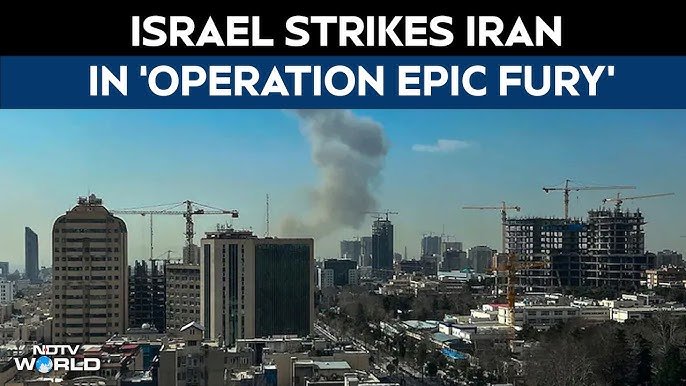
- Operation Epic Fury marks one of the largest coordinated U.S.–Israel military campaigns against Iran in decades.
- Precision strikes targeted Iranian nuclear facilities, missile systems, and senior leadership infrastructure.
- Iran’s retaliation and regional proxy networks raise fears of a wider Middle East war.
- Analysts warn the conflict could redefine deterrence, nuclear diplomacy, and regional power balance.
The United States and Israel have launched one of the most sweeping and coordinated military operations against Iran in decades, a campaign formally designated by the Pentagon as Operation Epic Fury.
The strikes, carried out across multiple Iranian cities and strategic installations, represent a dramatic escalation in the long-running confrontation over Tehran’s nuclear program, ballistic missile arsenal, and expanding regional influence. Early reports indicate that the operation has already inflicted significant damage on Iranian military and nuclear infrastructure while also targeting the upper echelons of Iran’s political and security leadership.
The Scope and Damage of the Initial Strikes
Explosions were reported across Tehran and several other major cities, including Qom, Isfahan, Kermanshah, and Karaj, marking a rare instance of simultaneous, multi-city strikes deep inside Iranian territory. One of the most notable impacts occurred near the offices of Supreme Leader Ayatollah Ali Khamenei, where blasts were confirmed in the vicinity of his compound, underscoring the precision and symbolic weight of the operation.
Civilian Killed in Abu Dhabi as Iran Missile Attacks Strike UAE, US Bases, and Israel Responds
U.S. and Israeli forces executed what defense officials described as multidomain precision strikes, combining airpower, cyber capabilities, and advanced intelligence coordination. Targets reportedly included command-and-control nodes, missile launch systems, air defense infrastructure, and sensitive nuclear enrichment facilities. The stated objective is to dismantle Iran’s ballistic missile architecture and halt further advancement of its nuclear weapons capability—long viewed by Washington and Tel Aviv as a critical national security threat.
US and Israel carry out joint attack on Iran as Tehran launches retaliatory strikes
Early assessments from Iranian officials, including statements provided to international media outlets, acknowledge that the damage to nuclear sites is “serious,” though the full extent remains undisclosed. Analysts suggest that the strikes were designed not merely to degrade physical infrastructure but also to disrupt operational continuity within Iran’s strategic command network.
The Iranian government responded swiftly by shutting down its airspace and activating nationwide air defense systems. Retaliatory missile launches toward Israel followed within hours, triggering air-raid sirens in multiple Israeli cities and signaling that Tehran intends to respond decisively, reinforcing fears of rapid military escalation.
Targeting Iran’s Leadership
While the United States has framed the operation as a strategic effort aimed at neutralizing Iran’s military capabilities, several regional reports indicate that the strikes also targeted senior Iranian officials and leadership hubs. According to regional coverage, the operation “primarily targeted Iranian leaders,” suggesting a broader effort to degrade—or potentially decapitate—the command structure overseeing Iran’s nuclear and regional military operations.
U.S. Joins Israel in Attack on Iran: Global Security Faces Historic Escalation
Explosions near the Supreme Leader’s office and reports of injuries among senior Iranian figures—including claims that the Iranian president sustained injuries during Israeli bombing activity earlier in the broader confrontation—underscore how leadership nodes have become central targets in modern high-intensity warfare.
Although no official U.S. statement has confirmed an explicit attempt to eliminate Ayatollah Khamenei or other senior leaders, the proximity of strikes to key operational centers and the declared objective of neutralizing Iran’s capacity to direct attacks strongly imply that leadership disruption forms part of the strategic calculus behind Operation Epic Fury.
President Trump’s Signaled Endgame
President Donald Trump has publicly stated that the United States is undertaking “major combat operations” to prevent what he described as a “wicked, radical dictatorship” from threatening American national security interests and destabilizing the Middle East. He has also emphasized that Iran must agree to a new agreement constraining its nuclear program while curbing its regional military posture.
Taken together, these statements suggest an end strategy built around three interconnected pillars:
- Crippling Iran’s nuclear and missile capabilities to force Tehran back into negotiations under U.S. strategic terms.
- Weakening or destabilizing the regime’s command structure, limiting its ability to coordinate regional militias and proxy networks.
- Creating internal political pressure within Iran, potentially encouraging a shift in leadership behavior or strategic policy direction.
While Trump has stopped short of explicitly advocating full-scale regime change, the scale, intensity, and geographic breadth of the strikes indicate a willingness to push Iran toward strategic exhaustion if necessary to secure a new regional security framework.
Regional War Capabilities and the Risk of Escalation
Despite the scale of the assault, Iran retains significant retaliatory capacity through its ballistic missile forces, naval assets in the Persian Gulf, and an extensive network of regional proxies, including Hezbollah in Lebanon and the Popular Mobilization Forces in Iraq. The conflict already appears to be expanding across multiple theaters, with U.S. and Israeli forces striking targets not only within Iran but also in areas where Iranian-aligned militias operate.
Israel has activated nationwide emergency protocols across hospitals and civil defense systems in anticipation of sustained missile barrages. Meanwhile, the United States has deployed additional naval strike groups, advanced air assets, and missile defense systems capable of sustaining long-duration operations, signaling readiness for an extended confrontation.
The risk of a broader regional war remains substantial. Sustained Iranian retaliation could draw Gulf states into the conflict, disrupt global energy markets, and threaten critical maritime routes, including shipping lanes vital to international oil supplies. Such developments could trigger a cascading escalation cycle that neither side may fully control.
Where the Conflict Could Go Next
Operation Epic Fury marks only the opening phase of what could become a prolonged and unpredictable geopolitical crisis. Several potential pathways now loom:
- A negotiated pause if Iran calculates that continued escalation threatens regime stability.
- A widening regional conflict should Tehran activate its full proxy network across the Middle East.
- A prolonged U.S.–Iran shadow war characterized by intermittent airstrikes, cyber operations, and covert confrontation.
- Internal political turbulence within Iran, depending on the depth of leadership disruption and economic pressure.
For now, the operation has fundamentally altered the strategic landscape of the Middle East. The coming days will determine whether Operation Epic Fury becomes a turning point toward a new regional security order—or the spark that ignites a far larger and more dangerous war.