


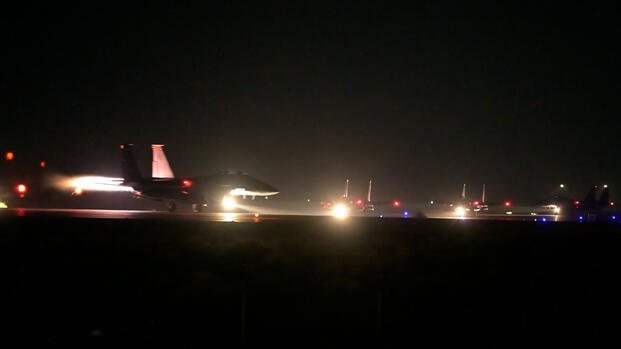
- Operation Hawkeye Strike involved over 90 precision munitions targeting 35+ ISIS locations.
- The mission serves as a direct retaliation for the December 13 attack on U.S. forces in Palmyra.
- Syrian President Ahmed al-Sharaa has officially aligned his government with the U.S.-led coalition.
- The strikes aim to dismantle the “parallel government” structures ISIS established in the Syrian desert.
The geopolitical landscape of the Levant shifted dramatically on January 10, 2026. Following a direct order from President Donald Trump, the United States military, in coordination with regional partners, executed Operation Hawkeye Strike—the largest and most ruthless air campaign against Islamic State (IS) infrastructure since the fall of the Assad regime in late 2024.
The scale of the operation was unprecedented: over 90 precision munitions launched by a fleet of 20 aircraft, including F-15Es, AC-130Js, and Jordanian F-16s, targeting more than 35 critical ISIS nodes across central Syria.
US Strikes ISIS in Nigeria: Trump Authorizes Deadly Christmas Day Missiles Against Extremists
For decision-makers in Washington, Damascus, and international think tanks, this strike is not merely a tactical victory; it is a strategic pivot designed to anchor the nascent government of President Ahmed al-Sharaa and signal the end of the “parallel governance” that has plagued the Syrian desert.
Neutralizing the “Shadow Caliphate”
Since the collapse of the Ba’athist state, ISIS has attempted to exploit the transitional vacuum. While the group lost its territorial “Caliphate” years ago, by late 2025 it had begun running a parallel administration in the Badiya (the central Syrian desert).
US military strikes Islamic State group targets in Syria, officials say
This “Shadow Caliphate” was no longer just a series of insurgent cells; it was collecting “taxes,” operating training camps, and—most dangerously—infiltrating the new Syrian security apparatus.
The December 13 attack in Palmyra, which killed two U.S. soldiers and a civilian interpreter, was the catalyst for this escalation. However, the importance of the Hawkeye Strike goes beyond “vengeance,” as Defense Secretary Pete Hegseth termed it.
Somali Fraud Scandal: The $9 Billion Crisis Shaking Minnesota and the Nation
It was a surgical removal of the organizational backbone that allowed ISIS to challenge Al-Sharaa’s authority. By obliterating command-and-control centers and drone launch sites, the U.S. has effectively decapitated the leadership capable of managing a parallel state.
The Strategic Lifeline for the Sharaa Government
For President Ahmed al-Sharaa—the former rebel leader turned statesman—this strike is a vital endorsement of his legitimacy.
Sovereignty through Partnership: By publicly backing the strikes and joining the anti-ISIS coalition, Sharaa has transitioned from a “designated” figure to a “geopolitical ally.” The strikes provide his government the breathing room to consolidate domestic control without being constantly overstretched by a desert insurgency.
Integration of the SDF: A primary hurdle for the new Syrian state has been the integration of the Kurdish-led Syrian Democratic Forces (SDF). The joint nature of these operations—involving U.S. intelligence and Syrian/Jordanian cooperation—creates a template for a unified national security architecture.
Economic Stabilization: Following the repeal of the Caesar Act sanctions by the Trump administration, Syria is desperate for foreign investment. No CEO or international body will commit capital to a country where ISIS can strike at will. This operation is a prerequisite for the $216 billion reconstruction effort Syria requires.
Operation Hawkeye Strike: Implications for International Stability
Heads of international bodies must recognize that the “Hawkeye Strike” represents a return to a high-intensity, low-footprint model of counterterrorism. President Trump’s message—”If you harm our warfighters, we will find you and kill you”—is a doctrine of absolute deterrence.
For the first time in over a decade, there is a realistic prospect of a unified Syrian state that is neither a Russian satellite nor an Iranian corridor. However, the risk remains: as ISIS loses its ability to govern “shadow territories,” it may pivot back to asymmetric, insider attacks. The challenge for the Sharaa government now is to turn this military momentum into civil stability.