


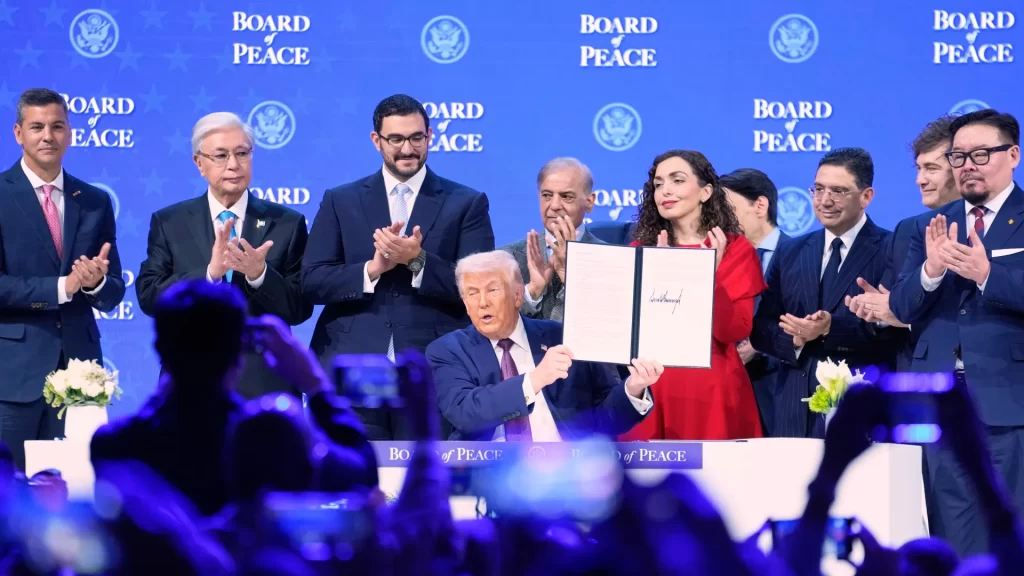
Eight Muslim nations, including nuclear-armed and strategically pivotal Pakistan, have issued a rare and forceful collective warning against what they describe as Israel’s accelerating expansionist project in the occupied West Bank—a move that lands just days before a planned meeting of US President Donald Trump’s newly constituted Gaza Peace Board.
The timing is deliberate, the language unusually blunt, and the signal unmistakable: the Muslim world’s key diplomatic actors are drawing a red line against the quiet normalization of annexation.
In a joint statement released on Monday, the foreign ministers of Pakistan, Egypt, Jordan, the United Arab Emirates, Indonesia, Turkiye, Saudi Arabia, and Qatar condemned “in the strongest terms” Israel’s latest legal and administrative measures aimed at imposing unlawful sovereignty over occupied Palestinian land.
The ministers warned that Israel’s actions are not isolated bureaucratic tweaks but part of a systematic effort to entrench settlements, alter the legal character of the West Bank, and accelerate what they called the de facto annexation of Palestinian territory.
The warning followed Israel’s security cabinet approval of steps that significantly ease land purchases by Jewish settlers in the West Bank while expanding Israeli enforcement authority over Palestinians.
Israeli media reports, citing statements by Finance Minister Bezalel Smotrich and Defence Minister Israel Katz, indicated that decades-old restrictions preventing private Jewish land acquisition in the occupied territory would be scrapped—effectively opening the door to rapid settlement expansion under a civilian legal framework.
For the eight Muslim states, this shift represents a dangerous escalation. Their statement reaffirmed a core legal position that has increasingly been challenged on the ground but remains anchored in international law: Israel has no sovereignty over occupied Palestinian territory.
The ministers argued that the new measures fuel violence, undermine regional stability, and deliberately sabotage the two-state solution at a moment when diplomacy—particularly around Gaza—remains fragile.
Pakistan’s inclusion is especially significant. Unlike some regional players constrained by normalization agreements or security dependencies, Islamabad has maintained a consistently hard diplomatic line on Palestine while simultaneously engaging major global powers. Its presence alongside Gulf states, Türkiye, and frontline Arab countries signals a broader convergence—linking moral argument, legal precedent, and geopolitical coordination.
The statement explicitly cited UN Security Council Resolution 2334, which condemns Israeli actions aimed at altering the demographic and legal status of territory occupied since 1967. It also recalled the 2024 advisory opinion of the International Court of Justice, which found Israel’s continued presence in the occupied Palestinian territories to be illegal and declared annexation efforts null and void.
By invoking both instruments, the ministers grounded their warning not in rhetoric but in binding international norms that many Western capitals publicly endorse yet rarely enforce.
What makes the intervention more consequential is its proximity to Trump’s Gaza initiative. The same eight countries have been working with the Trump administration on efforts to halt Israel’s war in Gaza and shape a post-conflict political framework. Earlier this month, they jointly condemned Israel’s repeated ceasefire violations, warning that continued military and political escalation risked collapsing the second phase of Trump’s plan.
In this context, the West Bank measures appear to the ministers not as a parallel issue but as part of a unified strategy: reshaping realities on the ground while diplomatic attention remains focused on Gaza. The joint warning is therefore as much a message to Washington as it is to Tel Aviv. Any peace framework that ignores annexation dynamics in the West Bank, the ministers suggest, will be structurally hollow.
The statement concluded by reaffirming support for Palestinian self-determination and statehood based on the two-state solution and the Arab Peace Initiative—still described as the only viable path to durable peace. Whether this unified Muslim front can translate diplomatic consensus into concrete international pressure remains uncertain.
But its emergence ahead of Trump’s Gaza peace deliberations marks a notable recalibration: Israel’s expansionist policies are no longer being treated as background noise but as a central obstacle to any credible regional settlement.