


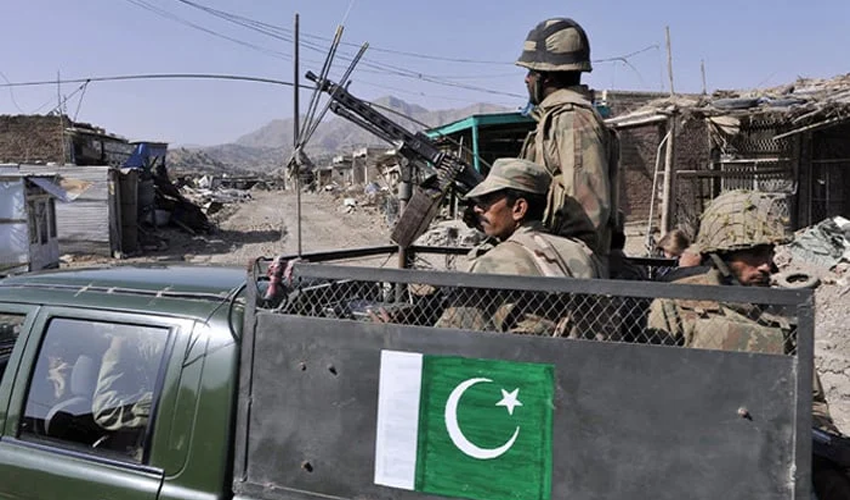
It looked like a scene straight out of a Hollywood blockbuster — only this was real, raw, and far more thrilling.
A group of braveheart soldiers from Pakistan Army smashed into a building overtaken by Indian-backed terrorists armed with sophisticated weapons. It was a highly dangerous mission. Inside, the terrorists were monitoring every movement through live CCTV feeds, believing technology would protect them. The soldiers knew one wrong step could mean instant death.
But hesitation is not in the DNA of Pakistan’s Armed Forces.
With lightning speed, the commandos stormed the structure, dodging bullets, breaking through barricades, and eliminating every terrorist within minutes. The building was cleared so fast that the attackers barely understood what hit them.
The operation spoke volumes about the preparedness, intelligence superiority, and battlefield professionalism of Pakistan’s military.
And while these fearless soldiers were hunting terrorists on the streets of Balochistan, thousands of kilometers away in Rawalpindi’s General Headquarters (GHQ), Field Marshal Asim Munir was receiving real-time operational intelligence — tracking troop movements, monitoring engagements, and directing strategic responses with surgical precision.
From the frontline to the command center, it was a perfectly synchronized counterterrorism operation.
It all unfolded on January 31, 2026 — a day that Fitna-al-Hindustan terrorists hoped would plunge Balochistan into chaos. Instead, it turned into one of their worst nightmares.
As one elite unit conducted a high-risk building clearance, multiple teams of Pakistan’s Armed Forces, Frontier Corps (FC), police, and Counter-Terrorism Department (CTD) launched coordinated counter-attacks across the province.
By sunset, at least 60 Indian-backed terrorists had been neutralized across 12 locations.
In Quetta’s Saryab Road area, terrorists targeted a police van, hoping to spark panic. Within seconds, police and FC troops responded with overwhelming firepower, killing four terrorists on the spot.
At Nushki FC headquarters, militants attempted a fire raid. Instead of success, they were met with heavy resistance, forcing them to flee in humiliation.
In Dalbandin, terrorists attempted a suicide attack on the FC headquarters. The area was immediately cordoned off as security forces engaged the attackers in a fierce firefight.
Kalat witnessed attacks on the DC headquarters and police lines, but once again, Pakistan’s forces responded decisively, inflicting heavy casualties.
In Pasni, a distant fire raid on Pakistan Coast Guard installations was swiftly repelled.
In Gwadar, terrorists targeted a laborers’ colony — a cowardly attempt to harm civilians. Police and FC arrived within minutes, engaging the attackers and preventing casualties.
Grenade and gun attacks were also launched on posts in Balicha, Tump, and Mastung — all successfully thwarted.
Across Balochistan, Fitna-al-Hindustan’s coordinated assault collapsed like a house of cards.Balochistan Chief Minister Sarfraz Bugti confirmed that security forces killed at least 37 terrorists while foiling attacks at 12 locations. Over the last 48 hours alone, more than 70 terrorists have been eliminated.
Ten brave soldiers and police personnel embraced martyrdom — heroes who laid down their lives for Pakistan’s peace.
“These attacks cannot shake our resolve,” CM Bugti said. “We will continue operations until the last terrorist is eliminated.”
State-run Radio Pakistan reported that pursuit operations are still ongoing, with more terrorist casualties expected as security forces hunt down fleeing militants.
As a precaution, mobile data services were temporarily suspended in sensitive regions, while ground operations continued without interruption.
Chief Minister Bugti personally visited the Quetta blast site, receiving briefings from Balochistan IG Muhammad Tahir. He praised the swift and effective response by police, FC, and CTD.
“Anti-state elements will not be spared,” he said firmly. “There will be no compromise on peace in Balochistan.”
Hospitals across the province were placed on emergency footing, ensuring immediate medical care for injured personnel.
In another major success, security agencies in Nasirabad discovered and neutralized an IED planted on a railway track, including an anti-tank mine and explosive material — preventing a major sabotage attempt.
President Asif Ali Zardari commended the Armed Forces and law enforcement agencies for their professionalism and courage.
“Our national unity and security will not be compromised,” the president said, vowing full-force action against externally backed terrorists.
But beyond official statements, what truly stood out was the flawless coordination between frontline soldiers and strategic command.
From GHQ Rawalpindi, Field Marshal Asim Munir monitored live updates, intelligence feeds, and battlefield progress — ensuring rapid decision-making and timely reinforcements wherever needed.
Military analysts say this real-time command-and-control system played a decisive role in foiling the multi-pronged terrorist assault.
“This was a textbook example of modern counterterrorism warfare,” one security expert noted. “From intelligence gathering to execution, everything was perfectly synchronized.”
Eyewitnesses across Quetta described scenes of fearless soldiers advancing through gunfire with calm confidence.
“It felt like watching a special forces movie — except it was real,” said Mustansar Klasra, Islamabad based defense and security analyst. “The terrorists had no chance.”
Another shopkeeper laughed while recalling fleeing militants. “They came thinking they were heroes. They ran like cowards.”
Meanwhile, Indian media outlets attempted — as usual — to exaggerate the situation, portraying chaos and instability. On ground, however, terrorists were being systematically hunted and eliminated.
What Fitna-al-Hindustan branded as “Herof 2.0” turned into an operation of total humiliation.
Instead of creating fear, they strengthened Pakistan’s unity.
Instead of destabilizing Balochistan, they showcased the strength of Pakistan’s security apparatus.
Instead of scoring propaganda wins, they suffered crushing losses.
January 31, 2026 will be remembered as the day Pakistan’s Armed Forces once again proved their dominance over terrorism.
From Hollywood-style building clearances to province-wide counterterror operations, the sons of the soil displayed unmatched bravery, discipline, and professionalism.
No matter how many terrorists are trained across the border.
No matter how many conspiracies are planned.
No matter how many attacks are launched.
Pakistan’s Armed Forces will always respond — swiftly, decisively, and victoriously.
They don’t just defend.
They dominate.