


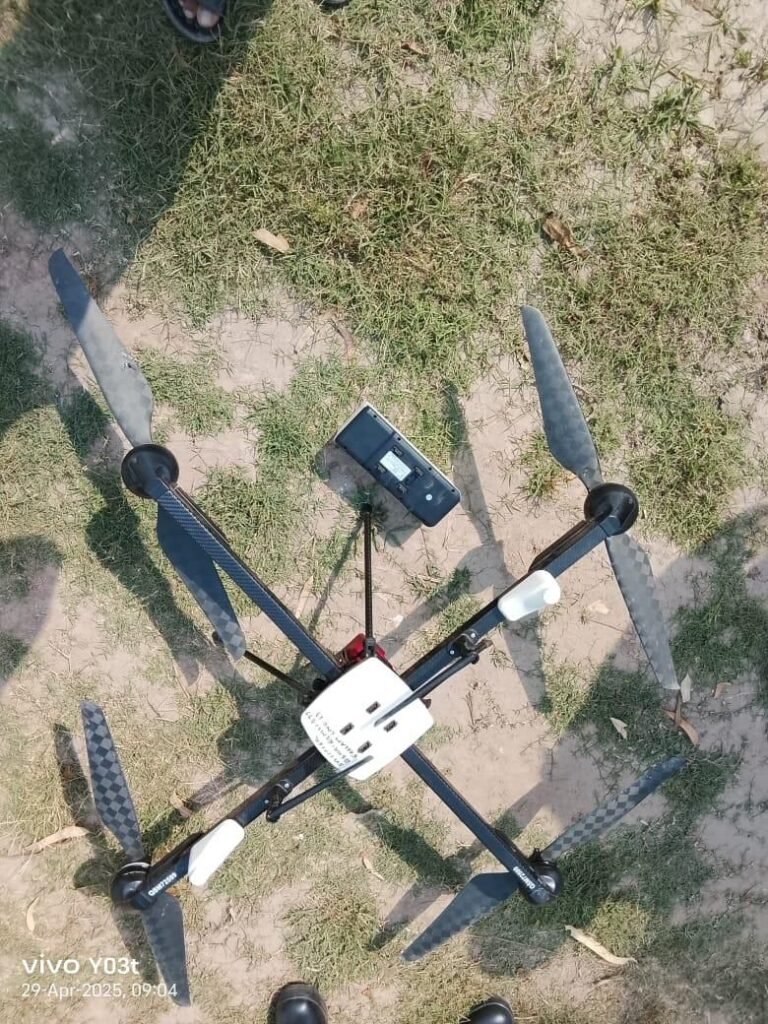
- Pakistan Army shot down an Indian surveillance drone in Bhimber sector, AJK, near the Line of Control.
- Armed forces remain on 24/7 high alert with advanced radar systems capable of detecting even minor aerial threats.
- Defence Minister Khawaja Asif warned of an imminent threat from India and reaffirmed Pakistan’s readiness for any aggression.
- Global powers and the UN have expressed serious concerns over rising tensions between nuclear-armed Pakistan and India.
ISLAMABAD — In a stark reminder of the fraught and ever-tense border between two nuclear-armed neighbors, the Pakistan Army on Tuesday successfully intercepted and shot down an Indian quadcopter drone attempting to violate Pakistan’s airspace across the Line of Control (LoC) in Azad Jammu and Kashmir (AJK).
According to sources, the surveillance drone was brought down in the Manawar sector of Bhimber district in AJK. Security officials confirmed that the drone’s incursion was “promptly and effectively” neutralized by Pakistan’s border troops who were operating on heightened alert following the recent uptick in cross-border tensions.
“The enemy attempted to conduct surveillance using a quadcopter in the Manawar sector, but Pakistan Army troops took timely action and foiled this nefarious attempt,” sources stated. “This incident is a clear testimony to the vigilance, professional skill, and defensive preparedness of the Pakistan Army.”
Security forces added that this was not an isolated incident but part of an increasingly aggressive pattern of violations emanating from the Indian side, especially in the aftermath of the deadly Pahalgam attack that claimed 26 lives on April 22.
Around-the-Clock Vigilance: Pakistan’s Radar Shield
Military analysts have long noted that Pakistan’s defense posture along the LoC is one of the most fortified and closely monitored zones in South Asia. Pakistani forces maintain a 24/7 radar and aerial monitoring system capable of tracking even the smallest objects entering its airspace.
In the Dead of Night: How Pakistan’s Brave Soldiers Crushed a Deadly Terrorist Infiltration
An intelligence official, speaking on condition of anonymity, noted: “Our systems are so finely tuned that even a bird flying across from the other side is detected. This recent interception of an Indian drone underscores how seriously Pakistan takes its territorial integrity.”
The radar coverage, integrated with real-time surveillance drones and thermal imaging systems, ensures that any attempt at airspace violation—be it manned or unmanned—is met with swift retaliation.
Tensions Escalate After Pahalgam Attack
The drone incident comes in the wake of the Pahalgam attack in Indian-occupied Kashmir that killed mostly tourists. India was quick to hint at cross-border involvement, despite not providing any credible evidence. In contrast, Pakistan has categorically denied any role in the assault and demanded an impartial international investigation into the incident.
The Resistance Front, which initially appeared to claim responsibility, later issued a statement denying involvement, calling the attribution “fraudulent.” Islamabad has since been on high alert, bracing for a potential military misadventure by India.


“The armed forces remain on maximum operational readiness,” said a military spokesperson. “We cannot afford to take any chances given the current hostile rhetoric emanating from across the border.”
Skirmishes have also resumed after four years of relative peace, with reports of intermittent exchanges of fire across several LoC sectors. Indian officials claimed gunfire in the Kupwara, Baramulla, and Akhnoor sectors, though Pakistan has yet to confirm these specific incidents.
Khawaja Asif Warns of Looming Threat
Pakistan’s Defence Minister Khawaja Asif added gravity to the situation with a series of stern warnings during media appearances on Monday. Speaking to Reuters, he disclosed that the military had “reinforced our forces” along vulnerable zones, anticipating a possible Indian incursion.
“We are ready for any incursion by India,” Asif stated. “Some strategic decisions have already been taken in response to an imminent threat.” He did not specify the nature of the decisions, but military observers interpret this as a prelude to either forward deployment or air defense upgrades.
Not a shred of evidence provided by India for baseless allegations against Pakistan: DG ISPR
In an interview with a local TV, Asif said bluntly, “There is a war looming on the horizon,” and later told another local news channel that the “next two to three days are crucial.” His statements reflect deep concern within the Pakistani security establishment that India may use the Pahalgam incident as a pretext for cross-border aggression—an allegation Pakistan has made in previous crises.
Global Community Urges Restraint Between Nuclear Rivals
As Islamabad and New Delhi trade threats, the international community is increasingly alarmed at the prospect of another armed conflict between the two nuclear-capable neighbors.
UN Secretary-General António Guterres issued a statement urging both sides to “exercise maximum restraint and avoid any action that could further destabilize regional peace.” Similarly, the U.S. State Department said it was “closely monitoring” the situation and had “encouraged direct communication” between the two governments to avoid escalation.

A Stunning Response: Pakistan Moves Decisively to Teach India a Strategic Lesson
Analysts and defense experts speaking to this correspondent on background, described the mood as “nervous but not yet panicked.” He warned that a minor incident, such as a drone shootdown, could become a trigger for something much bigger if not carefully managed.
Security analysts warn that the danger lies in miscalculation. “These drone flights are not just surveillance—they are tests,” said Mustansar Klasra, an-Islamabad defense analyst. “India is probing Pakistan’s defenses, and Islamabad is showing that it won’t let even the smallest violation go unanswered. The risk of escalation is real.”
Strategic Calculations and the Road Ahead
In the current scenario, the Indian drone shot down in Bhimber is more than a technical violation—it is a symbolic flashpoint. Pakistan’s swift response reflects not only a tactical success but a broader strategic message: any aggression, no matter how subtle, will not go unanswered.
While the region remains on edge, Pakistan’s civilian and military leadership appear united in signaling readiness and restraint—a balance that could determine whether diplomacy prevails or a dangerous conflict ignites.
With diplomatic backchannels reportedly active and global pressure mounting on both governments, much will depend on whether rhetoric gives way to rationality. But with drones falling, shots fired, and ministers warning of war, peace in South Asia hangs by a fragile thread.