


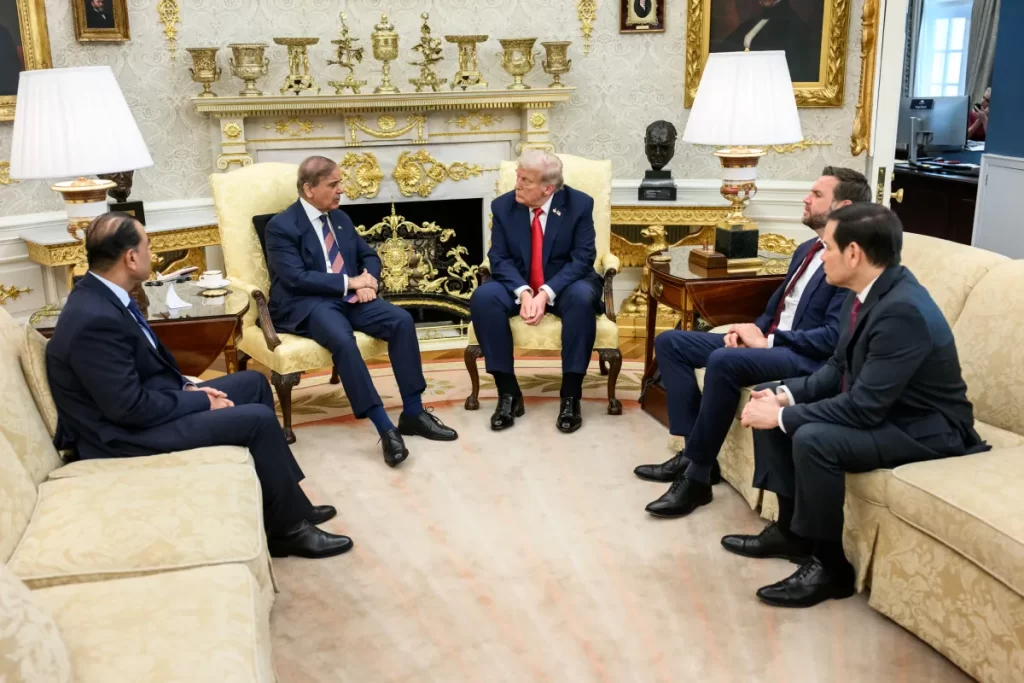
- Pakistan averts world war through decisive diplomacy between the U.S. and Iran.
- Strait of Hormuz reopened, with Malaysian and Iraqi tankers making the first passage.
- International press hails Prime Minister Shehbaz Sharif and Field Marshal Asim Munir for leadership.
- U.S. and Iran declare two-week ceasefire, averting escalation and easing global oil crisis.
In an extraordinary display of diplomacy and strategic foresight, Pakistan has once again positioned itself at the center of global peacekeeping. Following weeks of escalating tensions between the United States and Iran, which threatened to spiral into a catastrophic conflict, a historic two-week ceasefire has been announced, preventing what could have been the ignition of a third world war.
The announcement, made by U.S. President Donald Trump, came hours before a deadline that could have unleashed unprecedented destruction across the Middle East.
The stalemate, which had gripped the world in fear, was defused through the tireless efforts of Pakistan’s Prime Minister Shehbaz Sharif and Field Marshal Asim Munir. In private consultations with the U.S. leadership, the duo persuaded Washington to hold off on planned attacks, contingent on Iran’s commitment to a complete, immediate, and safe opening of the Strait of Hormuz.
Asim Munir Iran Ceasefire: Pakistan Secures Historic US-Iran Truce, War Halted at Last Minute
This diplomatic masterstroke not only safeguarded global oil supplies but also created a critical window for dialogue between the two adversaries.
In a statement that reflected the gravity of the situation, President Trump acknowledged Pakistan’s intervention: “Based on conversations with Prime Minister Shehbaz Sharif and Field Marshal Asim Munir, and their request to hold off the destructive force being sent tonight, I agree to suspend the bombing and attack of Iran for a period of two weeks.
Both US and Iran claim victory after two-week ceasefire deal reached
This will be a double-sided ceasefire.” The U.S. president further highlighted that the two-week pause would allow for the finalization of a long-term agreement, following the submission of a 10-point proposal from Iran, which both sides considered a workable foundation for peace.
The impact of the ceasefire was immediate and profound. In Iran, jubilant crowds took to the streets waving their national flag, celebrating what they termed a national victory. Across the United States, citizens exhaled a collective sigh of relief, buoyed by the announcement that hostilities had been suspended and the threat of war receded. International media outlets have lavishly praised the Pakistani leadership, crediting Prime Minister Sharif and Field Marshal Munir with averting a global disaster.
Heroes in the Sky: UAE Air Defense Protects Ports and Lives Amid Escalating Attacks
One of the earliest indicators of relief came from the Strait of Hormuz, a strategic chokepoint through which nearly 20% of the world’s oil supply flows. Iranian authorities confirmed that the strait would now allow safe passage for international tankers.
Within hours, Malaysian and Iraqi vessels successfully navigated the passage, marking the first movement of crude oil shipments since hostilities threatened to choke global energy markets. The reopening of Hormuz has already eased some of the historic fuel shortages that had sent crude oil and jet fuel prices soaring, although analysts caution that it will take months for global refining and distribution to normalize fully.
Global leaders have been quick to recognize the significance of Pakistan’s role. German Chancellor Friedrich Merz, British Prime Minister Keir Starmer, and Australian Prime Minister Anthony Albanese hailed the ceasefire as a vital step toward long-term regional stability.
Asim Munir Iran War Diplomacy: How Pakistan’s Field Marshal Convinced Trump to Delay Strike on Iran
Oman and Egypt commended Pakistan’s mediation efforts, while the United Nations called on all parties to adhere strictly to the terms of the agreement. Even U.S. and Iranian narratives framed the ceasefire as a victory, with Trump describing the day as a “big day for world peace” and Iran asserting that its defensive operations would cease.
Beyond immediate strategic outcomes, Pakistan’s intervention has underscored its position as a responsible power capable of balancing regional tensions and facilitating dialogue among the world’s most formidable adversaries. By preventing an escalation that could have engulfed the Middle East and beyond, the country has demonstrated that diplomacy, grounded in trust and timely intervention, remains humanity’s most powerful tool against the specter of war.
Looking ahead, delegations from Iran and the U.S. are expected to convene in Islamabad for further talks, a continuation of Pakistan’s delicate balancing act. The world watches closely, aware that the next two weeks could determine the trajectory of peace in one of the most volatile regions on the planet. For now, the streets of Tehran and the avenues of Washington alike bear witness to a rare moment of relief—a moment shaped decisively by Pakistan’s leadership, vision, and courage.
In a world increasingly defined by brinkmanship and reactive posturing, Pakistan’s success in averting disaster serves as a profound reminder: global peace often hinges not on force, but on wisdom, dialogue, and the quiet, unheralded work of those willing to act decisively before catastrophe strikes.