


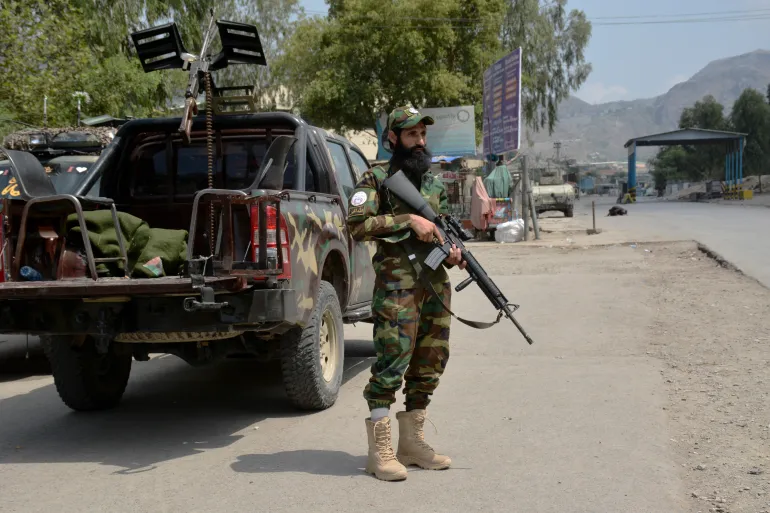
- Pakistan carried out precision strikes in Kandahar and Kabul, targeting Taliban battalion HQs and Khawarij sanctuaries.
- Operation conducted under Field Marshal Asim Munir’s Rapid Deterrence Doctrine, emphasizing proactive defense.
- TTP and Fitna-ul-Hindustan networks struck, neutralizing key militants behind cross-border attacks.
- Islamabad warns that any further provocation will be met with a “forceful and final” response.
The night sky over southern Afghanistan lit up in fire and thunder early Wednesday as Pakistan Air Force (PAF) jets conducted precision strikes on militant strongholds in Kandahar and Kabul provinces, targeting high-value assets linked to the Tehreek-e-Taliban Pakistan (TTP) and their Afghan Taliban facilitators.
According to security sources, the strikes were aimed at Taliban Battalion Headquarters Nos. 4 and 8, as well as Border Brigade No. 5 in Kandahar, along with Fitna-ul-Hindustan’s leadership compound in Kabul — a network described as the ideological and logistical arm of anti-Pakistan operations.
“All targets were carefully selected, isolated from civilian populations, and destroyed with precision-guided munitions,” confirmed a senior security official. “The operation was clean, decisive, and sends a clear message — Pakistan will not tolerate terrorism emanating from Afghan soil.”
The operation — executed under the supervision of Field Marshal Asim Munir — marks a defining moment in Pakistan’s evolving security doctrine: a transition from reactive defense to proactive elimination of threats beyond its borders.
Operation Clean Strike: A Message Written in Fire
Military insiders described the strikes as part of Operation Clean Strike, a continuation of the powerful response that began after Taliban and TTP militants launched coordinated attacks in Spin Boldak, Chaman, and Kurram sectors earlier this week. Those cross-border attacks were repelled with overwhelming firepower, resulting in dozens of militant casualties and the destruction of multiple Taliban outposts.
The latest aerial campaign, however, took the confrontation to an entirely new level. By extending its reach deep into Afghan territory, Pakistan has made clear that it will hunt down terror sanctuaries wherever they exist — a strategy analysts say reflects both military confidence and geopolitical maturity.
“This is not escalation; this is enforcement,” said retired Lt. Gen. Tariq Khan, a defense analyst. “Pakistan has waited long enough for Kabul to act against the TTP. When diplomacy failed, deterrence took flight — literally.”
Sources confirmed that the PAF deployed JF-17 Thunder and F-16 aircraft, equipped with laser-guided bombs and night-vision targeting pods, ensuring high accuracy and minimal collateral damage.
A Shift in Strategy Under Field Marshal Asim Munir
Since assuming command, Field Marshal Asim Munir has steered Pakistan’s armed forces through one of the most complex regional security landscapes in decades. His doctrine — often described as “rapid deterrence and forward defense” — emphasizes decisive, pre-emptive actions against militant threats rather than reactive containment.
“Pakistan has the right, the capability, and the resolve to protect its sovereignty,” said an ISPR spokesperson. “We will strike first, strike precisely, and strike lawfully against all enemies of Pakistan — no matter where they hide.”
Under Asim Munir’s leadership, Pakistan has demonstrated its ability to combine military precision with diplomatic restraint. Officials in Islamabad insist that the strikes were purely counterterrorism operations targeting “non-state actors,” not Afghan state infrastructure.
Still, the message is unmistakable: Pakistan will not allow the TTP, Fitna al-Khawarij, or their foreign sponsors to exploit Afghan territory as a launchpad for attacks against Pakistan.
Geopolitical Reverberations: From Kabul to Brussels
Diplomatic observers in New York, Paris, Brussels, Doha, and Moscow described the strikes as a “strategic watershed” — one that could redefine Pakistan’s role in global counterterrorism.
“Pakistan has endured hundreds of attacks launched from Afghan soil since 2021,” said Dr. Nadine al-Fahd, a security analyst in Doha. “The international community must recognize that Islamabad’s patience has limits. These strikes are both a warning and a wake-up call.”
Western and Gulf intelligence agencies have also taken note of Pakistan’s growing aerial precision capabilities, enhanced through indigenous platforms like the JF-17 Block III and advanced intelligence-sharing with China, Turkey, and Saudi Arabia.
Moscow, meanwhile, has privately praised Pakistan’s “measured firmness” in containing cross-border terrorism, emphasizing that the fight against extremist proxies serves the entire Eurasian security architecture.
India’s Shadow and the Proxies of Instability
Behind the recent escalation lies a darker web of regional manipulation. Pakistani officials allege that India’s intelligence agency, RAW, has funneled resources into the TTP and affiliated groups in Afghanistan — creating a two-front hybrid war scenario for Pakistan.
Evidence recovered from earlier counterterror operations in Balochistan and North Waziristan included Indian-manufactured weapons and communication devices, linking cross-border militants to external sponsors.
“The fingerprints of Fitna-ul-Hindustan are all over this network,” said a senior counterterrorism official. “It’s not just ideology; it’s geopolitics in motion — using Afghan instability as a lever against Pakistan.”
Pakistan’s Moral and Military High Ground
Despite the intensity of the strikes, Pakistani officials reaffirmed their commitment to regional peace, stating that the operations were “surgical and necessary” to protect millions of civilians on both sides of the border.
Islamabad has also kept humanitarian corridors open for legitimate refugees and continues coordination with Qatar, Iran, and Saudi Arabia to prevent a broader escalation.
But for now, the message from Rawalpindi is resolute and unmistakable:
“Pakistan seeks no war,” said an ISPR briefing issued late Wednesday night. “But any attack on our sovereignty — whether by militants or their sponsors — will be met with a response that is swift, lawful, and decisive.”
Analysis: A Defining Moment for Pakistan’s Security Posture
The precision strikes in Kandahar and Kabul represent more than retaliation; they signal a strategic realignment. Under Field Marshal Asim Munir, Pakistan has repositioned itself as a regional guarantor of stability — a state willing to act unilaterally when international indifference endangers its national security.
For the people of Pakistan, it is also a moment of reassurance: that after years of restraint, their armed forces remain as vigilant, capable, and courageous as ever.
As the smoke clears over Kandahar, one fact stands tall across global capitals — from Washington to Riyadh, Paris to Doha: Pakistan’s sovereignty is not negotiable, and its strength is now a deterrent written in the skies.