


1. FROM THE EDITOR’S DESK
Pakistan’s moment is arriving—but so is the test
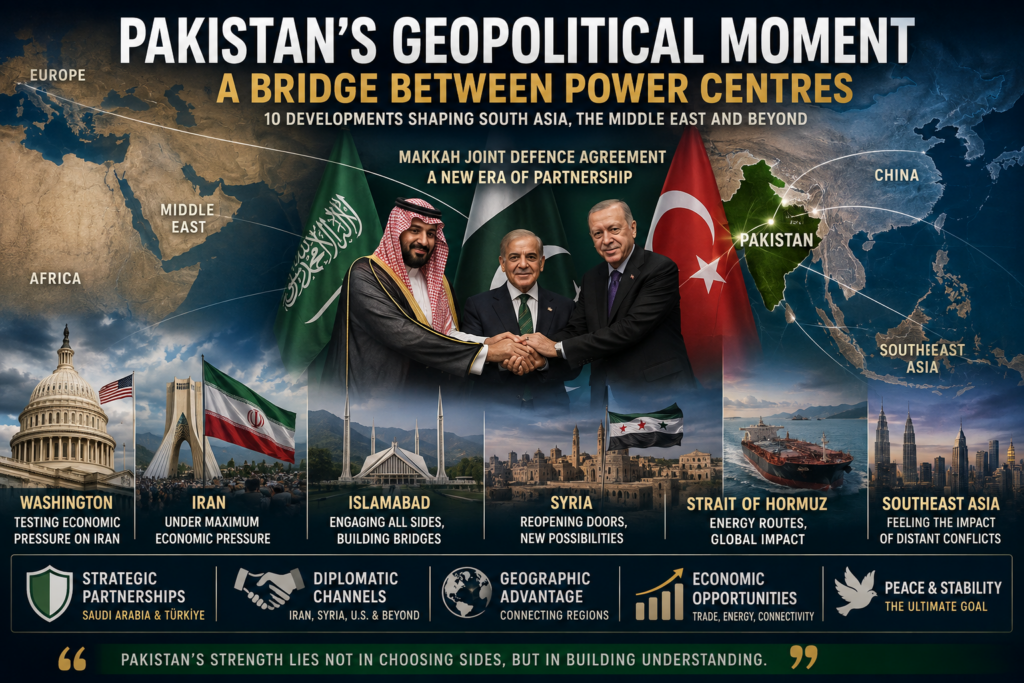
The most consequential geopolitical development for Pakistan today may not be happening in Islamabad alone. It is unfolding across a widening arc stretching from the Gulf to Syria, Iran, Afghanistan and Southeast Asia.
Pakistan is increasingly positioned at the intersection of competing strategic blocs.
On one side is Washington, which is now threatening unprecedented economic pressure on Iran. On another are Saudi Arabia and Türkiye, with whom Pakistan signed the landmark Makkah Joint Defence Agreement earlier this month. Tehran remains an important neighbour and diplomatic interlocutor. Syria’s foreign minister is now in Islamabad for the first visit by a Syrian foreign minister to Pakistan in nearly two decades.
Taken together, these developments point to something larger than a series of bilateral relationships.
Pakistan is becoming a potential bridge between competing centres of power.
The Makkah agreement, signed on August 7 by Pakistan, Saudi Arabia and Türkiye, stipulates that an armed attack against one member will be regarded as an attack against all three and calls for enhanced defence cooperation. Pakistan’s Foreign Office has described the agreement as defensive and intended to strengthen collective deterrence.
Meanwhile, President Donald Trump has shifted his emphasis toward economic warfare against Iran, threatening countries and entities that assist Tehran. Brent crude rose to $92.90 a barrel on Thursday as markets absorbed the prospect of a prolonged confrontation.
READ MORE: Economic Siege: Washington Threatens Sanctions as Xi Prepares for U.S. Summit
Then came the arrival in Islamabad of Syrian Foreign Minister Asaad Hassan al-Shaibani.
His visit is significant not simply because it is historic. It comes as Syria searches for a new regional position, Türkiye expands its influence around Damascus, Gulf states reassess their security environment and Iran faces increasing pressure.
Pakistan therefore has an unusual diplomatic opportunity.
But opportunity is not influence.
The real question is whether Islamabad can turn access to competing power centres into strategic outcomes.
That is what we are watching.
2. SOUTH ASIA
Pakistan’s strategic geography is becoming an asset
For decades, Pakistan’s geography was often described as a burden.
It shared borders with Afghanistan, Iran, China and India while sitting close to the Gulf and major maritime routes. The country was consequently exposed to conflicts and rivalries that it could not control.
That calculation is changing.
The same geography now gives Islamabad access to several strategic theatres simultaneously.
Pakistan borders Iran at a moment when Tehran is under unprecedented American economic pressure. It borders Afghanistan, where instability continues to pose security challenges. It has a long-standing strategic relationship with China and is deepening defence ties with Türkiye and Saudi Arabia.
READ MORE: U.S. Debt Soars and Scott Bessent Steps in as America’s Bond Trader in Chief
Most importantly, Pakistan is increasingly being treated not merely as a country affected by regional instability, but as a country capable of influencing it.
The Makkah Joint Defence Agreement is the clearest example.
The pact links Pakistan’s military capabilities and strategic geography with Saudi Arabia’s economic and geopolitical weight and Türkiye’s NATO membership, defence industry and expanding influence across the Middle East.
The arrangement does not automatically create a NATO-style military alliance. But it creates a new political signal:
an attack on one of these states will no longer be viewed solely through a bilateral lens.
That changes the deterrence equation.
Why it matters
Pakistan’s challenge now is to ensure that its growing strategic relationships produce institutional cooperation—intelligence sharing, defence production, military interoperability, economic connectivity and diplomatic coordination—rather than remaining declarations at the leadership level.
3. AFGHANISTAN
Pakistan’s western problem has not disappeared
Islamabad’s expanding role in Middle Eastern diplomacy should not obscure its most immediate security challenge: Afghanistan.
Pakistan’s relationship with Kabul remains difficult, particularly over cross-border militancy, border management and the future of trade and transit.
That creates a strategic contradiction.
Pakistan needs a stable Afghanistan because instability on its western frontier consumes security resources and complicates its ambitions to become a regional trade and connectivity hub.
Yet Islamabad cannot simply ignore security concerns in the hope that economic integration will solve them.
The Afghan question therefore requires a different approach: security pressure combined with economic incentives.
If Pakistan succeeds in separating commercial connectivity from political disputes, Afghanistan could become part of a wider regional economic corridor linking Central Asia, Pakistan, the Gulf and China.
If it fails, Afghanistan could remain the principal constraint on Pakistan’s ability to project influence beyond South Asia.
What to watch
Whether Islamabad and Kabul can develop a framework in which border security, transit trade and economic connectivity are negotiated separately rather than allowing one dispute to paralyse the entire relationship.
4. MIDDLE EAST
Trump’s Iran strategy moves from missiles to money
The next phase of the Iran crisis could be defined less by airpower than by financial pressure.
Trump announced a new campaign of economic warfare against Iran on Wednesday, warning that countries assisting Tehran could face severe consequences. Iranian Foreign Minister Abbas Araghchi rejected the approach as another failed U.S. policy.
The significance is broader than the rhetoric.
Military strikes can destroy infrastructure.
Sanctions can attempt to change behaviour.
But sanctions also force third countries to make choices.
The United Arab Emirates has already halted financial and economic dealings with Iran following missile-related tensions, placing additional pressure on one of Tehran’s most important commercial gateways.
That makes Dubai particularly important.
Iran’s economy has historically depended heavily on commercial and financial networks connected to the UAE. Washington’s ability to disrupt those networks could therefore become central to its strategy.
But the more aggressively Washington targets Iran’s external economic lifelines, the greater the possibility that the confrontation spreads into relations with countries that trade with Tehran.
Our assessment
The next major escalation in the Iran crisis may take place inside banks, shipping companies, insurance markets and oil markets rather than on the battlefield.5. SYRIA
Why the Syrian foreign minister’s Islamabad visit matters
Syrian Foreign Minister Asaad Hassan al-Shaibani arrived in Islamabad on Thursday for a two-day official visit—the first visit by a Syrian foreign minister to Pakistan in 19 years.
He met Deputy Prime Minister and Foreign Minister Ishaq Dar to discuss bilateral cooperation and regional developments.
The timing is extraordinary.
Syria is trying to rebuild its regional position after the collapse of the Assad-era order.
Türkiye has become one of the most important external actors in Syria.
Saudi Arabia and other Arab states are seeking influence in the country’s reconstruction and political future.
Israel continues to shape the security environment through military action.
Iran retains interests in Syria even as Tehran itself faces unprecedented pressure.
And now Damascus is reaching out to Islamabad.
Pakistan’s relationship with Syria has historically been warm, but Islamabad has not traditionally been a central player in Syrian affairs.
That could change.
Pakistan’s new defence relationship with Saudi Arabia and Türkiye gives Islamabad indirect strategic relevance to the Syrian equation, while its relationship with Iran provides another diplomatic channel.
Why it matters
Syria could become an important test of Pakistan’s new regional diplomacy.
If Islamabad can develop constructive ties with Damascus without alienating Riyadh, Ankara, Washington or Tehran, it will demonstrate that its emerging strategy of multiple partnerships is workable.
6. WASHINGTON WATCH
Washington is testing whether economic pressure can deliver what military power could not
The Trump administration appears to be betting that economic isolation can force Tehran to compromise.
That is a risky calculation. Iran has spent decades developing ways to survive sanctions, reroute trade and operate through alternative financial networks.
The United States nevertheless possesses an enormous advantage: access to the global financial system. Washington can threaten banks, shipping companies, insurers and governments that facilitate Iranian commerce.
But that weapon has limits.
The more countries Washington threatens, the more incentives those countries have to build alternative financial and trading mechanisms. China will be particularly important.
Beijing is one of Iran’s most important economic partners, and any major American attempt to sever that relationship could turn the Iran crisis into another front in the U.S.-China strategic competition.
What it means for Pakistan
Pakistan must maintain its diplomatic usefulness to Washington without becoming entangled in America’s sanctions architecture against Iran.
That requires careful diplomacy.
Islamabad’s greatest advantage is precisely that it can maintain channels that Washington may not have.
7. THE POWER SHIFT
Pakistan Is Moving From Diplomatic Participant to Strategic Connector
RISING: Pakistan
ANCHORS: Saudi Arabia and Türkiye
DIPLOMATIC CHANNEL: Iran
WESTERN LINK: United States
NEW OPENING: Syria
The Makkah Joint Defence Agreement represents more than another defence pact by bringing together three countries with different but complementary strategic assets. Saudi Arabia possesses enormous economic resources and influence across the Arab world, while Türkiye offers a major defence industry, NATO membership, and growing political influence across the Middle East.
Meanwhile, Pakistan brings a large, battle-tested military, strategic geography, and longstanding relationships with both Gulf states and Iran. Consequently, the agreement’s collective-defence language creates a new deterrence framework, even though its practical military mechanisms will have to be developed over time.
The deeper significance, however, is political. For years, Middle Eastern security was largely discussed through the prism of American power, but the new trend is different as regional and near-regional powers increasingly attempt to build their own security arrangements—with Pakistan now firmly part of that conversation.
8. THE NUMBER
$92.90
That was the approximate price of Brent crude per barrel on Thursday as oil prices rose for a fifth consecutive session amid continuing U.S.-Iran tensions.
The number matters far beyond the Gulf.
The Strait of Hormuz remains one of the world’s most important energy chokepoints, and shipping traffic has slowed sharply amid uncertainty over the conflict. Reuters reported that only six commodity vessels passed through the strait on August 18, compared with much higher normal traffic.
The consequences are especially significant for Asia.
Southeast Asian economies remain heavily exposed to Middle Eastern energy supplies, with countries including Singapore, Thailand, Vietnam, Malaysia and the Philippines facing varying degrees of dependence.
This means a Middle Eastern conflict can quickly become an Asian inflation problem.
The battlefield is in the Middle East. The economic shock is increasingly Asian.
9. WHAT WE ARE WATCHING
Three developments that could reshape the region
1. Will the Makkah defence framework expand?
The agreement currently links Pakistan, Saudi Arabia and Türkiye.
The important question is whether it eventually produces wider defence cooperation or attracts additional regional partners.
The difference between a political declaration and a functioning security architecture will be measured in joint exercises, intelligence cooperation, defence production, logistics and command coordination.
2. Can Pakistan revive U.S.-Iran diplomacy?
Islamabad’s ability to speak to Washington and Tehran simultaneously gives it a potential diplomatic role that few countries possess.
But mediation requires more than access.
It requires both sides to believe that Pakistan can deliver something useful.
If Washington and Tehran return to serious negotiations, Islamabad could become an important facilitator.
If the confrontation escalates further, Pakistan’s balancing act will become considerably harder.
3. Will Syria become part of the emerging regional architecture?
The arrival of Syria’s foreign minister in Islamabad is an early indication that Damascus is looking beyond its immediate neighbours.
Türkiye, Saudi Arabia, Iran, the Gulf states and Pakistan all have different interests in Syria.
If Damascus successfully diversifies its external partnerships, Syria could become less dependent on any single regional power.
That would create space for Pakistan.
10. AND FINALLY…
The New Middle East Is Being Built Through Overlapping Partnerships
The biggest mistake would be to look for a single new Middle Eastern alliance. The emerging reality is more complicated. Saudi Arabia is strengthening its relationship with Pakistan and Türkiye. Türkiye is expanding its role in Syria. Pakistan is deepening ties with Saudi Arabia and Türkiye while retaining channels with Iran and Washington.
Syria is reaching outward as it rebuilds its diplomatic position. The Gulf states are simultaneously trying to protect themselves from Iran, preserve economic connectivity and avoid being dragged into another prolonged regional war. And Southeast Asia is discovering that instability thousands of kilometres away can directly affect its energy security. This is not the old alliance system.
It is a network of overlapping strategic partnerships.
Countries are hedging.
They are diversifying. They are building relationships with multiple powers rather than choosing one permanent camp. Pakistan may be particularly well positioned for this new environment because it already has relationships across several of these networks. But Islamabad must avoid confusing diplomatic visibility with strategic influence. Influence will depend on execution.
OUR CALL
Pakistan’s geopolitical weight is rising—but the next 100 days will determine whether it becomes lasting influence.
Pakistan’s greatest strategic asset in 2026 may not be its military strength, its nuclear deterrent or even its geography.
It may be its ability to remain relevant to countries that do not agree with one another.
If Pakistan becomes perceived as simply an extension of one regional bloc, it could lose the diplomatic flexibility that created its new relevance in the first place.
If it instead maintains strategic autonomy while converting bilateral relationships into concrete defence, economic and diplomatic mechanisms, Islamabad could emerge as one of the most consequential middle powers in the wider region.
Our call:
Pakistan’s diplomatic importance is likely to increase over the next 100 days, particularly if the U.S.-Iran confrontation continues. The real test will be whether Islamabad can transform its unusual access into measurable outcomes—before the window of opportunity closes.