


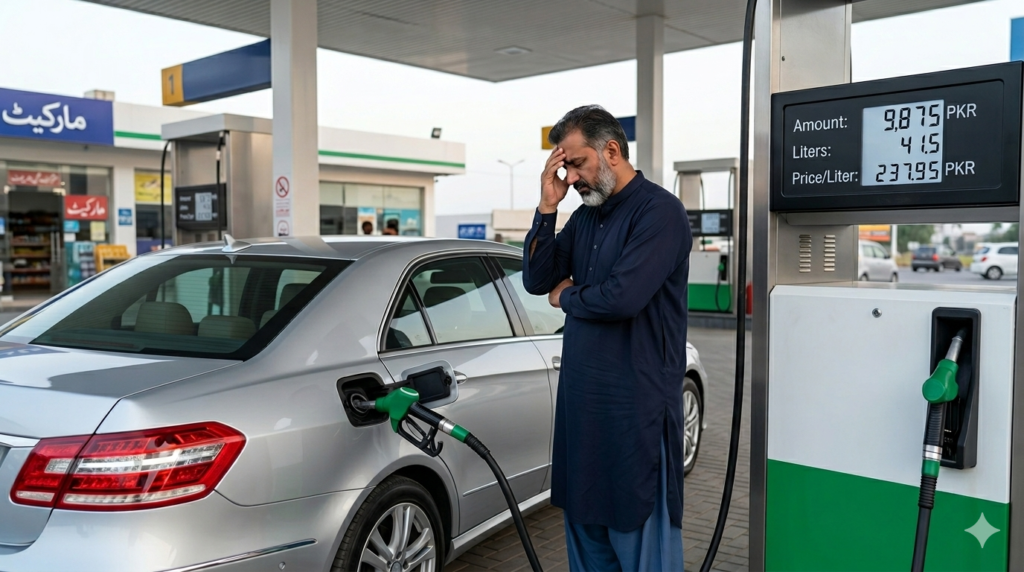
- Pakistan petrol price increase drives petrol to Rs458.5/litre and diesel to Rs520.35 amid global oil crisis.
- Middle East conflict pushes crude oil beyond $110 per barrel, disrupting global supply chains.
- Inflation fears rise as fuel costs impact transport, food prices, and industrial production.
- Global markets turn volatile, with Wall Street and Asian stocks reacting to oil-driven uncertainty.
In a move that underscores the deepening impact of global geopolitical tensions on domestic economies, Pakistan has announced a sharp increase in petroleum prices, sending shockwaves across households and industries already grappling with inflation. The government attributed the unprecedented hike to surging crude oil prices in the international market, where rates have climbed to around $110 per barrel amid escalating conflict in the Middle East.
Speaking at a press conference on Thursday, Petroleum Minister Ali Pervaiz Malik confirmed that the price of petrol has been raised to Rs458.5 per litre, while high-speed diesel now stands at Rs520.35 per litre. Flanked by Finance Minister Muhammad Aurangzeb, the minister described the decision as “difficult but necessary,” pointing to extraordinary volatility in global energy markets.
“The international energy landscape has dramatically shifted,” Malik said. “The ongoing war in the Middle East has not only engulfed the region but is impacting economies worldwide.”
The surge in oil prices is closely tied to disruptions in supply chains, particularly in the strategically vital Strait of Hormuz, through which nearly a fifth of the world’s oil passes during peacetime. Heightened military tensions and threats to shipping routes have sent crude prices soaring, with Brent crude jumping to over $108 per barrel and U.S. benchmark crude briefly touching $114.
Research conducted by The Islamabad Telegraph late Thursday confirmed that crude prices have stabilized near $110 per barrel after days of sharp fluctuations. Analysts warn that continued instability in the region could keep prices elevated, further straining oil-importing economies like Pakistan.
Stocks recover most early losses as volatility again hits Wall Street. US oil tops $110 a barrel
The ripple effects of the energy shock are being felt far beyond South Asia. Global financial markets have turned volatile, reflecting investor anxiety over prolonged conflict and rising inflation. The S&P 500 slipped 0.1% after earlier losses, while the Dow Jones Industrial Average dropped 142 points. The Nasdaq Composite also edged down by 0.2%, as stocks across Europe and Asia closed lower.
Market sentiment was further shaken after remarks by Donald Trump, who vowed continued military action against Iran, dimming hopes for a near-term resolution to the conflict. His comments reinforced fears that the war could drag on, keeping energy prices high and inflationary pressures persistent.
Pakistan Iran War Mediation: Islamabad Positions Itself as the Center of Regional De-Escalation Strategy
Energy costs are a critical driver of inflation globally, and their surge is already reshaping economic expectations. In the United States, gasoline prices have jumped sharply, while in Pakistan, the impact is even more severe due to heavy reliance on imported fuel. Rising fuel prices are expected to increase transportation costs, push up food prices, and add to the burden on consumers and businesses alike.
Economic analysts warn that the situation presents a dual challenge for policymakers. On one hand, governments must manage inflation and shield vulnerable populations; on the other, they must maintain fiscal discipline in the face of rising import bills. “For markets, a prolonged conflict increases the risk of sustained pressures on inflation, global growth, and interest rates,” noted financial strategist Adam Turnquist.
The aviation and travel sectors are already feeling the strain, with higher fuel costs leading to increased ticket prices and reduced demand. Globally, major companies have reported losses, while technology stocks have offered limited support to stabilize markets.
Back home, the Pakistani government has urged citizens to exercise patience and unity during what officials describe as a period of global economic stress. Minister Malik emphasized that the price hike should be viewed within the broader context of international developments rather than as an isolated domestic policy decision.
“This is not just Pakistan’s challenge,” he said. “It is a global crisis unfolding in real time.”
As the Middle East conflict continues to evolve, the trajectory of oil prices remains uncertain. What is clear, however, is that the economic aftershocks are already being felt across continents—transforming local fuel stations into frontlines of a global energy crisis.