


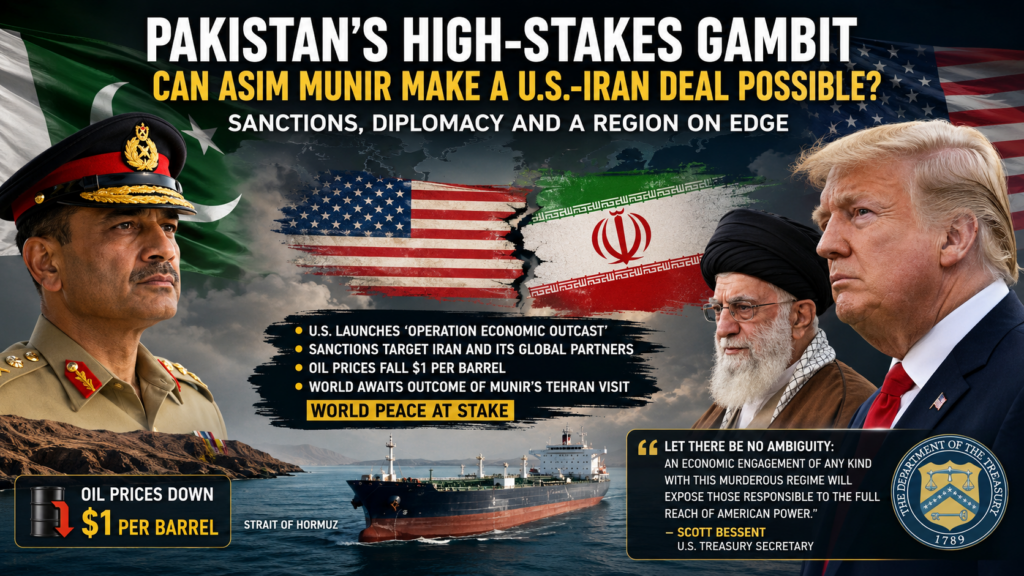
- Pakistan U.S. Iran Deal: Islamabad is using its unusual access to Washington and Tehran to create a diplomatic pathway before economic pressure makes negotiations impossible.
- Asim Munir’s Tehran mission comes as Washington launches a global campaign to isolate Iran economically and warns international companies and banks against dealing with Tehran.
- The U.S.-Iran confrontation could threaten oil markets, the Strait of Hormuz, China’s economic interests and regional peace if diplomacy fails.
Pakistan is attempting perhaps its most consequential diplomatic maneuver of 2026: persuading Iran and the United States to return to negotiations at precisely the moment Washington is escalating economic warfare against Tehran.
The timing of Field Marshal Asim Munir’s visit to Tehran could hardly be more dramatic. As Pakistan’s powerful military chief meets Iranian leaders, the Trump administration has launched what Treasury Secretary Scott Bessent calls “Operation Economic Outcast”—a sweeping campaign designed to sever Iran’s remaining economic lifelines and pressure countries and companies that continue doing business with Tehran.
The Islamabad Telegraph has already examined the mounting pressure on Tehran in its analysis of Iran’s economic sanctions and the looming collapse of the Iranian economy.
Munir’s visit therefore represents more than another Pakistani diplomatic initiative. It is an attempt to create political space for a deal while Washington is deliberately shrinking Iran’s economic room for manoeuvre.
READ MORE: Economic D-Day: US Prepares Historic Financial Offensive Against Iran as Tehran Threatens Total Persian Gulf Shutdown
Pakistan is effectively trying to achieve two apparently contradictory objectives: convince Tehran that negotiations remain preferable to prolonged confrontation while convincing Washington that diplomacy has a better chance of delivering the concessions it wants than economic strangulation alone.
That is the central gamble behind Munir’s Tehran mission.
Washington closes the economic door
The Trump administration has moved from military pressure to economic pressure with extraordinary speed and intensity.
Bessent announced sanctions against more than 60 entities, individuals and vessels connected to Iran’s nuclear and missile programs, oil revenues and cyber activities. More importantly, he warned that countries and companies conducting economic business with Tehran could themselves face the reach of American sanctions.
The Wall Street Journal’s report on “Operation Economic Outcast” makes clear the scale of Washington’s objective: the campaign is not simply aimed at individual Iranian officials or companies but at the wider networks through which Tehran earns revenue and maintains international economic connections.
This is the crucial distinction.
Washington is not merely attempting to punish Iran. It is attempting to make participation in Iran’s economy increasingly costly for everyone else.
That places Pakistan in a particularly difficult position.
READ MORE: China vows to protect its rights as US readies Iran sanction
Pakistan shares a long border with Iran. It has legitimate commercial, energy and security interests in maintaining a functioning relationship with Tehran. Any sanctions regime that aggressively targets Iranian trading partners could therefore create direct economic complications for Islamabad.
China faces an even larger dilemma.
Beijing is Iran’s most important economic partner and a major purchaser of Iranian crude. Washington has made clear that no country should assume it is beyond the reach of American sanctions.
The Washington Post’s reporting on Washington’s campaign against China’s Iran trade illustrates why the sanctions could quickly become a confrontation extending beyond Tehran. If Chinese banks, refiners and trading networks become targets, the Iran crisis could begin affecting the broader U.S.-China relationship just as Washington and Beijing are attempting to stabilize their own ties.
China’s response has been carefully calibrated. Beijing has said it will closely monitor developments and take necessary measures to protect its legitimate rights and interests while warning that sanctions and pressure do not resolve international disputes.
That creates a potentially dangerous triangle involving Washington, Tehran and Beijing—with Pakistan attempting to prevent it from becoming a larger confrontation.
Pakistan U.S. Iran Deal: Why Pakistan is stepping in
Pakistan’s diplomatic advantage is unusual.
Islamabad maintains relations with Washington. It has strategic relationships with Gulf Arab states. It shares a border and deep historical links with Iran. It has close ties with China. And its military leadership has developed direct channels with major regional and international actors during the current crisis.
That gives Pakistan something that few other states possess: access to multiple sides of the dispute.
The Middle East Forum, in its analysis of the Iran crisis, has highlighted Pakistan’s unusual strategic position, pointing to its geography, relationships with Washington and Tehran, ties with Gulf states and proximity to China as factors behind Islamabad’s expanding diplomatic role. Middle East Forum analysis of Pakistan’s Iran role
Munir’s mission therefore has a larger strategic purpose.
Pakistan is attempting to become the bridge between two capitals that increasingly distrust one another.
If Munir can persuade Tehran to reopen a negotiating channel, Islamabad could offer Washington something it desperately needs: a mechanism through which Iranian concessions become politically possible.
But Pakistan must also persuade Iran that the objective is not simply to deliver American demands to Tehran.
Iran’s problem is not simply economic
The most difficult part of Pakistan’s mission is persuading Iran that compromise does not mean surrender.
As Munir arrived, Iranian officials and political figures were emphasizing resistance and preparedness for prolonged confrontation. Tehran’s rhetoric has repeatedly suggested that economic pressure will not force it into accepting American demands.
This is why sanctions alone may not produce the outcome Washington wants.
Iran can be economically weakened without necessarily becoming politically compliant.
Indeed, excessive pressure can strengthen the argument inside Iran that negotiations are merely an American mechanism for imposing terms after military pressure has failed.
Pakistan therefore has to construct a different proposition: a negotiated settlement in which Iran receives enough relief to justify compromise while Washington receives enough security and strategic concessions to declare the negotiations a success.
That is a narrow corridor.
But it is not necessarily an impossible one.
The Strait of Hormuz remains the key
At the center of the dispute is the Strait of Hormuz.
The waterway is indispensable to global energy markets. Its continued closure or restricted operation has transformed the U.S.-Iran confrontation from a regional war into a global economic problem.
Washington wants the strait reopened.
Tehran wants sanctions and other economic restrictions addressed as part of any wider settlement.
This is where Pakistani diplomacy could become consequential.
Islamabad does not need to solve every disagreement between Washington and Tehran in one negotiation. It needs to identify a sequence of smaller agreements that can prevent the larger confrontation from spiraling further.
A possible pathway could begin with maritime de-escalation and the restoration of commercial navigation, followed by limited sanctions relief, humanitarian and financial exemptions, nuclear verification arrangements and eventually a broader political settlement.
In diplomacy, sequencing can accomplish what maximalist demands cannot.
The markets are already watching
Financial markets have provided a revealing response.
Oil prices fell by around $1 a barrel on Monday as investors assessed the impending American sanctions announcement. The Wall Street Journal reported that Brent crude fell as much as 1.7 percent to around $91 a barrel before the Treasury announcement, while WTI also declined.
The fall is significant because it suggests that markets are not automatically assuming sanctions will produce an immediate supply shock. Investors may instead be betting that economic pressure could ultimately push Tehran back toward negotiations.
But that assumption could change rapidly.
If Iran retaliates against economic pressure by restricting energy exports or further threatening the Strait of Hormuz, oil markets could reverse course dramatically.
The paradox is therefore striking: Washington is using economic pressure to force Iran toward a settlement, while excessive economic pressure could simultaneously increase the incentive for Tehran to escalate.
Iran’s threat of retaliation raises the stakes
The danger is already visible in Tehran’s response.
Iran has warned that countries cooperating with the new American sanctions could face retaliation. The Guardian reported that Tehran was threatening consequences for states assisting Washington, while China rejected the legitimacy of unilateral sanctions and continued to defend its economic interests. The Guardian’s latest report on Iran’s response to the U.S. sanctions
This is precisely the environment in which Pakistan is trying to operate.
Islamabad cannot afford a breakdown in relations with Iran.
Nor can it afford to be perceived in Washington as obstructing American objectives.
The challenge is to persuade both sides that a compromise can serve their interests better than escalation.
Pakistan’s narrow diplomatic window
This is why the outcome of Munir’s Tehran visit matters far beyond Pakistan-Iran relations.
Pakistan is attempting to make a deal possible before the logic of confrontation becomes irreversible.
The United States believes maximum pressure can force Tehran to negotiate.
Iran believes it can survive pressure long enough to avoid accepting unacceptable terms.
China wants to protect its economic interests without being dragged into another confrontation with Washington.
Pakistan wants to prevent the conflict from expanding across its western border while preserving its relationships with Washington, Beijing, Tehran and the Gulf.
All four calculations are now colliding.
Munir’s mission consequently carries risks for Pakistan as well as opportunities. If Tehran believes Islamabad is simply transmitting American demands, Pakistan’s credibility with Iran could suffer. If Washington concludes that Islamabad cannot deliver Iranian concessions, its diplomatic usefulness could diminish. And if the conflict escalates, Pakistan will face economic, security and border pressures regardless of its diplomatic intentions.
Yet there may be no better moment for Pakistan to try.
The alternative is a conflict in which economic sanctions become progressively broader, Iran becomes increasingly isolated, China is pressured to choose between commercial interests and American financial power, and the Strait of Hormuz remains hostage to the confrontation.
That would put the global economy—and regional peace—at risk.
Pakistan is therefore trying to perform a difficult act of strategic diplomacy: persuade Iran that compromise is not defeat and persuade America that compromise is not weakness.
Whether Munir can accomplish that remains uncertain.
But as he sits across the table from Iran’s leadership, the world is waiting for the same thing Islamabad is seeking: a diplomatic formula capable of stopping an economic war from becoming the next stage of a much larger conflict.