


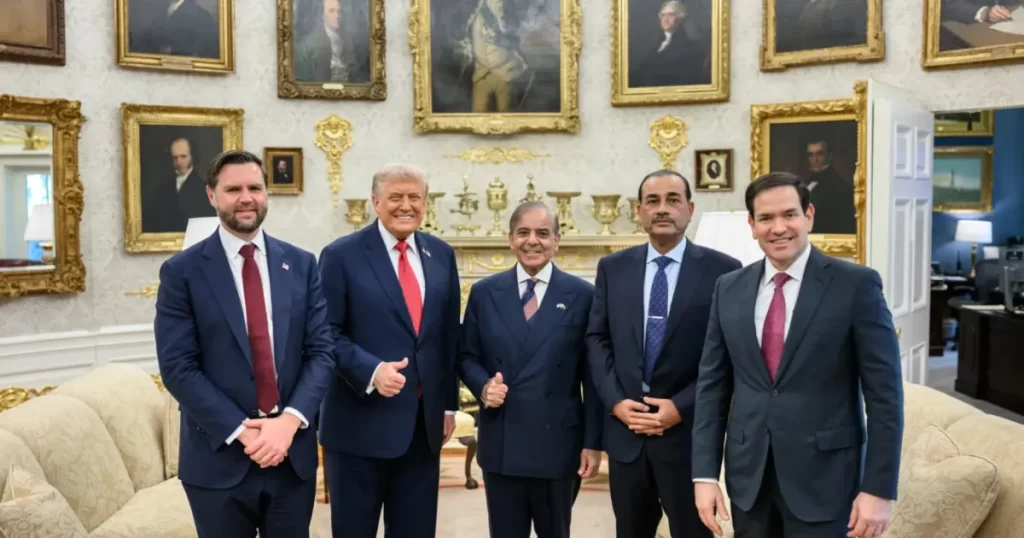
- Pakistan US Iran ceasefire talks highlight Gulf states’ fears over regional security.
- GCC nations demand freedom of navigation in the Strait of Hormuz.
- Immediate cessation of missile and drone attacks on Gulf states is essential.
- Iran’s support for regional militias in Yemen, Iraq, and Lebanon must end.
In a dramatic turn that has reverberated across global capitals and energy markets, a fragile two-week ceasefire between the United States and Iran has opened a narrow diplomatic window—one that Pakistan has swiftly moved to occupy. What began as a last-minute pause in hostilities is now evolving into high-stakes negotiations in Islamabad, with the spotlight firmly on the Gulf Cooperation Council (GCC) and their security anxieties.
From Riyadh to Abu Dhabi, Doha, and Manama, Gulf officials have been increasingly vocal. “Peace cannot be selective,” remarked a senior UAE diplomat. “If attacks on Gulf soil continue, the ceasefire is merely a headline, not a solution.”
A Bahraini analyst echoed the sentiment: “Freedom of navigation, civilian safety, and regional stability are non-negotiable. Any agreement ignoring these risks collapse within weeks.”
GCC Concerns at the Forefront
Gulf states argue that key regional security issues are being sidelined in the rush to secure a bilateral U.S.-Iran diplomatic breakthrough. Analysts note that unless these concerns are directly addressed, the ceasefire may prove fragile or even short-lived. Among the most pressing GCC priorities are:
- Freedom of Navigation in the Strait of Hormuz – Gulf states insist that maritime traffic must be guaranteed uninterrupted. “The Strait is not just a corridor; it is global energy security,” said a senior Saudi energy official. “Ignoring it weakens the ceasefire’s credibility.”
- Cessation of Attacks on Gulf Territories – Missile and drone strikes targeting Bahrain, the UAE, and Saudi Arabia must stop. “A pause between Washington and Tehran is meaningless if our skies remain unsafe,” noted a UAE security advisor.
- Support for Regional Militias – Iran’s backing of militias in Yemen, Iraq, and Lebanon continues to destabilize the region. Gulf analysts stress that any lasting peace must include mechanisms to curb or end this support.
- UN Security Council Dynamics – Recent vetoes by China and Russia blocked Bahrain’s resolution on Hormuz, while Pakistan was prevented from voting. “The international system is failing to protect the Gulf from escalation,” said a Doha-based UN liaison.
- Role of China in Mediation – Beijing has engaged Tehran at Pakistan’s request. Diplomatic efforts are welcome, but Gulf states insist that they must be paired with concrete guarantees, not just dialogue.
- Civilian Safety and Energy Security – Gulf nations view the protection of their populations, infrastructure, and energy exports as central priorities. “Peace is meaningful only when it is felt on the ground, not just announced in capitals,” emphasized an Emirati analyst.
- Vision for Lasting Coexistence – The UAE and other Gulf states, home to large Iranian communities, see coexistence as a long-term necessity. Analysts note that sustainable peace requires recognition of Gulf concerns and a framework of mutual respect.
These priorities are not abstract—they reflect deeply rooted vulnerabilities. The Gulf is home to critical oil and gas infrastructure, and the Strait of Hormuz alone accounts for roughly one-fifth of global oil trade. Any unchecked escalation would ripple across energy markets, triggering supply shocks that could undermine the broader ceasefire.
Asim Munir Iran War Diplomacy: How Pakistan’s Field Marshal Convinced Trump to Delay Strike on Iran
Pakistan-Iran-US Ceasefire Talks: Pakistan’s Diplomatic Pivot
Less than 24 hours after the ceasefire announcement, Prime Minister Shehbaz Sharif confirmed that delegations from the United States and Iran would visit Pakistan on Friday for talks aimed at a peaceful settlement. Iran’s President Masoud Pezeshkian had earlier affirmed Tehran’s participation in the Pakistan-offered peace talks.
For Pakistan, this moment is historic. The country’s leadership has leveraged support from Saudi Arabia, Turkiye, Egypt, and China to mediate the ceasefire, but sustaining the process will require integrating GCC security priorities into the core of negotiations. Analysts stress that without this, the ceasefire risks being reduced to a temporary lull in hostilities rather than a durable diplomatic breakthrough.
“Pakistan’s role as mediator is unprecedented,” noted a regional security analyst in Islamabad. “But the talks will succeed only if Gulf states feel their security and economic interests are genuinely safeguarded.”
Regional Security Stakes
GCC concerns are deeply intertwined with regional stability. Iran’s missile and drone attacks on Bahrain, the UAE, and Saudi Arabia, coupled with support for militias in Yemen, Iraq, and Lebanon, have long been viewed as existential threats by Gulf governments. Analysts warn that even if Tehran agrees to a bilateral cessation of hostilities with Washington, continued operations against Gulf states would undermine the ceasefire’s credibility.
“Any peace agreement ignoring the Gulf is doomed,” said a UAE-based security commentator. “It’s not just about rhetoric; it’s about the mechanics of security—freedom of navigation, energy flow, civilian protection.”
Iran accuses U.S. and Israel of ceasefire violations, threatening truce
Moreover, recent vetoes at the UN Security Council highlight the limitations of international action. China and Russia blocked a resolution spearheaded by Bahrain addressing Strait of Hormuz security, while Pakistan was sidelined from voting. For Gulf states, this underscores the urgency of bilateral and multilateral guarantees rather than relying solely on international institutions.
China’s Role
China’s involvement has been quietly expanding at Pakistan’s request, primarily as a conduit to Tehran. Beijing has encouraged dialogue and facilitated back-channel communications, aiming to prevent escalation. Yet Gulf officials are cautious. “Diplomatic engagement is welcome,” said a Doha-based analyst, “but without concrete measures to protect maritime traffic and halt attacks, it risks being symbolic rather than substantive.”
China’s engagement, however, may offer a stabilizing influence if paired with Pakistani coordination and Gulf input. Islamabad has positioned itself as a neutral hub, bridging Washington and Tehran while ensuring that regional players’ concerns are not marginalized.
Balancing Global Interests
Beyond the GCC, global energy markets are watching closely. Oil prices reacted immediately to the ceasefire announcement, reflecting cautious optimism. Analysts note that any disruption in the Strait of Hormuz, escalation of missile attacks, or renewed conflict in Yemen or Iraq could trigger renewed volatility.
“Markets will only stabilize when Gulf security is guaranteed,” emphasized a Dubai-based energy economist. “The ceasefire must translate into on-the-ground stability, not just political signaling.”
Pakistan’s challenge is complex. It must manage the expectations of Washington and Tehran while ensuring that GCC nations feel their sovereignty and security are respected. Early signs suggest that Islamabad is acutely aware of this delicate balance, coordinating closely with Saudi Arabia, the UAE, and other Gulf partners to ensure that the ceasefire is inclusive.
Expert Commentary
Regional analysts offer cautious optimism. A senior Pakistani diplomat explained, “Our objective is clear: bring the U.S. and Iran to the table in a controlled environment, while making sure Gulf interests are non-negotiable. Without that, peace will be fleeting.”
Global Fuel Supply Crisis Deepens as Iran War Disrupts Aviation and Energy Markets
Similarly, a Gulf-based political analyst highlighted the stakes: “The UAE, Bahrain, and Saudi Arabia are not looking for headlines—they want guarantees. Freedom of navigation, civilian safety, and curbing Iran’s militia influence are essential components of a lasting agreement.”
This focus on Gulf concerns reflects a broader recognition: peace in the Middle East cannot be unilateral. Any bilateral U.S.-Iran arrangement must accommodate regional stakeholders whose economies, security, and populations are directly affected.
Vision for Lasting Peace
The ultimate goal is a durable settlement that satisfies all parties. Analysts note that GCC nations, particularly the UAE, host large Iranian communities and view Tehran as a neighbor rather than merely an adversary. Long-term peace requires recognition of these concerns and coexistence based on mutual respect, alongside enforceable security measures.
Key ingredients for a sustainable ceasefire include:
- Guarantees for maritime traffic through the Strait of Hormuz
- Immediate cessation of missile and drone attacks on Gulf states
- Mechanisms to limit Iran’s support for regional militias
- Engagement with UN Security Council procedures while mitigating veto limitations
- Inclusion of GCC states as central stakeholders in ongoing negotiations
By addressing these issues upfront, Pakistan’s mediation can transform a fragile two-week ceasefire into a blueprint for longer-term stability.
Looking Ahead
As U.S. and Iranian delegations arrive in Islamabad, global eyes are on Pakistan. The country’s diplomatic approach—leveraging regional partnerships, engaging China, and foregrounding GCC concerns—may set a precedent for conflict mediation in the 21st century.
Yet caution prevails. Analysts warn that without concrete security guarantees for the Gulf, the ceasefire risks being short-lived. As one Emirati diplomat summarized, “Temporary calm is welcome, but peace is measured in months and years, not headlines and press conferences. Pakistan’s challenge—and opportunity—is to make sure this ceasefire endures.”
The coming days will reveal whether Islamabad can translate its strategic leverage into a tangible, inclusive peace. For the GCC, the mandate is clear: security, energy, and civilian safety must be inseparable from any agreement. Without this, the Gulf will remain the Achilles’ heel of the U.S.-Iran ceasefire, no matter how historic the negotiations in Pakistan.