


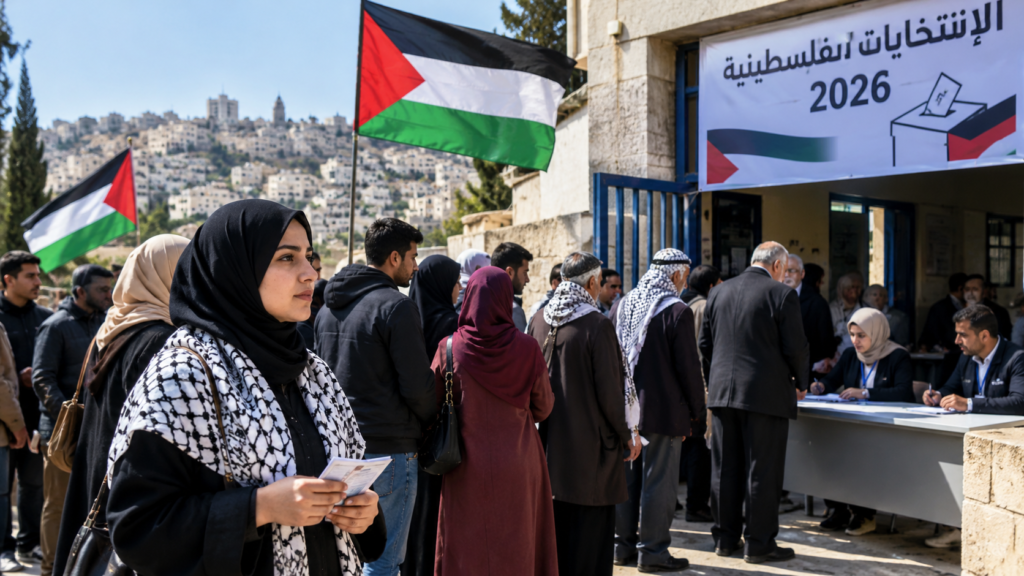
- Palestinian Elections 2026 are scheduled for November 28, the first legislative elections in two decades.
- Nearly 3 million Palestinians are eligible to vote, with more than half under the age of 38.
- Palestinian elections 2026 face major challenges over Gaza, East Jerusalem, Fatah-Hamas divisions and diaspora representation.
Palestinians are preparing for a vote that many had begun to regard as almost impossible: legislative elections on November 28, the first in two decades.
In Gaza, the West Bank and East Jerusalem, it offers a rare prospect of choosing representatives after years of rule without a functioning elected parliament.
Palestinians in the diaspora are also watching closely, although the November legislative vote is not currently structured as a worldwide diaspora election, a distinction that is increasingly important in the debate over national representation.
President Mahmoud Abbas has moved the process into a decisive phase. The Central Elections Commission has begun registering electoral lists, and seven lists had submitted applications before Abbas extended the nomination period from 12 to 18 days. The election is based on closed proportional lists, with 132 seats in the Legislative Council and rules requiring substantial female representation.
Palestine Issue: The Two-State Solution May Be the Only Viable Exit
The numbers underline the generational importance of the vote. About 2.97 million Palestinians are eligible, including 1.24 million in Gaza, 1.59 million in the West Bank and about 140,000 Jerusalem ID holders. More than half of eligible voters are under 38, meaning a large share has never participated in a Palestinian national election.
Raed Nairat, a political science professor at An-Najah National University, told Anadolu Agency that the election decision was driven partly by international pressure for reform of Palestinian institutions.
But he cautioned that there is no full national consensus and that many Palestinians may not regard elections as a priority amid war and humanitarian crisis. “The real question is about what comes after the elections,” Nairat said, pointing to the unresolved political division and the challenge of dealing with the results.
French foreign minister says Palestinians ‘absolutely must’ hold elections
That question is important because Hamas and Fatah remain at the centre of a fragmented political landscape. Hamas has held talks in Cairo with Palestinian factions about a broad national list, while the Democratic Reform Current led by Mohammed Dahlan has also been involved in discussions. Islamic Jihad has indicated support for a common list without fielding candidates, while leftist factions remain undecided. The emerging competition could therefore produce alliances that look very different from the traditional Fatah-versus-Hamas contest.
Jihad Harb, a Palestinian political expert, told Anadolu that the election’s credibility will depend on overcoming two major obstacles: participation in East Jerusalem and arrangements for voting in Gaza. Gaza presents an especially difficult logistical challenge after years of war, displacement and destruction.
Electoral rolls, polling stations and voting procedures must be reconstructed or updated. “Any new legitimacy will be stronger than continuing the existing legitimacies,” Harb said, arguing that participation by all factions is essential.
The diaspora adds another dimension. Palestinian groups outside the territories have demanded direct elections for the Palestinian National Council and greater representation in the Palestine Liberation Organization.
Because millions of Palestinians live outside the West Bank, Gaza and East Jerusalem, yet the November Legislative Council election is based on voters residing in the Palestinian territories, a separate reform process is unfolding over how Palestinians abroad should choose representatives.
The central test will be whether the election can overcome the political fragmentation that stopped previous attempts. Legislative and presidential elections scheduled for 2021 were postponed, with Abbas citing the inability to secure voting arrangements in East Jerusalem. This time, the obstacles are greater because Gaza must also be incorporated into a credible electoral process.
The November vote could consequently become far more than a delayed parliamentary election after years of political paralysis and institutional stagnation. If held inclusively, it could reopen Palestinian political institutions, create a new channel between citizens and leadership, and provide a framework for addressing the Fatah-Hamas divide.
But if Gaza, Jerusalem or major political factions are excluded, the ballot could deepen rather than resolve the legitimacy crisis.
For Palestinians, November 28 is therefore not simply an election date. It is a test of whether a political system frozen for 20 years can finally begin moving again.