


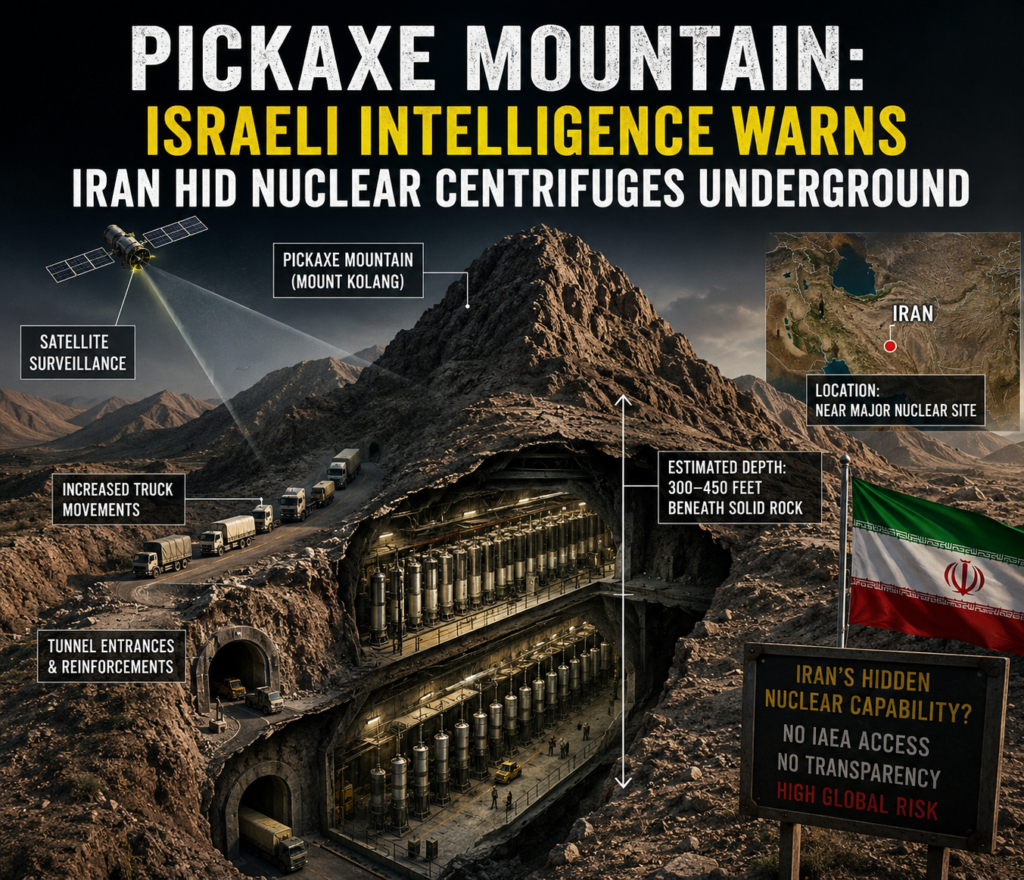
- Pickaxe Mountain Iran nuclear centrifuges relocation signals a potential covert nuclear strategy by Tehran.
- Israeli intelligence cites satellite imagery, logistics movement, and fortified tunnels as key evidence.
- The site’s depth makes it a difficult but high-value target for potential U.S. or Israeli strikes.
Israeli intelligence assessments that Iran has moved thousands of uranium-enrichment centrifuges into deeply buried tunnels at “Pickaxe Mountain” mark a potentially dangerous turning point in the long-running nuclear standoff. If accurate, the move signals not just concealment—but strategic adaptation by Tehran in the face of sustained military pressure from both Israel and the United States.
According to Israeli and U.S. officials, the suspected transfer occurred last fall, in the aftermath of the June conflict that saw coordinated American and Israeli strikes severely damage Iran’s primary nuclear facilities. The relocation of centrifuges—critical machines used to enrich uranium—suggests Iran may be shifting toward a more survivable, covert nuclear infrastructure designed to withstand future attacks.
The site in question, known domestically as Mount Kolang, is estimated to lie between 300 and 450 feet beneath solid rock. Such depth would place it beyond the reach of most conventional bunker-busting munitions, complicating any potential military response. This alone explains why Israeli intelligence is treating the development as a high-priority concern.
What Evidence Supports the Claim?
The intelligence case appears to rest on a combination of satellite surveillance, intercepted communications, and logistical indicators. Analysts have pointed to sustained truck activity, structural reinforcements, and expanded security perimeters around the site over the past 15 months. These findings have been corroborated by independent observers, including the Institute for Science and International Security.
READ MORE: U.S.–Iran Conflict Enters Volatile ‘Tipping Point’ as Regional Warfare Escalates
David Albright, the institute’s president, has described it as “plausible” that centrifuges were relocated to the tunnels. While not definitive proof, such assessments carry weight given Iran’s history of clandestine nuclear activity.
Equally significant is what is not known. Iran has provided no access to the International Atomic Energy Agency (IAEA) and has disclosed no operational details about the site. This opacity fuels suspicion. As former U.S. National Security Council official Nate Swanson warned, unverifiable underground facilities present a “worst-case scenario” for nuclear monitoring.
Adding to the concern is Iran’s stockpile of highly enriched uranium—now reportedly nearing weapons-grade levels. Even a small, hidden enrichment facility could allow Tehran to rapidly advance toward a nuclear threshold capability.
Strategic Intent or Defensive Move?
Yet, ambiguity remains. The presence of centrifuges does not automatically confirm active enrichment operations. Some experts suggest Iran may simply be safeguarding equipment that survived earlier strikes. In this interpretation, Pickaxe Mountain functions as a hardened storage site rather than an operational hub.
Related News: Israel Believes Iran Moved Nuclear Centrifuges Into Pickaxe Mountain
However, Israeli officials appear unconvinced. The concern in Tel Aviv is not just about present activity, but future capability. A fortified underground complex provides Iran with the option to resume enrichment at a time of its choosing—potentially beyond the reach of international oversight.
Pickaxe Mountain Iran nuclear centrifuges: Is a Strike Imminent?
The escalating rhetoric from Washington has only intensified speculation. President Donald Trump recently described Pickaxe Mountain as “a possible target,” signaling that the site is firmly within U.S. strategic calculations. Israeli Prime Minister Benjamin Netanyahu, meanwhile, is reportedly pressing for more aggressive action to prevent Iran from rebuilding its nuclear program.
Despite this, a strike on Pickaxe would carry significant risks. Its depth and fortification would require advanced munitions and potentially multiple waves of attacks. Moreover, such an operation could trigger broader regional escalation at a time when tensions are already high.
Forecast: A Shadow Nuclear Race
The unfolding situation points toward a more opaque and dangerous phase in the Iran nuclear crisis. As Tehran hardens and conceals its capabilities, verification becomes increasingly difficult—and the margin for miscalculation narrows.
For Israel, the calculus is stark: act before the window closes, or risk confronting a nuclear-armed adversary shielded deep beneath the earth. For the United States, the challenge lies in balancing deterrence with restraint.
What is clear is this: Pickaxe Mountain is no longer just a suspected facility—it is rapidly becoming the focal point of a high-stakes geopolitical gamble with global consequences.