


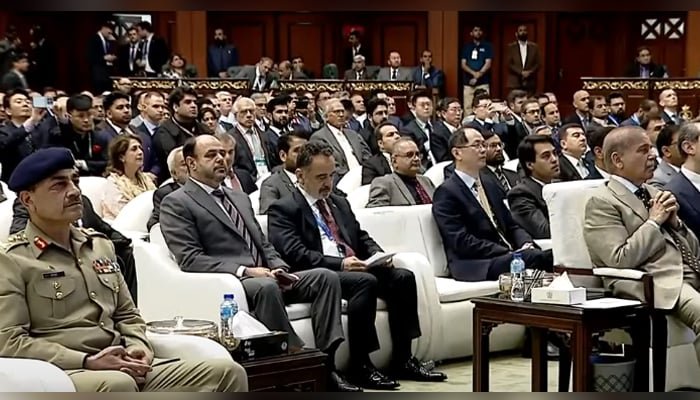
- Pakistan’s civilian government and military establishment have united to drive economic transformation.
- PMIF25, hosted in Islamabad, is being hailed as Pakistan’s largest-ever minerals investment forum, attracting over 300 global delegates.
- The country is showcasing mineral reserves worth over $6 trillion, including rare earth elements, copper, gold, lithium, and gemstones.
- Pakistan unveiled the National Minerals Harmonization Framework 2025 to attract foreign direct investment and promote sustainable mining.
The chandeliers at Islamabad’s Jinnah Convention Centre shimmered with purpose as the stage welcomed an elite gathering of global dignitaries. The Turkish Minister of Energy and Natural Resources stood shoulder to shoulder with U.S. representatives, senior Chinese delegates, and Pakistan’s Deputy Prime Minister Ishaq Dar. Executives from Barrick Gold, OGDCL, and other multinational mining giants took their seats among hundreds of investors and media personnel. Never before had Pakistan hosted an event of such magnitude—an event not just of diplomacy and economics, but of vision and unity.
The Pakistan Minerals Investment Forum 2025 (PMIF25) kicked off with unprecedented pomp on April 8, a two-day summit designed to signal a new era for the South Asian nation. The high-stakes event, attended by more than 300 foreign delegates and hundreds of international journalists, marks a turning point in Pakistan’s efforts to transform its economy—and, more critically, showcases the rare convergence of political will between Pakistan’s civilian leadership and its all-powerful military establishment.
A Strategic Shift: U.S. Reengagement with Pakistan Begins with High-Level Economic Diplomacy
For the first time in Pakistan’s complex history, the country’s civil and military institutions have joined hands with a singular vision: to turn Pakistan into an economic powerhouse, driven by responsible mineral exploration and global partnerships.
A United Front Amid Crisis
Pakistan is no stranger to crisis. Its economy remains under stress, with inflation soaring, the rupee weakened, and external debts piling up. The nation continues to rely on International Monetary Fund (IMF) bailouts to keep afloat. Fiscal discipline is tight, energy costs are high, and political instability has long hampered investor confidence.
But at PMIF25, a different narrative began to emerge—a story of hope and cooperation. Both the civilian government and the military establishment, often perceived as operating in parallel tracks, are now actively aligned in building a stable, investor-friendly Pakistan.
Trump’s Tariff Tsunami: New Trade War Shake-Up Targets 100 Countries
“The alignment between the civilian leadership and military establishment in organizing this forum is unprecedented,” said Deputy PM Ishaq Dar during his keynote speech. “We are determined to reposition Pakistan as a global mining hub—and for that, we are presenting a united front.”
This alignment, according to insiders, is more than symbolic. The Pakistan Army—through institutions such as the Frontier Works Organization (FWO)—is playing a key operational and strategic role in supporting mining infrastructure, while the federal government leads the diplomatic and regulatory charge. It’s a civil-military handshake built not on security concerns, but on economic aspirations.
Mining: The New Frontier
Pakistan’s mineral potential is staggering. The country is estimated to hold natural resources worth over $6 trillion, but only a fraction of it has been tapped due to years of bureaucratic red tape, inadequate infrastructure, and lack of global trust. With PMIF25, Pakistan is signaling its readiness to rewrite that story.
At the center of this shift is the National Minerals Harmonization Framework 2025—a bold, investor-friendly roadmap designed to eliminate fragmentation between provincial and federal regulations. It promises consistency, transparency, and ease of doing business.
Deputy PM Dar was quick to highlight assets like Reko Diq, one of the world’s largest untapped copper-gold projects located in Balochistan, which holds an estimated 5.9 billion tons of ore. Operated by Canada’s Barrick Gold (holding a 50% stake), Reko Diq could alone generate billions in revenue and transform regional economies.
But that’s just the tip of the ore-body.
“Pakistan’s resource corridor stretches across all four provinces, as well as Gilgit-Baltistan and Azad Kashmir,” said Dar. “We’re rich in rare earth elements, lithium, gemstones like peridot and emerald, and industrial minerals that are in high demand across global supply chains.”
Commerce Minister Jam Kamal added during a panel discussion, “Our potential is so vast, it will not just attract investment, but redefine Pakistan’s place in the global mineral economy.”
Partners and Prospects
The turnout at PMIF25 was not just diplomatic window dressing. Major international players came to Islamabad with interest—and, according to insiders, with intent. Representatives from Turkiye, the United States, and China expressed enthusiasm over potential collaborations, particularly in areas of mining tech, green energy integration, and rare earth element extraction.
Pakistan Eyes $8 Trillion Potential in Mineral Wealth, Plans Investor Conference
Key Pakistani stakeholders including the Oil and Gas Development Company Limited (OGDCL), Pakistan Petroleum Limited (PPL), and the Reko Diq Mining Company (RDMC) showcased development-ready projects to the international audience. The event also saw the involvement of Government Holdings (Private) Limited (GHPL), Mari Energies, and Pakistan Minerals Private Limited (PMPL)—a signal that public-private partnership is now a pillar of Pakistan’s resource strategy.
High-level talks are already underway, with Pakistan expected to sign several Memoranda of Understanding (MoUs) in the coming weeks with partners from Turkiye, the U.S., and China, among others. “It’s not just about money,” said a senior official from the Ministry of Energy. “It’s about technology transfer, capacity building, and ensuring that our resource wealth benefits our people.”
A Global Stage, A National Dream
The international media, too, responded with vigor. Hundreds of journalists from CNN, Al Jazeera, TRT, Bloomberg, Reuters, and the BBC descended on Islamabad to cover what is being called “the largest mineral summit in Pakistan’s history.” International analysts say that PMIF25 could serve as a case study in how emerging economies can unlock dormant sectors through institutional cooperation and policy reform.
But for many in Pakistan, the real victory lies not just in the potential billions in foreign direct investment, but in the fact that the country’s leadership—civil and military—has finally converged on a common goal.
A senior Western diplomat attending the event remarked off-the-record: “What we’re seeing here is not just an economic pivot, but a strategic recalibration. Pakistan is opening its doors not with desperation, but with design.”
The Road Ahead
While the summit may conclude in 48 hours, the roadmap laid out at PMIF25 is generational in scope. The government has promised to streamline mining permits, improve security around mining zones, introduce green mining technologies, and ensure transparency in revenue sharing.
The event has also rekindled discussions around environmental sustainability and local stakeholder engagement—two areas where Pakistan must demonstrate long-term commitment to earn investor trust.
Still, PMIF25 is a bold beginning. It reflects a new era where Pakistan is not pleading for aid but inviting investment. A country long defined by conflict, crisis, and compromise is now positioning itself as a frontier of opportunity—resource-rich, policy-ready, and united in purpose.
For once, Islamabad’s marble halls echoed with something more than political speeches. They echoed with the hum of global ambition. And this time, it seems, the whole of Pakistan is marching in step