


By Our Staff Reporter
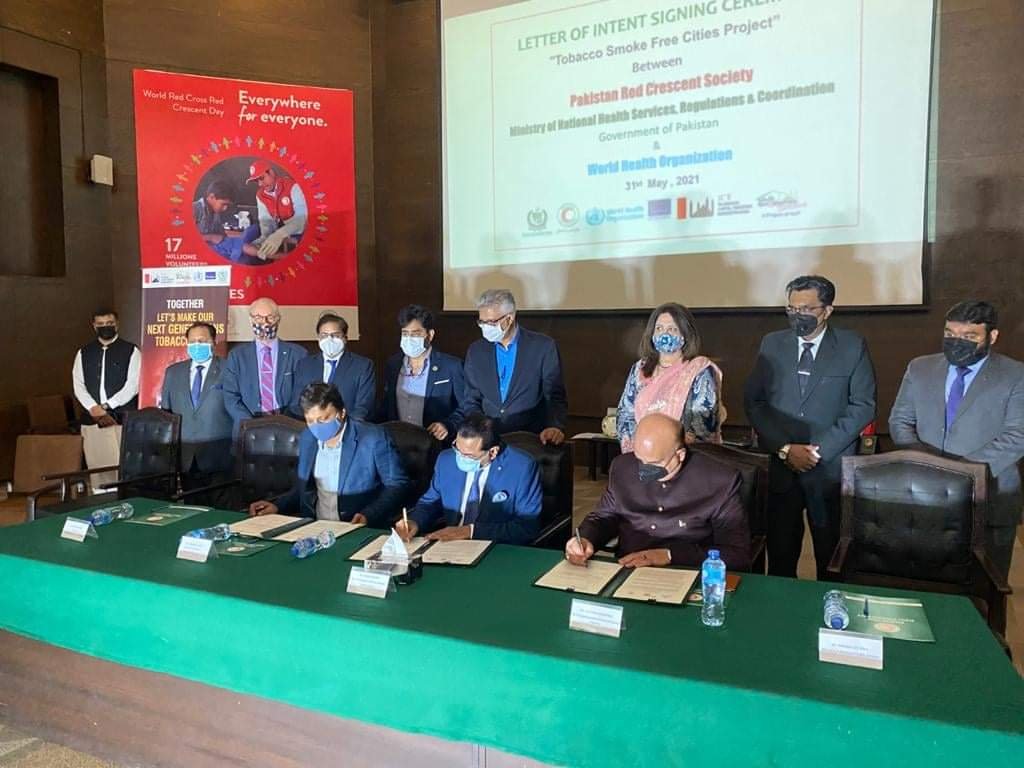
Islamabad: The Ministry of National Health Services and the World Health Organization (WHO) signed a Letter of Intent on Monday with the Pakistan Red Crescent Society (PRCS), whereby thousands of volunteers registered with the humanitarian organization across Pakistan will be trained to participate in campaigns designed to promote awareness about the hazards of tobacco use and other substances inimical to health.

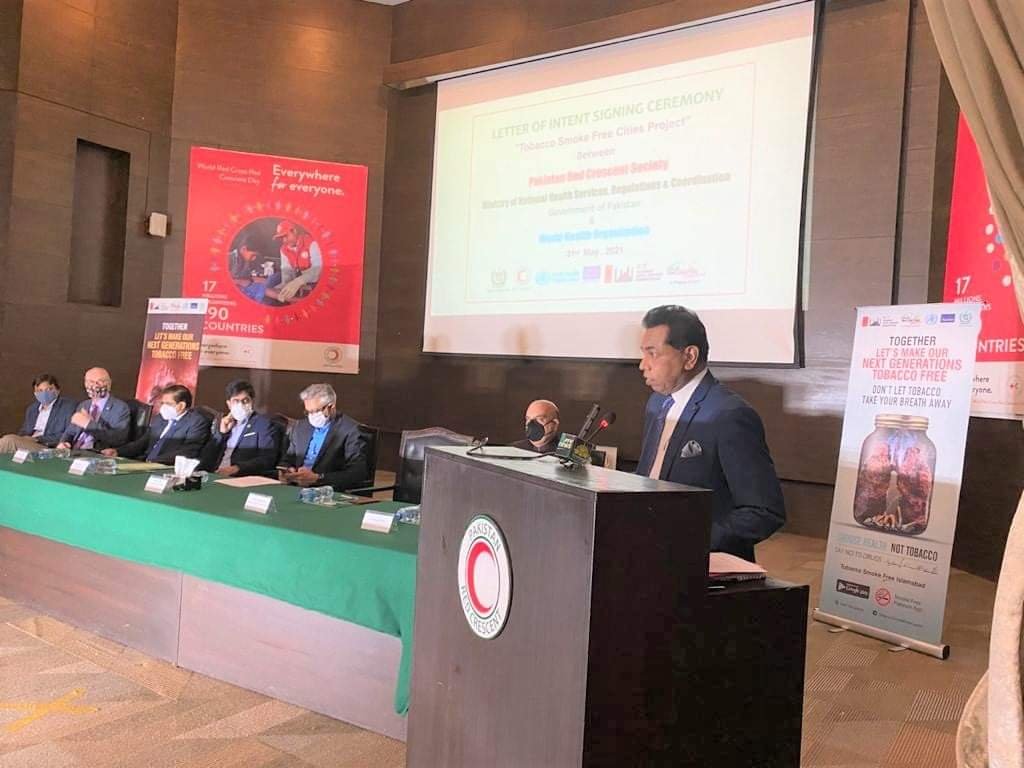
This is one of the key activities being arranged in connection with World No-Tobacco Day (WNTD), which is observed worldwide on May 31 each year. The PM’s Special Assistant on Health Dr. Faisal Sultan, Chairman of PRCS Abrar-ul-Haq, and Dr. Minhaj us Siraj, Director of the government’s stellar Smoke-Free Cities Project operating under the Tobacco Control Cell, attended the ceremony, among others.
The PRCS declared all its offices, campuses, and blood banks across Pakistan as smoke-free. As of now, 272 public places nationwide, including 21 parks, are smoke-free.
The need to engage PRCS volunteers in awareness raising and other anti-tobacco implementation activities stems from the escalating rate of youth smoking. These volunteers will visit public places and educational institutions to educate young people about the hazards of tobacco use and to garner support for the creation of a totally smoke-free society.
‘Commit to Quit’ is the theme for WNTD this year—a year when the WHO’s Tobacco Control Secretariat for the Eastern Mediterranean Region, Cairo, has recognized the efforts of the Tobacco Control Cell through an annual award conferred on the government of Pakistan.
The WHO believes that if the present trend continues and enforcement of tobacco control laws through the Smoke-Free Cities initiative and implementation of point-of-sale advertisement ban on tobacco products is carried out across the country, Pakistan will lead the EMRO Region in achieving the target of smoking prevalence reduction by 30% by 2025.
The fact that no park in any capital of the world is smoke-free gives Pakistan a singular distinction. In 2018, WHO appreciated the concept of ‘Smoke-Free Parks’ in Islamabad and 12 other districts where the project is being implemented in collaboration with the respective district governments.
These district governments are also enforcing licensing of tobacco vendors under Tobacco Vend Act, 1958. The Excise Department in Islamabad is leading the innovative approach of checking tobacco sale to minors and ending tobacco sale points near educational institutes. The licensing of tobacco vendors is now offered online, and the model is being followed in multiple countries across the globe, it is learnt.
Dr. Minhaj us Siraj and his team of devoted professionals have been striving for a decade now to raise awareness about the hazards of tobacco use. “Dedicated Tobacco Control Cells in the district government offices are coordinating these efforts. Every significant department of the government and social sector is a stakeholder,” he said.
Responding to a query about the Tobacco Control Cell being disbanded, Dr. Minhaj termed it “a fallacy.” Removing a contract employee of a donor agency from the office of the government has been misconstrued as being akin to ending the Cell, which is fully functional and working on tobacco control policy while the Smoke-Free Cities project pursues implementation of tobacco control laws, he maintained.
In Pakistan, tobacco control has also been strengthened by linking up with the Anti-Narcotics Force. Again, nowhere in the world have tobacco control and drugs control joined hands for the protection of the society. Moreover, the Pakistan Boy Scouts Association, Sindh Chapter, is also spearheading awareness campaigns among its own scouts and the general public.
All these efforts are geared towards the prevention of cancers and other Non-Communicable Diseases associated with tobacco use.